This article explores the life and breathtaking genius of Bhāskarāchārya, the 12th-century polymath who stands as the pinnacle of medieval Indian science. Through a journey into Bhaskara II Mathematics Logic, we reveal how he mastered the concept of zero, predicted the principles of gravity, and developed the roots of calculus long before Newton or Leibniz. Beyond the numbers, we look at the emotional core of his work—the Lilavati—a book written to console his daughter, proving that in the hands of an Ancient Indian Astronomer, mathematics was not just a cold science, but a language of love and universal truth.| Category | Details |
| Name | Bhāskara II (Bhāskarāchārya) |
| Era | 1114 – 1185 CE |
| Location | Bijapur/Vidyapur (Karnataka/Maharashtra region) |
| Masterpiece | Siddhanta Shiromani |
| Key Discovery | Foundations of Calculus & Gravity |
| Title | Ganakachakrachudamani (Jewel among Calculators) |
The Master of Infinity: Unlocking the Genius of Bhāskara II
In the lush landscapes of 12th-century India, specifically in the region near the Sahyadri mountains, lived a man whose mind moved at the speed of light. While medieval Europe was largely disconnected from advanced scientific inquiry, India was witnessing the zenith of its mathematical tradition. Bhāskara II, later honored as Bhāskarāchārya (Bhāskara the Teacher), looked at the stars and the numbers with a clarity that seemed divine. His crowning achievement, the Bhaskara II Mathematics Logic, was not just a collection of formulas; it was a rhythmic, poetic investigation into how the universe functions, from the smallest fraction of a second to the rotation of the earth itself.
The story of Bhāskara is one where the heart and the head are in perfect alignment. As an Ancient Indian Astronomer, he led the famous observatory at Ujjain, continuing the legacy of great thinkers like Aryabhata and Brahmagupta. However, Bhāskara took their work to a level of sophistication that was truly ahead of its time. He lived in an era where science was expressed through verse, making his complex proofs sound like soulful melodies, yet the logic beneath the poetry was as sharp as a diamond.
1971 Nagarwala Case: India’s Great Bank Heist Mystery
The Lilavati: A Father’s Gift to His Daughter
One of the most enduring mysteries of his life surrounds the Lilavati Mathematical Mystery. Legend tells us that Bhāskara had a daughter named Lilavati, for whom he had calculated a perfectly auspicious moment for her wedding using a water clock. He believed that if she married at that exact second, she would lead a life of eternal happiness. However, as the young girl leaned over the clock, a pearl from her ornament fell into the mechanism, blocking the flow of water. The auspicious moment passed unnoticed, and the wedding never took place.
To console his heartbroken daughter, Bhāskara promised to write a book in her name—one that would keep her memory alive for as long as the stars remained in the sky. The result was the Lilavati, the first part of his magnum opus, the Siddhanta Shiromani. In this book, he poses mathematical problems as if he is talking to her, using bees, flowers, and peacocks as variables. This unique blend of emotion and Bhaskara II Mathematics Logic turned a difficult subject into an accessible art form, ensuring that students for centuries would learn the secrets of arithmetic through the name of his beloved daughter.
The Siddhanta Shiromani Brilliance
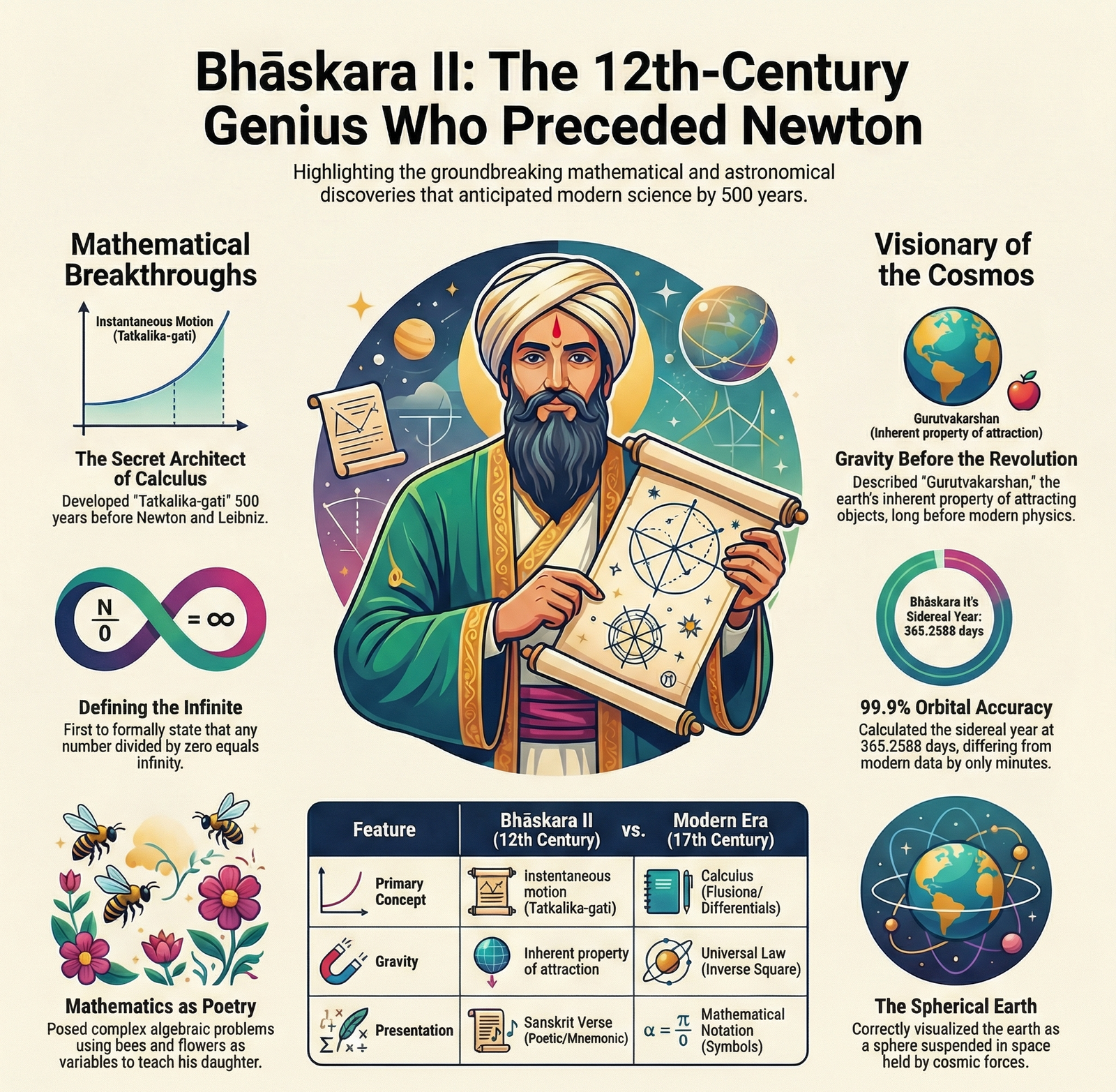
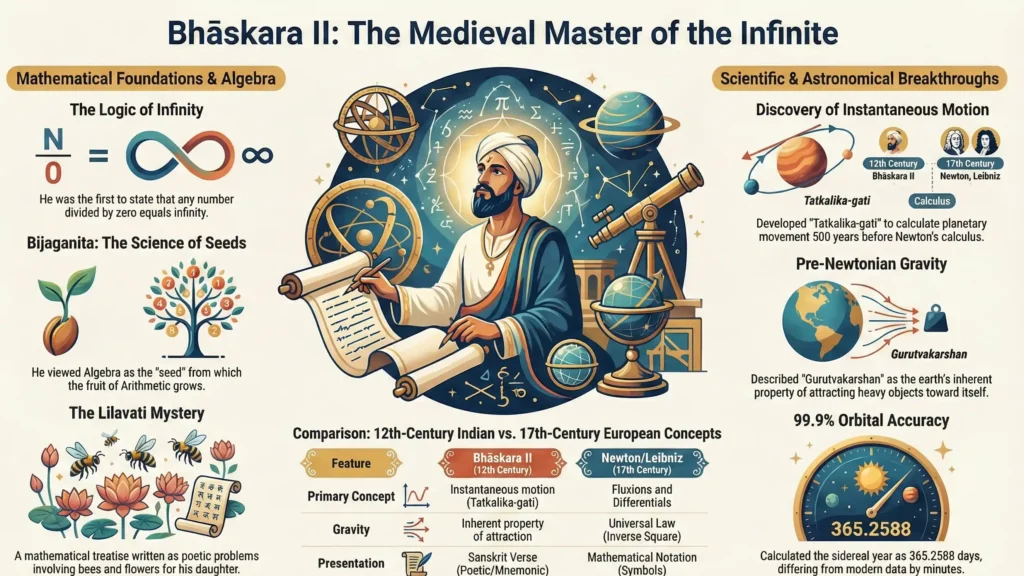
The Siddhanta Shiromani (The Crown of Treatises) is divided into four parts: Lilavati (Arithmetic), Bijaganita (Algebra), Grahaganita (Astronomy), and Goladhyaya (The Sphere). The Siddhanta Shiromani Brilliance lies in how Bhāskara handled concepts that had baffled mathematicians for ages. He was the first to state clearly that any number divided by zero is infinity. He understood that infinity cannot be changed by adding or subtracting from it—a concept that mirrors the spiritual teachings of the Upanishads regarding the nature of the Absolute.
In Bijaganita, he advanced the study of “Pell’s Equation” and other indeterminate equations long before European mathematicians took interest in them. His logic was so robust that he could calculate the square roots of large numbers and solve complex quadratic equations with ease. He didn’t just find answers; he sought to understand the very nature of “vakta” (the unknown), treating algebra as the “seed” from which the “fruit” of arithmetic grows.
Dr. A.P.J. Abdul Kalam: (1931-2015)
The Secret Architect of Calculus
Perhaps the most shocking revelation for modern science is the Bhaskaracharya Calculus Discovery. Five hundred years before Isaac Newton and Gottfried Wilhelm Leibniz were born, Bhāskara was already using the principles of differential calculus. He developed the concept of “Tatkalika-gati” (instantaneous motion). He realized that to understand the movement of a planet at a specific moment, one had to look at an infinitely small interval of time.
This was a massive leap in Bhaskara II Mathematics Logic. He used these “derivatives” to find the area and volume of spheres and to calculate the accurate sine of angles. His work on trigonometry was so precise that he arrived at the value of Pi (π) as 3.14166, which is remarkably close to the modern value. He was mapping the infinitesimal, proving that the ancient Indian mind was comfortable with the idea of the “vanishingly small” long before the European Enlightenment.
The Earth, Gravity, and the Cosmos
Bhāskara was also a visionary of the physical world. In his Goladhyaya, he addressed the common fear of his time: “If the earth is round, why don’t people fall off?” He explained that the earth has an inherent property of attraction (Gurutvakarshan). He wrote that the earth, by its nature, attracts any heavy object in the sky toward itself. While this wasn’t the full mathematical law of universal gravitation, it was a clear precursor to the Newtonian revolution.
As an Ancient Indian Astronomer, he also corrected the length of the sidereal year, calculating it to be 365.2588 days—a figure that differs from modern measurements by only a few minutes. He visualized the earth as a sphere suspended in space, held by the balance of cosmic forces. His Indian heritage and science contributions represent a time when India was the lighthouse of global knowledge, illuminating the path for future generations of scientists.
8 Defining Chapters in the Vikram Sarabhai Biography
Quick Comparison: Bhāskara II vs. Modern Calculus Era
| Feature | Bhaskara II (12th Century) | Newton/Leibniz (17th Century) |
| Primary Concept | Instantaneous motion (Tatkalika-gati). | Fluxions and Differentials. |
| Division by Zero | Defined as Khachahara (Infinity). | Developed through Limit Theory. |
| Gravity | Described as an inherent attraction. | Defined as a Universal Law (Inverse Square). |
| Trigonometry | Tables of sines and spherical geometry. | Modern Calculus-based Trig. |
| Presentation | Sanskrit Verse (Poetic/Mnemonic). | Mathematical Notation (Symbols). |
Curious Indian: Fast Facts
- Zero Logic: Bhāskara was the first to clarify that $x \div 0 = \infty$, a concept vital for modern mathematics.
- The Perpetual Motion Machine: He described a wheel with mercury-filled spokes that would rotate forever, an early concept in mechanics.
- The Poet Scientist: His books were written in such beautiful Sanskrit verse that they were often sung in royal courts.
- Planetary Precision: He calculated the time it takes for Earth to orbit the Sun with 99.9% accuracy compared to modern data.
- Algebraic Seed: He called Algebra Bijaganita, meaning “the science of seeds,” signifying it as the source of all calculation.
Conclusion
Bhāskarāchārya was more than a mathematician; he was a bridge between the finite and the infinite. Through Bhaskara II Mathematics Logic, he showed us that the universe is governed by laws that are both beautiful and immutable. His legacy reminds every “Curious Indian” that our history is not just about kings and wars, but about the staggering power of the human intellect to decode the stars. As we move into an age of quantum computing and space exploration, the echoes of Bhāskara’s sutras remind us that we have always been a civilization of seekers, looking at the heavens and finding the truth in the numbers.
The Roopkund Skeleton Lake Mystery: Why Were Greeks Dying in the Indian Himalayas?
If you think you have remembered everything about this topic take this QUIZ
Results


#1. What is the title of Bhāskara II’s magnum opus, which includes sections on Arithmetic and Algebra?
#2. Bhāskara II wrote the book Lilavati to console his daughter after what unfortunate event?
#3. Which mathematical truth regarding zero was Bhāskara II the first to clearly state?
#4. What term did Bhāskara II use to describe “instantaneous motion,” anticipating the principles of calculus?
#5. In the Siddhanta Shiromani, which section is dedicated to Algebra?
#6. How did Bhāskara II explain the concept of gravity (Gurutvakarshan) in his work Goladhyaya?
#7. Bhāskara II calculated the length of the Earth’s orbit (sidereal year) with remarkable precision to be:
#8. Bhāskara II calculated the value of Pi ($\pi$) to be approximately:
Why is Bhaskara II called the Father of Calculus?
While Newton and Leibniz popularized it, Bhāskara used the principles of “instantaneous motion” and derivatives to calculate planetary positions 500 years earlier.
What is the significance of the book Lilavati?
It is a foundational text on arithmetic and geometry, uniquely written in poetic form and named after his daughter to immortalize her name.
Did Bhaskara II know about gravity?
Yes, he wrote about Gurutvakarshan, stating that the earth has a natural power of attraction that pulls objects toward its surface.
What did he say about dividing by zero?
He was the first to mathematically define that any number divided by zero results in infinity (Khachahara).
Read More: https://curiousindian.in/bhaskara-i-c-600-c-680-ce/