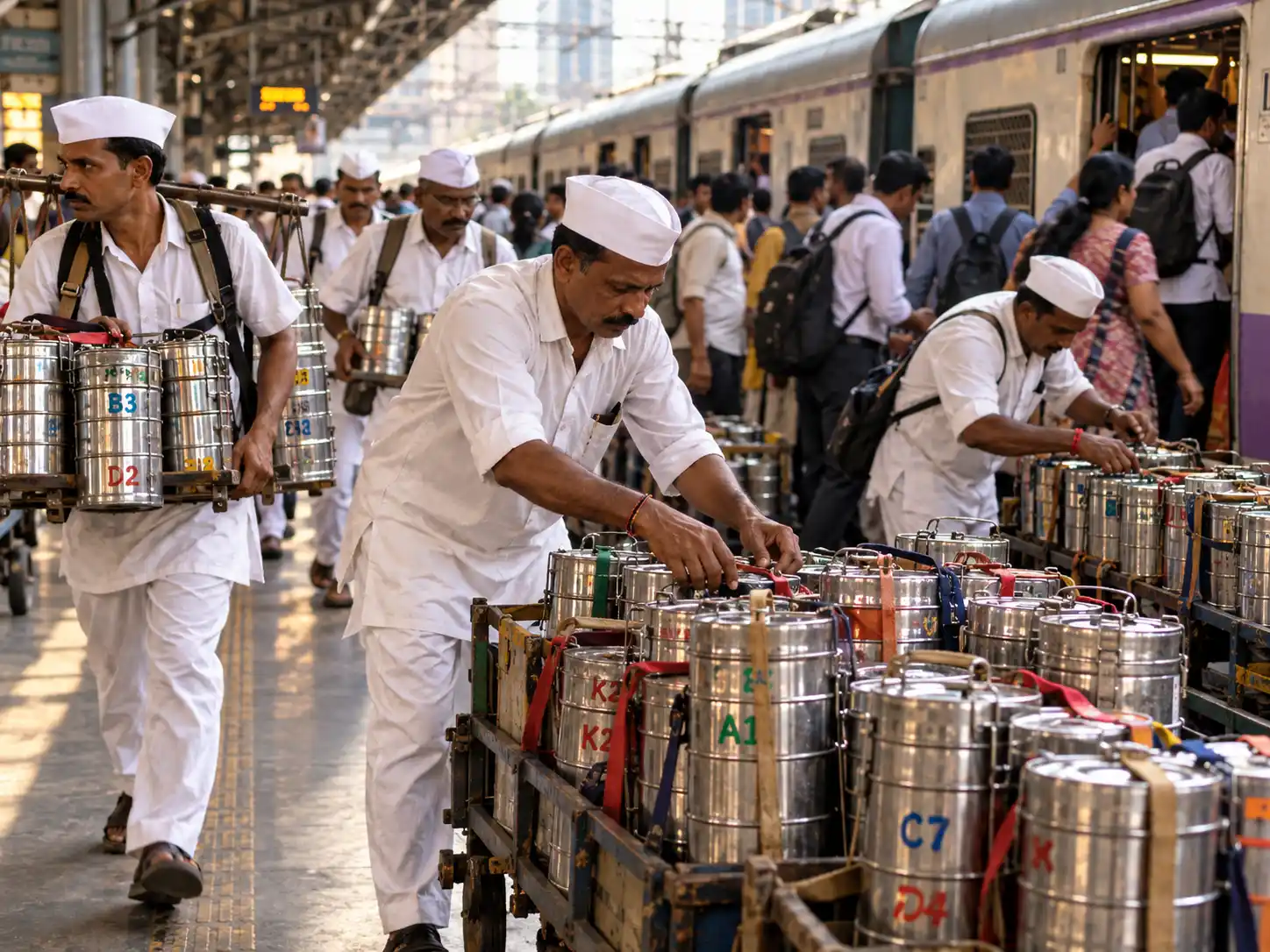
In 2014 a lunchbox leaving a flat in Vile Parle for an office in south Mumbai might have had this painted on its lid: E-VLP-3-10-MT-12. It carried no name, no street and no phone number. The reporter Geetanjali Minhas, who followed the boxes for Governance Now that March, wrote out what the marks meant. E was the pickup locality, Hanuman Nagar. VLP was Vile Parle, the suburb and its station. The 3 was the station where the box would get off the train, Churchgate. The 10 was the area around that station, Colaba and Cuffe Parade. MT was the building, Maker Tower. The 12 was the floor. The men who read that code are called dabbawalas. A dabba is a box, in this case a stack of round steel tins held together by a clasp. For most of the last hundred years there were about 5,000 of them, and they carried somewhere between 130,000 and 200,000 lunches a day from kitchens in the
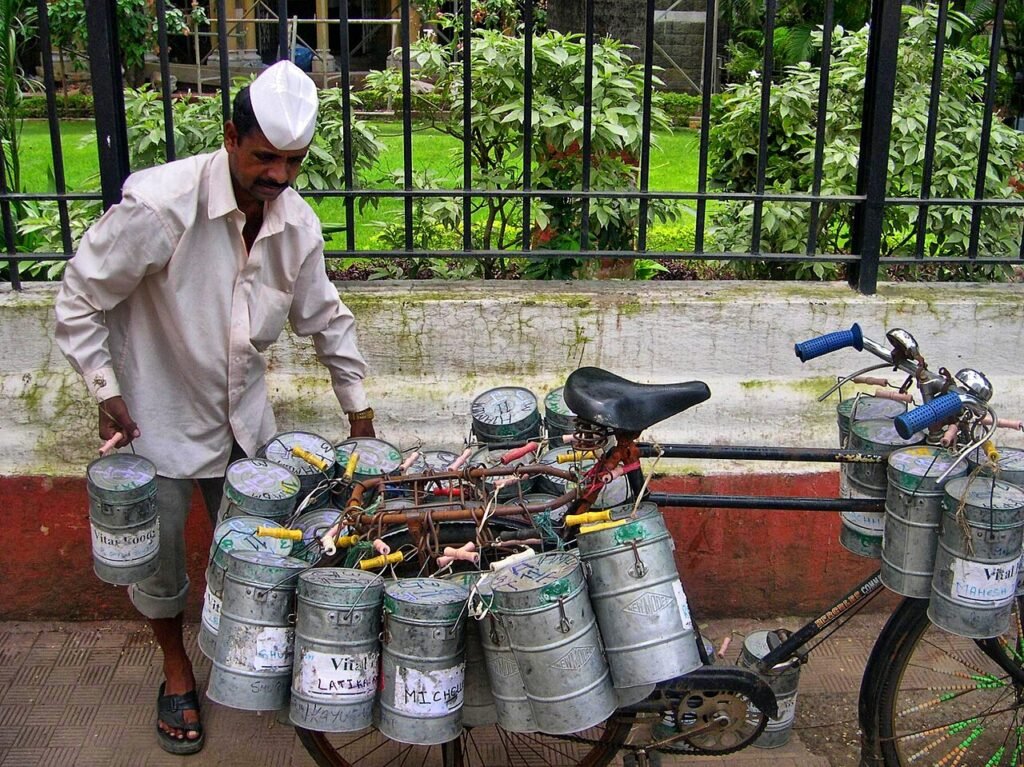
suburbs to desks in the city and then carried the empty tins home again.
One box, one morning
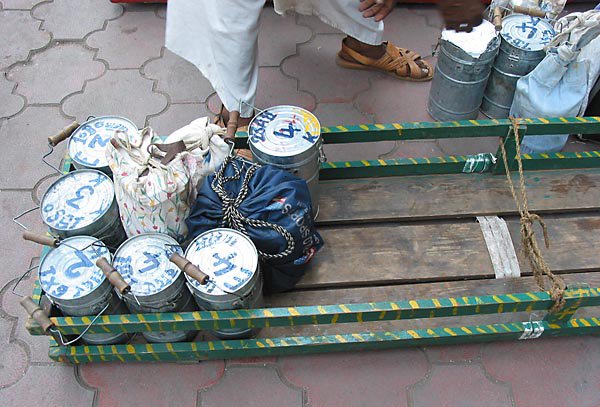
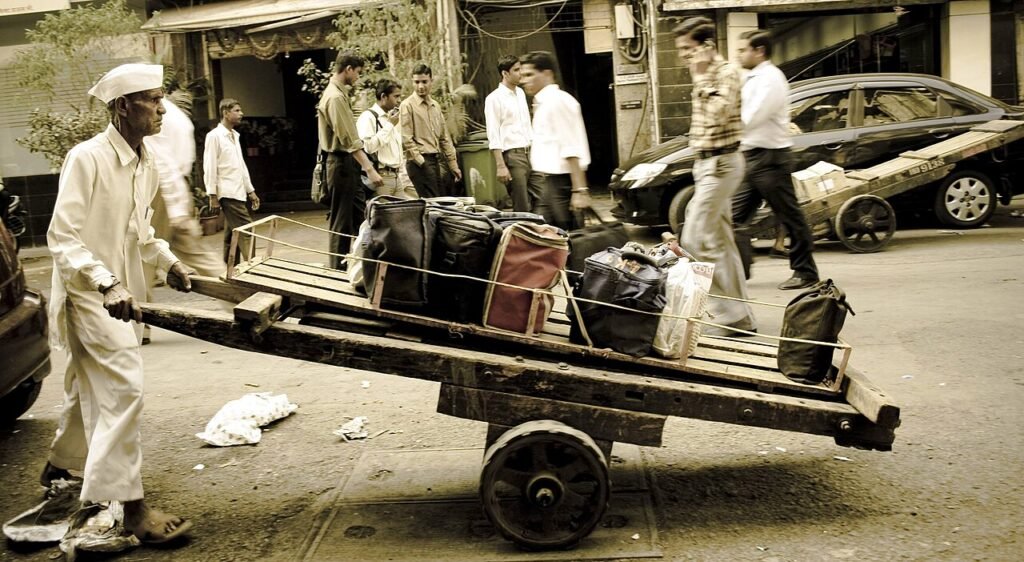
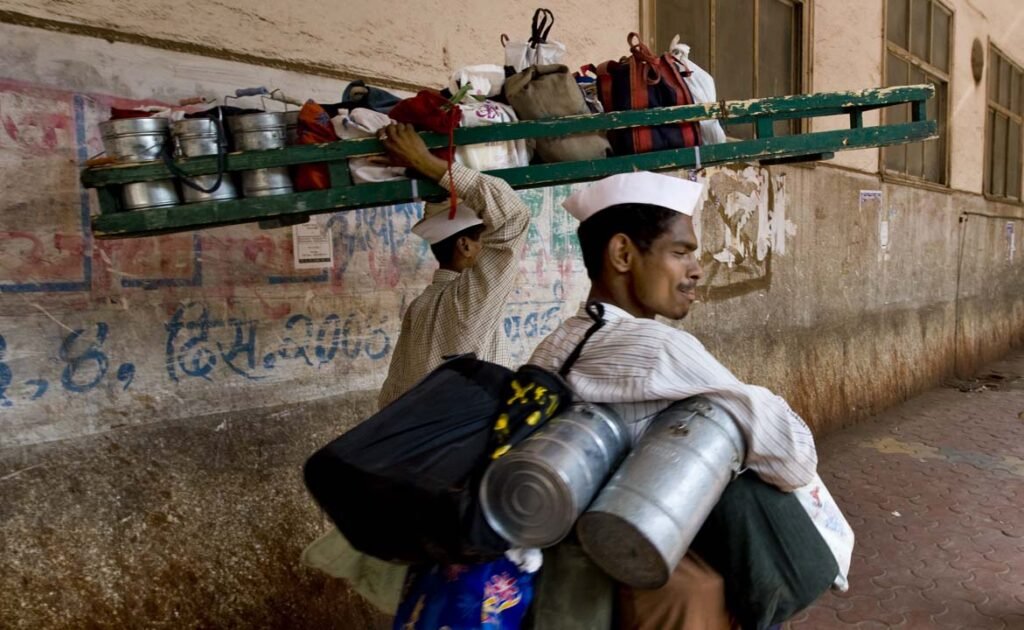
Minhas rode along with Dhondi Bhau Chorge, who was 55 and had been doing the job for 35 years. He knocked on his first door in Andheri at eight in the morning. By half past ten he had about 25 dabbas hanging from his bicycle and was at Andheri station, where other men from his group were arriving with loads of the same size. On the platform the boxes were re-sorted by destination and packed into long wooden crates. The crates went into the luggage compartment of a Churchgate train. At the other end a different set of men lifted them out, sorted them again by area and building, and set off on foot, by bicycle or behind a handcart. Forbes had weighed one of those crates in 1998 and put it at about 100 kilograms. Lunch was on the desk by one o’clock. At two the dabbawalas came back for the empties. By three those were on a train going north, and by five Chorge was at the door where he had started. The man who collects a box is almost never the man who delivers it. Nobody in the chain needs to know who cooked the food or who will eat it. Each man has to read only the part of the code that concerns him: which station, which bundle, which building.

Why the trains did the work of a map
A phone with GPS tells a courier where he is and works out a route. The dabbawalas never needed a route worked out, because it did not change. Mumbai is built along railway lines that run north to south, and the offices sat at the bottom of them. "Mumbai is perfect for us," Gangaram Tarekar, then secretary of the dabbawalas’ association, told the Yale Globalist in 2010. "It is a long and narrow city, and it has an excellent train system." The train timetable did the scheduling too. A crate that misses its train misses lunch, so every step before the platform was timed backwards from the train. Stefan Thomke of Harvard Business School, who wrote a case study on the dabbawalas with Mona Sinha in 2010, described in the Harvard Business Review how the men were organised into units of about 25. Each unit ran itself and kept a few spare hands who could step in when someone was sick or a bicycle broke. Every member could do every job. The men used no mobile phones for the work. The code itself grew up with the city. An account from the dabbawalas’ own museum in Bandra says the first boxes were told apart by coloured threads, and the letters and numbers came later as Bombay spread north. It was designed to be read by men who had left school early. Thomke calls the workforce semi-literate.
A loader from Maval
The association dates itself to 1890. Its founding story is that a Parsi banker in Bombay wanted lunch from his own kitchen and paid a young man to fetch it, and that his colleagues soon wanted the same. Bombay’s Parsis kept strict rules about food, so the story is plausible. No document for it has been published, and other tellings put it in 1885 or simply "the 1880s".
The young man was Mahadeo Havaji Bachche, from the hill country of Maval near Pune. One newspaper account says he had been working as a loader at the Bombay docks. In 1890 he set up a delivery service with about a hundred men. In 1956 the group registered as a charitable trust, the Nutan Mumbai Tiffin Box Suppliers Trust. Bachche hired from home, and so did everyone after him. The dabbawalas still come mostly from a cluster of villages around Pune. Many are related, and many are Varkaris, devotees of Vithoba of Pandharpur. "We only take new dabbawalas from our own people," Tarekar said. There are no employers. Each man buys into his group and takes an equal share of what it earns.
The number that grew
In 1998 the Forbes writer Subrata Chakravarty asked Raghunath Medge, president of the association, how often a lunch went astray. About once every two months, Medge said. Forbes did the arithmetic. At 175,000 lunches a day, two months is roughly eight million deliveries, or sixteen million if you count the trip home. That was one man’s estimate, turned into a ratio by a magazine. Within a few years it was being repeated as a measured error rate. Then it became a certificate. Articles began to say that Forbes had awarded the dabbawalas a Six Sigma rating, in 1998 or 2001 or 2002 depending on who was writing. Six Sigma is a quality method invented at Motorola. Forbes does not hand it out. The anthropologist Gauri Sanjeev Pathak went back to Chakravarty for a 2010 paper. He told her that Forbes had never certified the dabbawalas as anything and that he had never used the term. Nobody has audited the real figure. What Medge said next in 1998 is probably the better guide: "If we made 10 mistakes a month, no one would use our service."
Without the trains
Tarekar had another line he liked. "Error is horror. Strike is suicide." In August 2011 the dabbawalas called their first strike in 120 years, for one day, to join Anna Hazare’s anti-corruption rally at Azad Maidan. The stoppage that hurt came in March 2020. The lockdown shut the suburban railway, and the system had no way of working around it. "We cannot function without trains," Medge told Arab News that July. More than 4,000 of the men went back to their villages. Many offices never filled up again. In June 2026 the Press Trust of India counted about 3,000 dabbawalas carrying a little over 50,000 lunchboxes a day. Ramdas Karvande, the association’s president, put it down to people working from home or coming in a few days a week. A monthly subscription now costs between Rs 1,500 and Rs 2,500. Raghunath Mendge, the same man who gave Forbes its number, started carrying boxes in 1974. His father had joined in 1930. The fee when he began, he told PTI, was twelve rupees a month.
Test your knowledge
Answer 5 questions about the story.
What does the code on a dabbawala lunchbox mean?
The letters and numbers stand for places, in order: the pickup locality, the suburb and its station, the destination station, the area near it, the building and the floor. In the example E-VLP-3-10-MT-12, VLP is Vile Parle, 3 is Churchgate and MT-12 is the twelfth floor of Maker Tower.
When did the dabbawala service start?
The dabbawalas’ association dates it to 1890, when Mahadeo Havaji Bachche organised about a hundred men to carry lunches in Bombay. Some accounts place the first deliveries a few years earlier.
Did Forbes give the dabbawalas a Six Sigma certificate?
No. A 1998 Forbes article reported the association president’s estimate of about one mistake every two months. Its author later said Forbes never certified the dabbawalas and that he never used the term Six Sigma.
How many dabbawalas are there today?
A Press Trust of India report in June 2026 counted about 3,000 dabbawalas delivering a little over 50,000 lunchboxes a day, down from nearly 5,000 men before the pandemic.
Why does the system depend on Mumbai’s local trains?
The boxes travel most of their distance in the luggage compartments of suburban trains, and the whole day is timed around the train timetable. When the trains stopped during the 2020 lockdown, the service stopped with them.
Sources and further reading
- Stefan Thomke, "Mumbai’s Models of Service Excellence", Harvard Business Review, November 2012: https://hbr.org/2012/11/mumbais-models-of-service-excellence
- Subrata N. Chakravarty, "Fast food", Forbes Global, 10 August 1998: https://www.forbes.com/global/1998/0810/0109078a.html
- Geetanjali Minhas, "Dabbawallahs: carriers that feed a hungry Mumbai every day", Governance Now, 18 March 2014: https://www.governancenow.com/news/regular-story/dabbawallahs-carriers-feed-hungry-mumbai-every-day
- Sara Roncaglia, Feeding the City: Work and Food Culture of the Mumbai Dabbawalas (Open Book Publishers, 2013): https://doi.org/10.11647/OBP.0031
- Gauri Sanjeev Pathak, "Delivering the Nation: The Dabbawalas of Mumbai", South Asia: Journal of South Asian Studies 33(2), 2010, pp. 235-257
- Uzra Khan, "The Lunch Box Men", The Yale Globalist, 2010: https://globalist.yale.edu/politics-and-economy/164/