Ismat Chughtai was one of the four pillars of modern Urdu fiction, a writer of short stories and novels whose fearless engagement with female desire, class consciousness, domestic oppression, and the specific texture of women's interior lives produced some of the most important literature written in any South Asian language in the twentieth century. Born in 1915 in Badaun in the United Provinces, she was educated against considerable family resistance, joined the Progressive Writers Movement, and published her most celebrated and most controversial story Lihaaf in 1942, a story about female loneliness and desire that resulted in an obscenity trial before the Lahore High Court in 1944. She appeared at the trial, refused to apologise, challenged the court to specify which elements of the story were obscene, and walked away when the case was dropped without winning any particular argument except the one that mattered most: that she would not be made to feel that what she had written was wrong. She continued writing for five more decades, producing a body of work that remains the most honest and the most technically accomplished portrait of the inner lives of Indian Muslim women in the Urdu literary tradition.| Detail | Information |
| Full Name | Ismat Chughtai |
| Born | 21 August 1915, Badaun, United Provinces, British India |
| Died | 24 October 1991, Mumbai, India |
| Nationality | Indian |
| Primary Art Form | Urdu short story, novel, screenplay |
| Literary Movement | Progressive Writers Movement, All India Progressive Writers Association |
| Most Celebrated Works | Lihaaf 1942, Terhi Lakeer 1944, Chauthi Ka Joda, Mughal Bachcha |
| Obscenity Trial | Lahore High Court 1944, charges of obscenity for Lihaaf |
| Co-accused | Saadat Hasan Manto, tried separately for his story Bu |
| Husband | Shahid Latif, film director |
| Film Work | Screenplays for multiple Hindi films including Arzoo 1950 |
| Awards | Padma Shri 1976, Sahitya Akademi Award 1975 |
| Associated Publication | Adab-e-Latif, Urdu literary journal |
| Legacy | Considered one of the four pillars of modern Urdu fiction alongside Manto, Bedi, and Krishan Chander |
Why Ismat Chughtai Faced a Trial for Her Fearless Storytelling
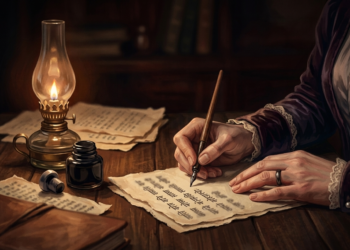
There is a particular kind of literary courage that does not announce itself. It does not write manifestos about the importance of speaking truth or declare its intention to challenge convention. It simply writes what it sees, in the clearest and most precise language available to it, and discovers afterward that what it has written has caused a disturbance that it genuinely did not anticipate, not because it was naive about the world but because it was so entirely focused on the truth of what it was describing that the world’s reaction to that truth was a secondary consideration that arrived late and was handled with irritation rather than anxiety.
This is the specific quality of Ismat Chughtai’s courage. She did not write Lihaaf in order to be controversial. She wrote it because the situation it described, a woman’s loneliness in a marriage that offered her no companionship, and the specific warmth she found in the closest available relationship, was real, was common, and had not been written about in Urdu literature with anything approaching the honesty it deserved. The controversy was the world’s problem. The writing was her business. She treated these as clearly separate matters.
The obscenity trial that followed the publication of Lihaaf in 1942 was, by this understanding, not the central event of her literary life. It was an interruption. An administrative nuisance generated by a system that had decided the truth she was telling was socially inconvenient. She handled it with the combination of intellectual precision and personal stubbornness that characterised her approach to every obstacle, went to court, asked a question that the court could not answer, and went home.
She continued writing.
The World That Formed Her
Ismat Chughtai was born on 21 August 1915 in Badaun in the United Provinces, the ninth of ten children in a family whose size and whose particular dynamics would prove to be as significant to her literary formation as any formal education she received. Her father was a government official, her family was Muslim and middle-class, and the household she grew up in was one in which the claims of female education and independence were in continuous, productive tension with the claims of conventional respectability.
She grew up surrounded by brothers, a biographical fact that shaped her personality and her literary sensibility in specific ways. The brothers’ world, with its freedom of movement, its access to education, its assumption that the public world was available to it, was visible to her from the earliest age as both attractive and unjustly exclusive, available to boys by birthright and to girls only through the kind of sustained argument and persistent demand that Chughtai began making in childhood and did not stop making until her death.
She educated herself partly through the books that her brothers left lying around, absorbing literature in multiple languages with the specific hunger of someone who understands that reading is not a luxury but a form of self-construction, a way of building an interior world large enough to contain the understanding she was developing of the exterior world’s inequities.
The Compassionate Teachings of Sant Tukaram in Maharashtra
She attended Isabella Thoburn College in Lucknow, one of the first women’s colleges in India, a choice that required family negotiation of considerable intensity and that gave her access to both formal literary education and to the community of educated women whose experience of the gap between their capabilities and the roles available to them was the common ground from which the best Urdu women’s writing of the mid-twentieth century emerged.
She received a Bachelor of Arts degree, then a Bachelor of Education, and began teaching, a profession that gave her both economic independence and the daily encounter with the social realities of women’s lives that would fuel her fiction across four decades. She was simultaneously a teacher, a reader, a writer, and a woman watching the world around her with the specific quality of attention that the best fiction writers develop, the attention that notices not only what happens but how people feel about what happens and what they do with those feelings when the social world gives them nowhere to put them honestly.
The Progressive Writers Movement and the Literary Company She Kept
Chughtai’s engagement with the All India Progressive Writers Association connected her to the most significant literary movement in twentieth century South Asian writing and placed her within a community of writers whose commitment to social and political honesty in literature provided both intellectual companionship and, when the institutional response to that honesty arrived, a form of solidarity that made the isolation of controversy somewhat more bearable.
The AIPWA’s founding commitment to literature that engaged honestly with social reality, that did not aestheticise poverty and oppression out of visibility, and that treated the experience of ordinary people, including and especially women and the poor, as legitimate subjects of serious literary attention, was the framework within which Chughtai’s own literary programme found its most complete articulation.
Her relationship with the other major figures of the Progressive Writers tradition was one of genuine intellectual engagement rather than simply shared institutional membership. Saadat Hasan Manto, who would face his own obscenity trials for stories that explored the darker dimensions of male sexuality and violence with a directness that colonial and post-colonial propriety could not accommodate, was her closest literary associate and in some accounts her closest friend among the writers of her generation. The specific quality of their friendship, marked by mutual recognition of each other’s literary courage and by the particular solidarity of two people who were both being told by institutional power that what they were writing was unacceptable, is one of the more illuminating relationships in the history of South Asian literature.
Faiz Ahmad Faiz, whose political poetry was examined in the preceding article in this series and whose own relationship with institutional power through imprisonment and exile runs parallel to Chughtai’s experience of the obscenity trial, was another significant figure in the literary world she inhabited. The Progressive Writers Movement’s community, for all its internal debates and personal tensions, provided a context in which the work of both writers was produced and received that shaped the specific quality of intellectual seriousness and political commitment that distinguishes their best work from the more accommodationist literature that surrounded it.
The research on the Progressive Writers Movement and its relationship to Urdu women’s writing in the mid-twentieth century has been most rigorously developed by scholars including Rakhshanda Jalil, whose work on the movement published through academic presses including Oxford University Press India provides the most comprehensive available account of the institutional and intellectual framework within which Chughtai’s literary career developed.
Lihaaf and What It Actually Says
The story that resulted in Ismat Chughtai’s obscenity trial is, by the standards of contemporary literary fiction, remarkably restrained. It contains no explicit sexual description. Its most physically suggestive moment is the shadow of moving shapes beneath a quilt. Its primary subject is not sex but loneliness, the specific loneliness of a woman in a marriage whose husband has given his companionship and attention elsewhere while leaving his wife in the material comfort and emotional desolation that the arrangements of middle-class Muslim domesticity in colonial India could produce.
The story is narrated by a child, a young girl who comes to stay with her relative Begum Jan and who observes, with the particular clarity of a child who sees what adults do without understanding its full social meaning, the relationship between Begum Jan and her servant Rabbo. Begum Jan’s husband is a Nawab who has no interest in his wife beyond the social convenience of having one, spending his time and his attention with the young men whose company he prefers. Begum Jan, left alone with her needs and her loneliness, finds in Rabbo a warmth and a physical closeness that the marriage has never provided.
The child narrator does not understand what she is witnessing between Begum Jan and Rabbo. The adult reader does. And what the adult reader understands is rendered not through explicit description but through the specific details that Chughtai selects with the precision of a writer who knows that what is most powerful in fiction is not what is stated but what is implied, not the thing that is said but the quality of attention given to the things around it.
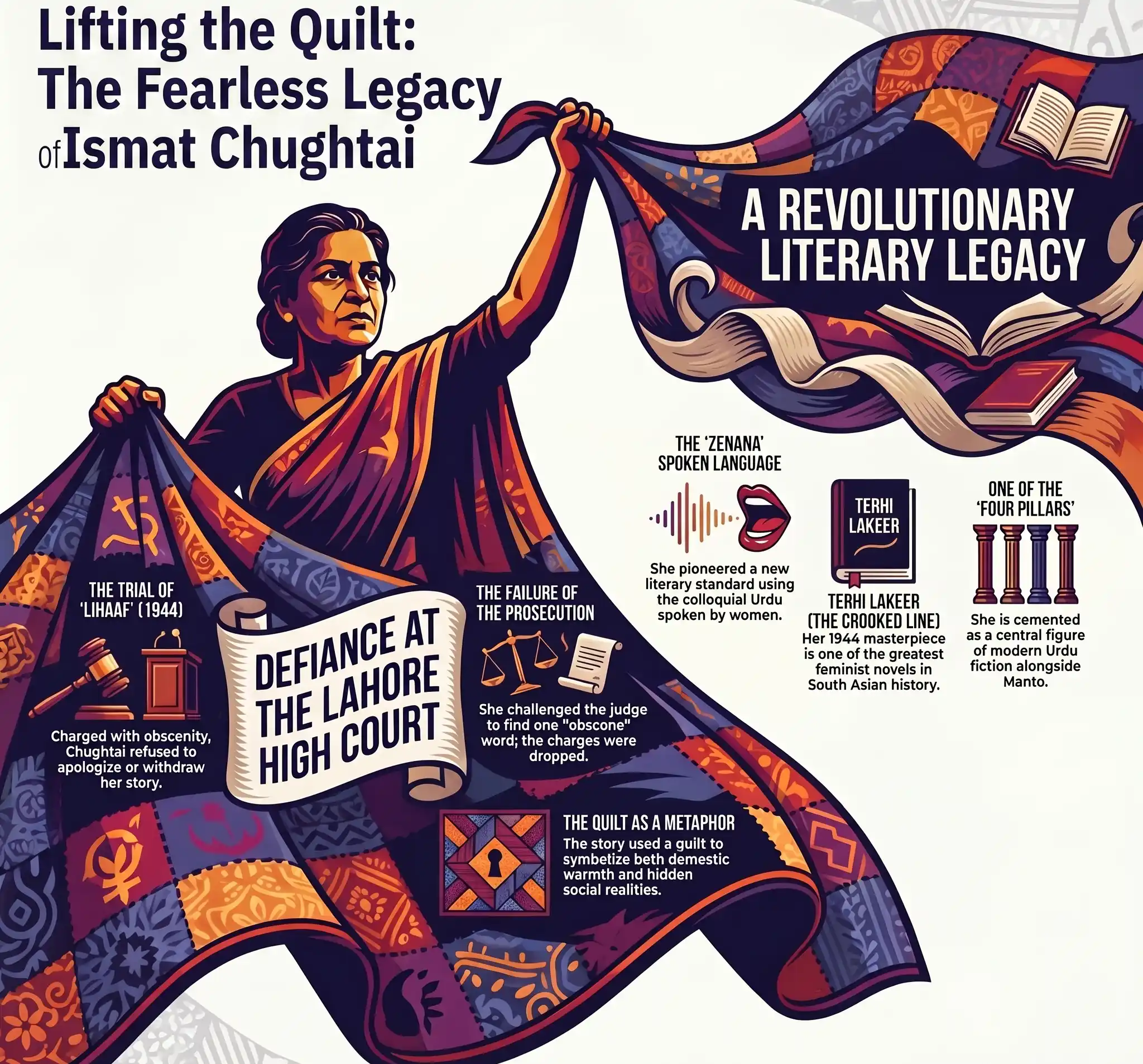
The quilt of the story’s title is both a physical object and a metaphor, both the actual quilted covering under which Begum Jan and Rabbo share their warmth on cold nights and the larger covering of respectability and convention under which the realities of women’s lives in this world are maintained. The quilt keeps things warm. It also keeps things hidden. The story’s gesture, its specific literary act, is to lift the corner of the quilt just enough that the reader can see what is underneath, not completely, not with any claim to full exposure, but enough to make the pretence that nothing is underneath no longer available.
This is what the colonial authorities and the conservative literary establishment found obscene. Not the sex that the story does not explicitly describe but the acknowledgment that the sex, or something like it, exists. The obscenity was the naming. The quilt had been there for a long time. What was unacceptable was Chughtai’s decision to acknowledge it.
The literary analysis of Lihaaf and its place in the tradition of Urdu women’s writing has been most rigorously developed by scholars including Sukrita Paul Kumar, whose work on Ismat Chughtai published through Katha and other literary presses provides the most nuanced available critical account of the story’s technical achievement and its significance within the Urdu literary tradition.
The Obscenity Trial
The charges against Ismat Chughtai were filed in 1944, two years after the publication of Lihaaf in the literary journal Adab-e-Latif in 1942. The delay reflects the specific pace of colonial administrative action rather than any slow building of public outrage, and the timing, in the middle of the political crisis of the final years of British India, when the colonial government had considerably more pressing concerns than an Urdu short story, suggests that the trial was driven by specific complaints from the conservative establishment rather than by any governmental initiative.
The charges were filed under Section 292 of the Indian Penal Code, the provision dealing with obscene publications, the same legal provision under which Manto had been charged for his story Bu and under which the colonial and post-colonial governments of both India and Pakistan would continue to charge writers for decades.
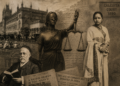
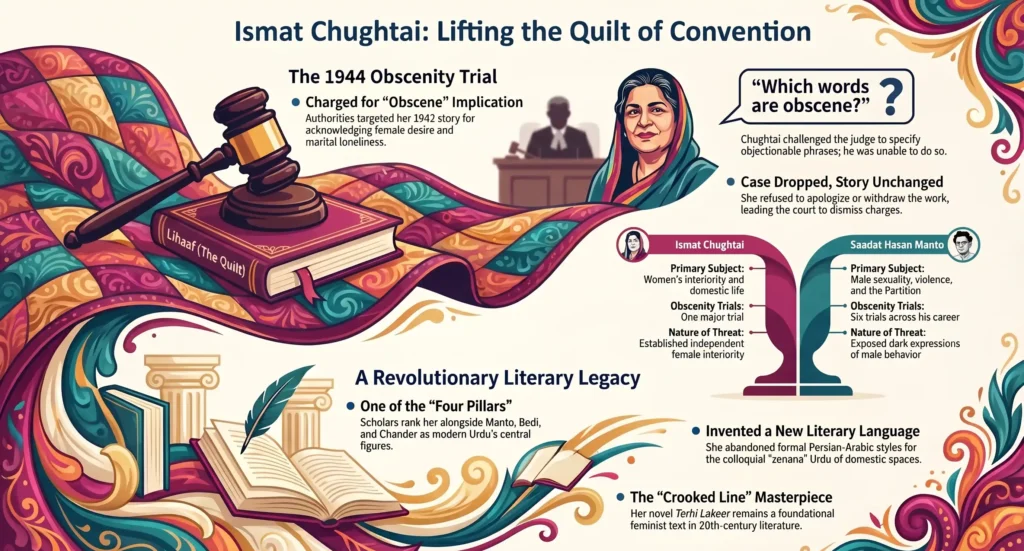
Chughtai appeared before the Lahore High Court with the specific quality of prepared stubbornness that characterised her approach to all institutional authority. She had thought carefully about what the charges actually required the prosecution to prove, which was that specific content in the story was obscene by the legal standard, and she had identified the vulnerability in the prosecution’s position, which was that the story’s most suggestive elements were implied rather than stated and therefore difficult to specify as objectionable without simultaneously acknowledging what the prosecution would prefer not to acknowledge, which was that it was acknowledging the sexuality it was claiming to be protecting public morality against.
Her question to the court, asking the judge to specify exactly which words or phrases in the story were obscene so that she could consider addressing them, was not a rhetorical flourish. It was a precise legal challenge that placed the prosecution in the position of having to either identify specific explicit content, which did not exist in the story, or acknowledge that what they were calling obscene was the story’s implication rather than its statement, which would have required the court to take a position on the propriety of literary implication that the colonial legal system was not equipped to adjudicate.
The case was eventually dropped. The accounts of the proceedings that survive, including Chughtai’s own recollections published in her autobiographical writing, suggest that the dropping of the case reflected less a judicial vindication of the story’s literary merit than a pragmatic retreat from a prosecution that was not going to succeed on its own terms.
Chughtai did not treat the dropping of the case as a victory, because she did not accept the court’s jurisdiction over the question it had been asked to adjudicate. She treated it as a termination of an irrelevant process and returned to her writing. The story was not withdrawn. The story has never been withdrawn. Lihaaf is today one of the most read and most studied short stories in the Urdu literary tradition.
The Fearless Verses of Kabir That Challenged Orthodox Society
What She Was Actually Writing About
The reduction of Ismat Chughtai’s literary significance to the Lihaaf trial and its implications for queer or same-sex representation in Urdu literature, while not wrong, is incomplete in ways that do disservice to the full range and depth of her literary achievement.
Chughtai was, across her entire literary career, primarily a writer about class. The female desire that Lihaaf explores is inseparable from the class structure that produces it, the specific arrangement of middle-class Muslim domestic life in which women of the Nawab class are materially comfortable and personally imprisoned, in which their servants are economically dependent and emotionally proximate, and in which the specific warmth that the story describes emerges from an economic relationship that is itself a form of exploitation. Chughtai sees all of this simultaneously and holds it all in the story without resolving any of it, because resolution would be dishonest about the complexity of what she is observing.
Her novel Terhi Lakeer, meaning the crooked line, published in 1944 and widely considered her masterpiece, is an autobiographical novel that traces the formation of a woman’s consciousness through childhood and education and the first encounters with the gap between the world’s expectations of her and her own understanding of what she is capable of and what she desires. The title refers to the crooked line of a woman’s life, the path that refuses the straight line that convention prescribes and finds its own direction through the obstacles that the straight line’s enforcers place in its way.
The novel is formally ambitious in ways that her short stories, for all their technical accomplishment, do not attempt: it sustains a psychological portrait across a full narrative arc, tracking the protagonist’s consciousness through the specific stages of a woman’s formation in a world that consistently underestimates and misuses her capabilities. It is one of the great feminist novels of twentieth century South Asian literature and it remains, outside specialist academic circles, almost entirely unknown in English.
Her short stories, of which she produced several hundred across her career, are studies in the specific textures of domestic life, the conversations between women in zenana spaces, the negotiations of arranged marriage, the specific economics of middle-class Muslim households, the relationships between women of different classes who share domestic space without sharing social power, and the interior lives of women who have been assigned roles that do not contain them and who manage the gap between their assigned role and their actual self in the various ways that women have always managed it, through creativity, through solidarity, through withdrawal, through the specific kinds of resistance that are available to those whose resistance must be conducted without announcement.
The literary scholarship on Terhi Lakeer and the broader body of Chughtai’s fiction has been most comprehensively developed by scholars including Tahira Naqvi, whose English translations of Chughtai’s work published through Kali for Women and other feminist presses have made the most significant portion of her work accessible to English-language readers, and whose critical introductions to these translations provide the most accessible available scholarly context for the non-specialist reader.
Manto and Chughtai: Two Voices, One Courage
The parallel between Ismat Chughtai and Saadat Hasan Manto, both Progressive Writers, both obscenity trial defendants, both writers who used Urdu fiction to describe realities that the dominant culture had decided were too uncomfortable to name, is one of the most illuminating comparisons in twentieth century South Asian literary history, and it illuminates precisely because the parallels exist alongside significant and revealing differences.
Manto’s obscenity trials, six of them across his career in both British India and Pakistan, were for stories that explored male sexuality and violence, the brothel, the partition massacre, the specific ugliness of male desire in its most destructive expressions. His writing was about the world that men make and the damage it does, including the damage it does to women, and his trial was the institutional response to a male writer making that damage visible with an honesty that was experienced as more threatening than the damage itself.
Chughtai’s trial was for a story that explored female desire and female loneliness in a domestic space that men do not occupy and do not, therefore, control the description of. This is the specific difference that matters. Manto was being tried for describing a world that men made. Chughtai was being tried for describing a world that men did not make and did not enter, the interior domestic world of women, in which women’s experiences, desires, and relationships existed without male mediation or male permission.
The threat that Chughtai’s writing represented was therefore different in kind from the threat that Manto’s represented. Manto was threatening to expose male behaviour. Chughtai was threatening to establish the existence of a female interiority that was independent of male attention, male desire, and male definition. The first kind of threat can be managed by condemning the behaviour being exposed. The second kind of threat is more fundamental, because it challenges the assumption that women’s inner lives exist primarily in relation to men.
The obscenity charge against Lihaaf was, in this reading, not really about the sexual content of the story. It was about the story’s establishment of a women’s domestic world in which men are peripheral and in which women’s most significant relationships and most intense experiences occur without male participation. The quilt was not obscene. The independence it covered was.
This reading of the trial has been developed most rigorously by feminist literary scholars including Priyamvada Gopal, whose work on the politics of literature in colonial and post-colonial South Asia published through Cambridge University Press and Edinburgh University Press provides the most sophisticated available framework for understanding the specifically political dimensions of the institutional response to Chughtai’s writing.
The Language She Invented
One of the aspects of Ismat Chughtai’s literary achievement that receives the least attention in general accounts of her work and the most attention from the specialists who study Urdu literature most carefully is the specific literary language she developed, a language that was, at the time of its development, unprecedented in the Urdu literary tradition and that has had a shaping influence on the tradition’s subsequent development that has never been adequately mapped.
The Urdu literary language of the early twentieth century was a formal literary language, descended from the Persian and Arabic traditions that had shaped classical Urdu poetry and prose, characterised by a syntactic complexity and a lexical elevation that maintained a significant distance between literary language and the actual spoken language of the communities that Urdu served.
Chughtai wrote in the spoken language of the women she was writing about, specifically the colloquial Urdu-Hindi mixture spoken in the zenana spaces of middle-class Muslim households in the United Provinces, a language full of the specific idioms, the specific rhythms, the specific forms of wit and irony that women developed in the domestic spaces available to them and that had never previously been considered adequate for serious literary expression.
This was not simply a stylistic choice. It was a political act. The decision to write literary fiction in the actual spoken language of the women whose lives the fiction was describing, rather than in the elevated literary language that would have placed those lives at an aestheticising distance, was a statement about whose experience deserved serious literary attention and in whose voice that attention should be expressed.
The spoken quality of Chughtai’s prose, its intimacy, its irony, its specific quality of woman-talking-to-woman that gives even her most painful stories a warmth that prevents them from becoming either sentimental or clinical, is the technical achievement that distinguishes her work most completely from that of her contemporaries and that makes it feel, to contemporary readers, considerably more modern than its dates of composition would suggest.
The Urdu language she used was not a compromise between literary and colloquial. It was a new literary standard, proposed by the quality of what it was capable of doing in her hands, and accepted by the subsequent tradition’s recognition that the prose fiction she wrote in it was among the finest produced in the language across the twentieth century.
Film and the Public World
Ismat Chughtai’s marriage to Shahid Latif, a film director, gave her access to the Hindi film industry of the 1940s and 1950s and resulted in a body of screenplay work that extended her literary sensibility into a popular medium with considerable commercial reach. The films she wrote screenplays for, including Arzoo in 1950 and several others in collaboration with her husband, represent the Progressive Writers Movement’s most sustained attempt to bring the social and political consciousness of the literary left into the mainstream Hindi film industry.
The film work was not simply a commercial sideline to her literary career. It reflected the same impulse that had driven her literary work from the beginning, the desire to bring honest portrayals of women’s experience into the public sphere in forms accessible to the widest possible audience. The literary journal where Lihaaf was published reached thousands of readers. Hindi cinema in the 1950s reached millions. The specific constraints that commercial filmmaking placed on the kind of honesty available in the literary short story were real and were negotiated with varying success, but the attempt to use the popular medium for serious social purpose was continuous with rather than contradictory to the literary project.
Her autobiographical writing, which she produced in the later decades of her career, gives the most direct account of the film world she inhabited and the specific quality of practical intelligence she brought to it, the combination of creative ambition, commercial realism, and the specific stubbornness of a woman who knew what she was trying to do and was not going to be talked out of it by the various forms of institutional pressure that the film industry, like every other institution she encountered, applied with considerable consistency.
The Class Consciousness Beneath the Desire
Throughout this article, the claim has been made that Chughtai’s writing is primarily about class rather than primarily about gender or sexuality, and this claim requires development because it might seem to minimise the feminist dimensions of her work that are most visible and most celebrated.
The claim is not that gender and sexuality are unimportant in Chughtai’s work. They are central to it. The claim is that Chughtai’s treatment of gender and sexuality is inseparable from her treatment of class, that the specific forms of oppression she describes are produced by the intersection of gender hierarchy and class structure, and that the full meaning of her writing cannot be accessed without attending to both dimensions simultaneously.
How Bulleh Shah’s Poetry Transformed the Sufi World of Punjab
The relationship in Lihaaf between Begum Jan and Rabbo is not simply a relationship between a lonely woman and her companion. It is a relationship between a woman of the Nawab class and a woman who is economically dependent on her, a relationship in which the emotional and physical intimacy that develops exists within a power structure that the intimacy does not dissolve. Chughtai sees this without resolving it into either a celebration of the relationship or a condemnation of it. The warmth is real. The power differential is real. Both things coexist in the story without either cancelling the other.
This simultaneous holding of emotional reality and material reality, of the warmth of the relationship and the structure that produces and contains it, is the specific quality of Chughtai’s class consciousness, and it is what distinguishes her from writers who treat the domestic world as either a space of pure oppression or a space of pure solidarity. The domestic world she describes is both, simultaneously, and the women who inhabit it are neither simply victims nor simply agents but human beings navigating a structure that constrains them while finding within that constraint the specific forms of life and warmth and connection that are available to them.
The relationship between class, gender, and the specific arrangements of Muslim middle-class domesticity in colonial India has been examined by scholars including Faisal Devji, whose work on Muslim political identity in colonial India published through Stanford University Press provides the most sophisticated available analysis of the social structures within which Chughtai’s fiction operates.
The Trial She Never Stopped Conducting
The obscenity trial of 1944 was the most visible moment in a longer and more continuous confrontation between Ismat Chughtai and the various institutions of social propriety that her writing consistently threatened. The trial was conducted in a court. The longer confrontation was conducted in the literary world, in the critical reception of her work, in the specific forms of dismissal and condescension that women writers in any tradition face when they write about female experience with a directness that the male-dominated critical establishment finds uncomfortable.
She did not stop writing. She did not moderate her voice. She did not make the accommodations that the literary establishment offered her in exchange for a more acceptable kind of honesty, a honesty that acknowledged women’s suffering without naming its causes, that described the domestic world without making visible what the domestic world was used to conceal.
The Sahitya Akademi Award she received in 1975 and the Padma Shri in 1976 were the institutional acknowledgments of a career that had been conducted in continuous defiance of the institutions that subsequently honoured it. The timing of these recognitions, coming in the later decades of a career that had begun with an obscenity trial, reflects the specific trajectory of literary figures whose work is too honest to be accommodated by the institutions of their time and whose importance the subsequent generation, which has had time to process what was threatening about the work, is better equipped to acknowledge.
She died in Mumbai on 24 October 1991, at the age of seventy-six. She had spent fifty years writing what she saw, in the clearest language available to her, without apology and without significant modification in response to institutional pressure. The body of work she left behind is one of the most important in the Urdu literary tradition, and it remains, in both its specific literary quality and its specific social honesty, the most complete portrait of the inner lives of Indian Muslim women that the twentieth century produced.
She was tried for obscenity. She was cleared, not because the court found her innocent but because the court could not find the specific words that proved her guilty. She went home. She kept writing.
The trial was not the story. The writing was the story. The writing is still the story.
What She Proved by Refusing
The thing that Ismat Chughtai proved by refusing to apologise for Lihaaf is not simply that the story was not obscene, though that is also true. It is something more fundamental about the relationship between literary honesty and institutional authority, and about what happens when a writer refuses to accept that institutional authority has the right to determine the limits of honest literary expression.
The colonial and conservative institutions that brought the obscenity case against her were not wrong about what the story was doing. It was doing exactly what they said it was doing, naming a reality that the domestic conventions of the world it described required to remain unnamed. They were wrong only about whether that naming was a crime. And they were wrong specifically because they had accepted the premise that the conventions of social respectability have a legitimate claim over the subject matter of literature, that literature’s function is to work within the limits that propriety prescribes rather than to examine and challenge those limits.
Chughtai’s refusal to apologise was a refusal of this premise. It was a statement that literature’s function is not to confirm what is socially acceptable but to describe what is actually true, that the gap between the two is precisely the territory that literature exists to explore, and that the discomfort produced in readers and institutions by honest literary description of that gap is not a reason to withdraw the description but evidence of its accuracy.
This is the literary argument that the trial made possible, not by the court’s proceedings but by her response to those proceedings. The argument is not complicated. It is the oldest argument in the history of literary censorship. But it required someone to make it in this specific context, in Urdu, in colonial India, about a story that named the loneliness of Muslim women in their own domestic spaces, and the person who made it was Ismat Chughtai, and she made it without flinching and without apology and without any indication that she considered the question of whether she had the right to write what she had written to be one that deserved serious engagement.
It did not deserve serious engagement. She was right. The trial was wrong. The story was not obscene.
The quilt is still there. What it covers is still there. Chughtai is the writer who lifted the corner. She did it once and the corner has never quite gone back down.
That is the trial. That is courage. That is the literature. They are the same thing.
The Musical Revolution of Chaitanya Mahaprabhu in Medieval India
Quick Comparison Table
| Dimension | Ismat Chughtai | Saadat Hasan Manto | Amrita Pritam | Qurratulain Hyder |
| Birth Year | 1915 | 1912 | 1919 | 1927 |
| Primary Language | Urdu | Urdu | Punjabi, Hindi | Urdu |
| Primary Form | Short story, novel | Short story | Poetry, novel | Novel, short story |
| Obscenity Trial | Yes, 1944, Lahore High Court | Yes, six trials across career | No | No |
| Progressive Writers | Central figure | Central figure | Associated figure | Associated figure |
| Primary Subject | Women’s interiority, class, domestic life | Male sexuality, violence, partition | Female desire, partition, identity | Cultural memory, history, Muslim identity |
| Most Famous Work | Lihaaf 1942 | Toba Tek Singh 1955 | Pinjar 1950 | Aag Ka Darya 1959 |
| Literary Language | Colloquial zenana Urdu | Street Urdu, Mumbai Urdu | Punjabi literary tradition | Classical Urdu prose |
Curious Indian: Fast Facts
- Ismat Chughtai published Lihaaf in the Urdu literary journal Adab-e-Latif in 1942 and was charged with obscenity under Section 292 of the Indian Penal Code two years later, the same legal provision used against her contemporary Saadat Hasan Manto for his story Bu, making 1944 one of the most significant years in the history of Urdu literary censorship.
- Her response to the Lahore High Court when charged with obscenity for Lihaaf, asking the judge to specify exactly which words or phrases in the story were obscene so that she could consider addressing them, was a precise legal challenge that the prosecution could not answer without acknowledging the implied rather than explicit nature of the story’s content, and the case was eventually dropped without Chughtai withdrawing or apologising for the story.
- She was the ninth of ten children in her family, and the freedom of movement and access to education that she observed in her brothers while being denied to herself as a girl was one of the primary biographical sources of the gender consciousness that runs through every work she produced.
- Her novel Terhi Lakeer, published in 1944 and widely considered her masterpiece, is an autobiographical novel tracing the formation of a woman’s consciousness from childhood through the specific obstacles placed by social convention, and is considered by scholars of Urdu literature to be one of the great feminist novels of twentieth century South Asian literature.
- Chughtai’s literary language was one of her most revolutionary contributions to the Urdu tradition, writing in the colloquial spoken Urdu-Hindi mixture of zenana domestic spaces rather than the elevated formal literary Urdu of the tradition, establishing a new standard for literary prose that subsequent Urdu women writers have drawn on while the critical discourse took decades to adequately acknowledge its significance.
- She was one of the four figures consistently identified by scholars as the central pillars of modern Urdu fiction, alongside Saadat Hasan Manto, Rajinder Singh Bedi, and Krishan Chander, a designation that places her at the absolute centre of the tradition’s twentieth century achievement rather than in any supplementary or secondary position.
- Her marriage to film director Shahid Latif gave her access to the Hindi film industry and resulted in screenplay work that extended the Progressive Writers Movement’s social consciousness into a popular medium reaching millions, including the screenplay for Arzoo in 1950, representing one of the most sustained attempts to bring literary left sensibility into mainstream Hindi cinema.
- The Sahitya Akademi Award she received in 1975 and the Padma Shri in 1976 came in the later decades of a career that had begun with an obscenity trial, representing the specific trajectory of a writer whose honesty was too threatening for the institutions of her time to accommodate immediately but whose importance the subsequent generation recognised with the formal recognition that her contemporaries had been unable to provide.
- Chughtai’s treatment of the relationship between class and gender in her fiction, particularly her insistence on holding both the emotional reality of women’s relationships and the material power structures that contain them simultaneously without resolving either dimension, is one of the most sophisticated literary treatments of the intersection of class and gender in any South Asian language.
- Her autobiographical writing, produced in the later decades of her career, gives the most direct account of the specific combination of intellectual courage, practical stubbornness, and genuine literary seriousness that characterised her approach to every institutional obstacle she encountered, and that makes her life story as significant a contribution to the tradition of South Asian women’s intellectual autobiography as her fiction is to the tradition of South Asian women’s literature.
Conclusion
Ismat Chughtai lifted the corner of the quilt. She did it in 1942, in an Urdu literary journal, in a short story that described a woman’s loneliness and the warmth she found in the closest available relationship, and she did it with the specific precision of a writer who knows that what matters most in fiction is not what is stated but what is made visible, not the thing that is named but the thing whose existence is acknowledged.
The colonial establishment charged her with obscenity. She went to court. She asked which words were obscene. Nobody could tell her. The case was dropped. She went home and kept writing.
This sequence—the writing, the charge, the challenge, the dropping of the charge, the continuing to write—is not primarily a story about legal vindication or literary freedom in the abstract. It is a story about the specific quality of a particular woman’s relationship to the truth she was trying to tell, and about what it looks like when a writer refuses to accept that institutional discomfort with truth is a reason to stop telling it.
Chughtai was not brave in the dramatic sense of performing courage for an audience. She was brave in the more ordinary and more durable sense of being consistently unwilling to pretend that what she saw was not what she saw. The domestic world she described was real. The loneliness she named was real. The desire she acknowledged was real. The class structures that produced all of these were real. She wrote about all of it because it was real and because real things deserve honest description regardless of the discomfort that honest description produces in the institutions that benefit from things being described otherwise.
How Swami Vivekananda Brought Vedanta to the Modern World
She produced, across fifty years of literary work, the most complete and the most technically accomplished portrait of the interior lives of Indian Muslim women in the Urdu literary tradition. She did it in a language she invented, in a voice she refused to moderate, about subjects she refused to abandon.
The Lahore High Court could not find the obscene words. There were none. There were only true words, arranged with great care and great precision, about things that were true and that the world had decided should not be said.
She said them anyway. She kept saying them. The quilt’s corner has never quite gone back down.
That is the trial. That is the courage. That is the literature. They are the same thing.
If you think you have remembered everything about this topic take this QUIZ
Results


#1. What is the title of Ismat Chughtai’s controversial 1942 short story about female loneliness and desire that resulted in a colonial obscenity trial?
#2. Before which historic judicial body did Ismat Chughtai famously appear in 1944, successfully challenging the prosecution to point out the specific “obscene” words in her story?
#3. In which city and province of British India was Ismat Chughtai born on August 21, 1915?
#4. Ismat Chughtai is universally celebrated as one of the “four pillars” of modern Urdu fiction alongside Krishan Chander, Rajinder Singh Bedi, and which other fearless writer?
#5. Which highly influential twentieth-century literary collective did Ismat Chughtai actively join and align her sharp social consciousness with?
#6. What is the name of Chughtai’s 1944 autobiographical novel, widely considered her masterpiece, which tracks the crooked path of a woman’s consciousness?
#7. What unique linguistic standard did Ismat Chughtai bring to serious Urdu literature that revolutionized the tradition’s prose style?
#8. Which set of prestigious civilian and literary awards did independent India bestow upon Ismat Chughtai in the mid-1970s?
What was the obscenity trial against Ismat Chughtai and what was its outcome?
Ismat Chughtai was charged with obscenity under Section 292 of the Indian Penal Code in 1944, two years after the publication of her story Lihaaf in the Urdu literary journal Adab-e-Latif in 1942. She appeared before the Lahore High Court, refused to apologise or withdraw the story, and challenged the court to specify exactly which words or phrases in the story were legally obscene. The prosecution was unable to identify specific explicit content because the story’s most suggestive elements were implied rather than stated. The case was eventually dropped without Chughtai making any concession, and Lihaaf was never withdrawn from publication.
What is Lihaaf about and why was it considered obscene?
Lihaaf, meaning the quilt, is a short story narrated by a child who observes the relationship between her relative Begum Jan and Begum Jan’s servant Rabbo. Begum Jan’s husband, a Nawab, ignores his wife in favour of the young men whose company he prefers, leaving Begum Jan emotionally and physically isolated. She finds warmth and companionship with Rabbo, and the child narrator observes the moving shapes beneath the quilt on cold nights without fully understanding their significance. The story was considered obscene not because it contained explicit sexual description, which it did not, but because it acknowledged the existence of female desire and intimate relationships between women in a domestic space outside male supervision and male definition.
Why is Ismat Chughtai considered one of the pillars of modern Urdu fiction?
Ismat Chughtai is considered one of the four central pillars of modern Urdu fiction, alongside Saadat Hasan Manto, Rajinder Singh Bedi, and Krishan Chander, because of the combination of technical literary achievement and social honesty that her work represents. Her development of a colloquial literary language drawn from the actual spoken Urdu of zenana domestic spaces, her sustained and sophisticated treatment of women’s interior lives and class consciousness, and her formal achievement in the novel Terhi Lakeer and across several hundred short stories collectively represent the most complete and technically accomplished portrait of Indian Muslim women’s experience produced in the Urdu literary tradition in the twentieth century.
What was the relationship between Ismat Chughtai and Saadat Hasan Manto?
Ismat Chughtai and Saadat Hasan Manto were both central figures of the Progressive Writers Movement, both defendants in obscenity trials, and by most accounts close literary friends whose relationship was marked by mutual recognition of each other’s literary courage and the specific solidarity of two writers who were both being told by institutional power that what they were writing was unacceptable. The parallel between their situations, both charged under Section 292 of the Indian Penal Code for stories that named realities the dominant culture had decided could not be named, illuminates the specific threat that honest writing posed to the colonial and conservative establishment, while the difference between their specific situations, Manto describing the world men make and Chughtai describing the world women inhabit without men, reveals the distinct and in some ways more fundamental nature of the threat Chughtai represented.
What is Terhi Lakeer and why is it significant?
Terhi Lakeer, meaning the crooked line, is an autobiographical novel published by Ismat Chughtai in 1944 that traces the formation of a woman’s consciousness from childhood through education and the first encounters with the gap between the world’s expectations of her and her own understanding of her capabilities and desires. It is considered by scholars of Urdu literature to be her masterpiece and one of the great feminist novels of twentieth century South Asian literature, demonstrating a formal ambition and a sustained psychological portrait that her short stories, for all their technical accomplishment, do not attempt. It remains almost entirely unknown to English-language readers outside specialist academic circles, a gap that reflects the broader failure of the English literary world to engage seriously with the Urdu literary tradition’s most significant achievements.