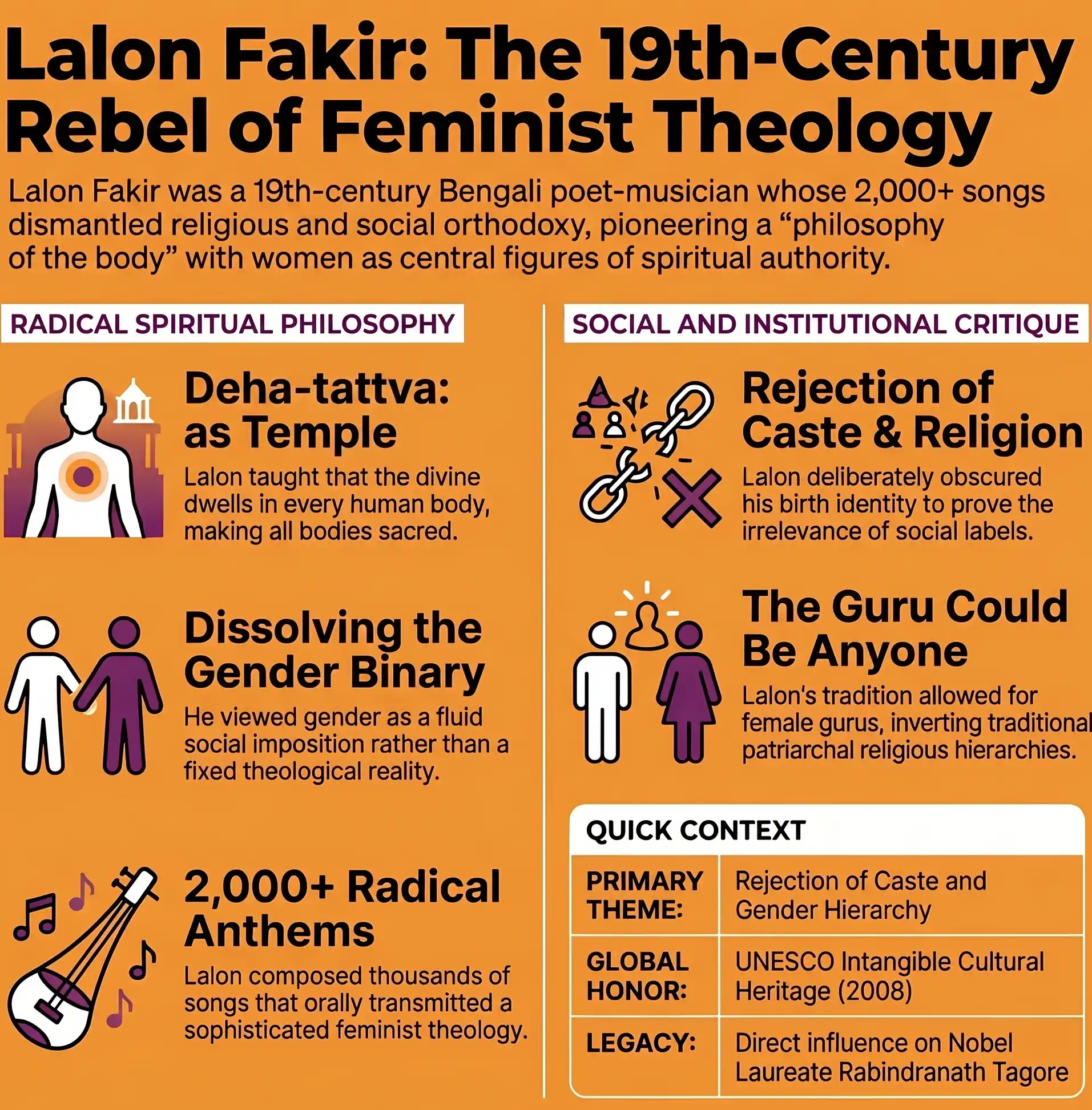
Lalon Fakir was the most celebrated and most philosophically significant poet-musician of the Baul tradition of Bengal, whose over two thousand compositions collectively constitute one of the most radical critiques of religious orthodoxy, caste hierarchy, and gender-based social organisation produced anywhere in South Asia in the nineteenth century. Born in circumstances that he himself obscured as a theological statement about the irrelevance of birth-identity, he built a community at Chheuria in what is now Kushtia district of Bangladesh whose practice of Baul spirituality placed the human body, understood as the primary site of divine knowledge, at the centre of a philosophy that dissolved the social distinctions of gender, caste, and religious affiliation with equal and systematic thoroughness. His songs, called Lalon Geeti, contain within their apparently simple folk vocabulary a feminist theology of extraordinary sophistication that challenged the most fundamental assumptions of the patriarchal religious systems of his time and that continues to carry that challenge into the present with undiminished force.| Detail | Information |
| Full Name | Lalon Shah, also known as Lalon Fakir, Lalon Shah Fakir |
| Born | Circa 1774, disputed between Kumarkhali, Kushtia and Chapra, Nadia, Bengal |
| Died | 17 October 1890, Chheuria, Kushtia, Bengal Presidency |
| Age at Death | Approximately 116 years, though disputed by some scholars |
| Community | Baul tradition of Bengal, syncretic mystic tradition |
| Primary Art Form | Baul song composition and performance |
| Estimated Compositions | Over two thousand songs, called Lalon Geeti |
| Spiritual Affiliation | Syncretic, drew from Islam, Vaishnavism, Tantra, and indigenous Bengali spirituality |
| Primary Themes | Divine love, rejection of caste and religious hierarchy, gender fluidity, body as spiritual site |
| Disciples | Extensive community of followers across Bengal and the Bengal Presidency |
| Influence | Rabindranath Tagore acknowledged direct influence of Lalon on his own work |
| UNESCO Relevance | Baul music inscribed on Representative List of Intangible Cultural Heritage, 2008 |
| Legacy Institution | Lalon Academy, Kushtia, Bangladesh |
The Powerful Feminist Anthems Hidden in the Songs of Lalon Fakir
There is a particular kind of revolutionary who does not announce revolution. Who does not write manifestos or organise marches or demand recognition from the institutions whose authority they are dismantling. Who simply sings, in a language that everyone can understand and that contains, for those willing to listen carefully, a systematic destruction of everything those institutions are built on.
Lalon Fakir was this kind of revolutionary. He was a wandering mystic musician of Bengal who composed over two thousand songs in the nineteenth century and who, in the process of composing them, produced one of the most thoroughgoing critiques of patriarchal religious and social organisation that South Asia has ever generated. He did not call it feminist theology. He did not call it anything, because naming the project would have been to make it less dangerous rather than more. He called it the search for the Maner Manush, the man of the heart, the divine presence within the human body, and he built that search into every song he wrote with a craft and a philosophical precision that makes his work, examined closely, one of the most extraordinary bodies of thought in the Bengali literary tradition.
The feminist dimensions of his songs have been recognised by scholars working in Bengali for several decades. They are almost entirely unknown in the English-language literature on South Asian religious and cultural history. That invisibility is its own form of injustice, and correcting it begins with understanding what Lalon actually wrote and why it matters.
The Man Who Had No Caste
The first and most fundamental feminist act in Lalon Fakir’s life was his absolute refusal to have a social identity. Not his rejection of a particular social identity, but his refusal of the category itself.
The circumstances of his birth are disputed, and Lalon himself appears to have encouraged the dispute deliberately. Some accounts place his birth in a Hindu family in Nadia district. Others suggest a Muslim origin. The most carefully researched biographical scholarship, including the work of historians at Dhaka University whose archival research on Lalon’s life provides the most comprehensive available academic account, concludes that the dispute cannot be definitively resolved and that Lalon’s own behaviour throughout his life suggests he understood the unresolvability of the question as a gift rather than a problem.
He had been ill as a young man, possibly with smallpox, and had been abandoned by his family and caste community during the illness. A Baul couple nursed him back to health, accepting him without reference to his birth identity. When he recovered, he did not return to whatever social category he had come from. He remained with the Baul community, and he extended the experience of that abandonment and that rescue into a philosophy.
If caste community abandons you when you are ill and dying, and a community of people who have rejected caste saves your life, what does that tell you about the moral worth of caste? This is not a rhetorical question in Lalon’s songs. It is the foundational question from which everything else follows.
The abandonment of caste identity was not only a personal decision. It was a theological statement. Lalon argued, across two thousand songs, that the categories by which human beings divide and rank each other, caste, religion, gender, are impositions on the human body that have no basis in the body’s actual nature. The body, in Lalon’s understanding, is a vessel of the divine, equally so regardless of whose body it is. The social categories overlaid on the body by religious and social tradition are not descriptions of the body’s reality. They are distortions of it, obstacles to the recognition of the divine that the body contains.
This argument has specific feminist implications that Lalon develops with considerable precision, as we shall see. But it begins with caste, because in the Bengal of Lalon’s time, caste and gender were not separate systems of oppression. They were interlocking dimensions of a single system in which a woman’s position was determined by the intersection of her gender with her caste location, and in which the lowest-caste women experienced a double oppression whose specific texture the dominant culture had no interest in examining.
Lalon examined it. He sang about it. He made it the subject of some of his most powerful and most technically accomplished compositions.
The Body as the Only Temple
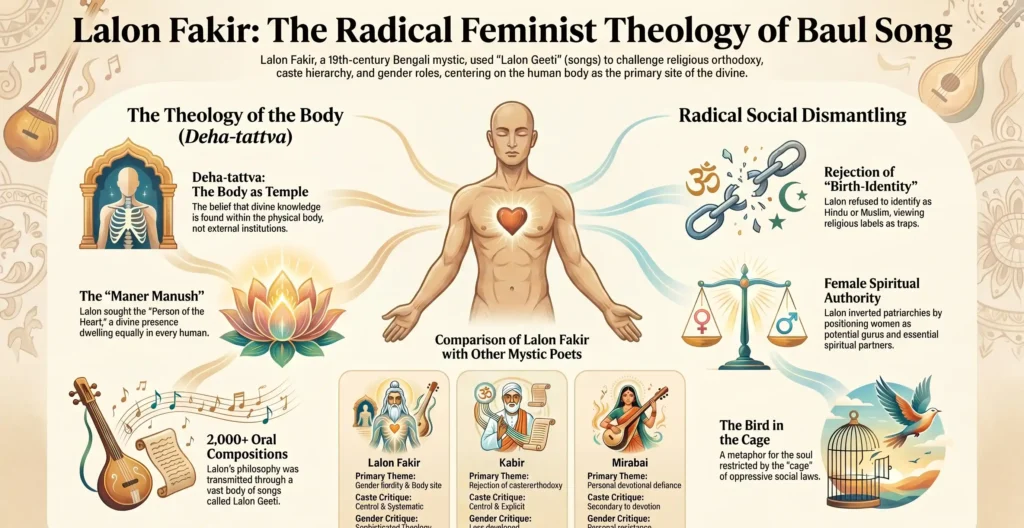
The theological foundation of Lalon’s feminist critique is his understanding of the human body as the primary site of the divine, a concept he expresses in the Baul philosophical vocabulary as Deha-tattva, the philosophy of the body.
The established religious traditions of Bengal in the nineteenth century, both the Hindu Brahminical tradition and the Islamic tradition as it was institutionally practiced, shared a fundamental agreement on one point despite their disagreements on most others: the female body was a source of spiritual danger that required management, restriction, and subordination to male religious authority. In the Hindu tradition, this manifested through caste-based rules about female purity and pollution, through restrictions on women’s participation in ritual, and through the theological framework in which women’s spiritual liberation was understood to depend on their correct performance of wifely duty rather than on any direct relationship with the divine. In the Islamic tradition as institutionally practiced in the Bengal of Lalon’s time, the restrictions on women’s public participation in religious life and the theological positioning of women’s spiritual status as derivative of their relationship to male family members served similar functions of subordination through different mechanisms.
Lalon rejected both frameworks with equal thoroughness through the single move of insisting that the divine is located in the body and that the body’s natural state is one of equivalence across all the social distinctions that have been imposed on it.
If the divine is in the body, and all bodies equally contain the divine, then the female body is as much a temple as the male body. If all bodies equally contain the divine, then the religious traditions that restrict women’s access to the divine through their bodies are not describing a theological reality. They are constructing a social one, and constructing it in the interests of those who benefit from the restriction.
This argument appears across Lalon’s songs in multiple registers and through multiple metaphors. It appears as the image of the Maner Manush, the person of the heart, who dwells equally in every human body regardless of gender or caste. It appears as the Baul concept of Sadhana, the spiritual practice centred on the body, which Lalon’s songs consistently present as available to women as well as men, as requiring female practitioners as necessary partners rather than as subordinate students. It appears as the repeated insistence that the guru, the teacher, the source of spiritual knowledge, can be found in any body, including and specifically including the bodies of those whom the dominant social order has classified as inferior.
The song that contains the line Shabar upare manush satya, meaning above all else the human being is truth, attributed to Lalon in the Bengali devotional tradition, is perhaps the most concentrated single expression of this theological democratisation. It is addressed to no specific gender. It asserts the primacy of the human being as such, the human being as a category that precedes and exceeds all the social distinctions imposed on it, as the ultimate spiritual reality.
The Deha-tattva philosophy of the Baul tradition and its specific expressions in Lalon’s songs have been examined in scholarly work published through the Journal of the Royal Asiatic Society and through academic presses including Orient Blackswan, whose publications on Bengali religious and cultural history provide the most authoritative available English-language scholarship on the Baul philosophical tradition and its relationship to the broader landscape of South Asian mystical thought.
The Songs About the Birdcage
Some of Lalon’s most celebrated and most philosophically dense songs use the image of a bird in a cage to explore the relationship between the soul, the body, and the social structures that restrict both. These songs have been read primarily as meditations on death and liberation, the bird as the soul and the cage as the body from which it will eventually be released. This reading is not wrong. It is also incomplete.
The cage in Lalon’s songs is not only the body. It is also the social body, the network of rules and restrictions and prescribed roles that the dominant culture constructs around the individual body and calls dharma or shariat or respectability or correct behaviour for a woman of your station. The bird that cannot fly is not only the soul awaiting death. It is the woman whose capacities and whose spiritual life are constrained by the social structures that have been built around her body and presented to her as the natural order of things.
When Lalon asks, in one of his most famous compositions, who built this cage and who keeps the bird inside, the question has an obvious metaphysical dimension. It also has an obvious social one, and in nineteenth century Bengal, where the question of who keeps women inside the restrictions placed on their bodies and their spiritual lives was an extremely pressing political question, the social dimension of Lalon’s birdcage imagery was not available to be missed by anyone paying attention.
The women who sang Lalon’s songs, who carried them through the villages of Bengal in the nineteenth and early twentieth centuries, were paying attention. The Baul women practitioners who incorporated his compositions into their own spiritual practice understood the birdcage songs not only as meditations on the soul but as commentary on their own specific social situation, and they used them, in the way that subordinated communities have always used the arts available to them, as a language for naming their experience that the dominant culture could not quite bring itself to suppress because it was expressed in terms that the dominant culture recognised as spiritual rather than political.
The distinction between spiritual and political is one that the dominant culture maintains with considerable anxiety because the dissolution of that distinction is one of the most powerful tools available to movements for social change. Lalon’s songs dissolve it in every line.
The Guru Who Could Be Anyone
One of the most radical feminist propositions in the entire body of Lalon’s work is his insistence on the possibility, and in some songs the necessity, of a female guru. The guru in the Indian spiritual tradition is the teacher whose direct transmission of knowledge to the student is the mechanism through which spiritual realisation is achieved. In the dominant understanding of both Hindu and Muslim spiritual traditions in nineteenth century Bengal, the guru was male. The spiritual authority that the guru embodied was understood as inherently masculine, associated with the social authority of the Brahmin priest and the Islamic imam through which its transmission flowed.
Lalon systematically dismantled this assumption through his consistent presentation of the guru as the Maner Manush, the divine person who dwells within the human body, who can be encountered in any body regardless of gender, caste, or religious identity, and who must be recognised through the quality of direct spiritual experience rather than through the social credentials of birth or institutional ordination.
The specific Baul practice that this philosophy generates, in which the female practitioner is understood as a potential vehicle of the highest spiritual knowledge and in which the male practitioner’s relationship with a female spiritual partner is understood as a necessary dimension of the most advanced Sadhana, is one of the most contested and most misrepresented aspects of the Baul tradition in both popular and scholarly accounts. The misrepresentation typically takes one of two forms: either the practice is sanitised into a purely metaphorical partnership that has no actual embodied dimension, which erases its most radical implications, or it is reduced to a form of sexual exploitation in which the female practitioner is a passive instrument of the male practitioner’s spiritual advancement, which reverses its actual philosophical structure.
What Lalon’s songs describe, when examined without the distorting lens of either sanitisation or reduction, is a spiritual practice in which the female body is understood as a vehicle of divine knowledge that the male practitioner must approach with a quality of receptive attention that inverts the usual hierarchy of teacher and student, of active and passive, of knower and known. The woman in this framework is not the object of the man’s spiritual practice. She is its teacher.
This is a radical proposition. It was radical in nineteenth century Bengal. It remains radical in any context where the assumption that spiritual knowledge flows from male to female, from institutional authority to lay recipient, from the socially empowered to the socially subordinated, is taken for granted.
The Baul women who practiced within the tradition that Lalon established understood their position in it as one of spiritual authority rather than spiritual service, and the songs that Lalon composed gave them a language for that authority that was simultaneously available to them and unavailable to suppression by the dominant religious institutions, because it was expressed in the vernacular register of folk song rather than in the Sanskrit or Arabic of institutionally authorised religious discourse.
The scholarly examination of gender and spiritual authority in the Baul tradition has been most rigorously pursued by scholars including Jeanne Openshaw, whose research published through Cambridge University Press provides the most thorough available English-language analysis of the gender dimensions of Baul practice and their relationship to the philosophical framework of Lalon’s compositions.
Who Made You a Hindu and Who Made You a Muslim
The most immediately accessible feminist dimension of Lalon’s songs is their systematic demolition of religious identity as a meaningful category of human self-understanding. The connection between this demolition and feminist politics requires some explanation, because the link is not always made explicit in accounts of Lalon’s religious radicalism.
The religious identity systems of nineteenth century Bengal, both Hindu and Muslim, were patriarchal in their structure in ways that were not accidental but functional. Religious identity was transmitted through the male line, enforced through male religious authority, and expressed through practices that consistently positioned women as objects of religious regulation rather than subjects of religious life. A woman’s religious identity determined the specific form of her subordination, but the subordination itself was a feature of the religious identity system as such rather than a variation between systems.
When Lalon asks, in one of his most celebrated songs, who made you a Hindu, who made you a Muslim, where were these distinctions when you were born and where will they be when you die, he is asking a question that is simultaneously about religious identity and about gender. The body that exists before the imposition of religious identity, that exists after the stripping away of all social categories in the moment of death, is a body without gender hierarchy as well as without caste or religious hierarchy. The stripped-down human body in Lalon’s theological imagination is equal across all the dimensions on which the social order ranks and restricts.
The specific song Shob loke koy Lalon ki jat shongshare, meaning everyone asks what is Lalon’s caste in this world, is perhaps his most direct engagement with the politics of identity. In it, Lalon refuses to answer the question of his caste or religious identity not because he does not know the answer but because he understands the question itself as a trap, as an invitation to participate in a system of categorisation that he has rejected at its foundation.
The refusal to participate in identity categorisation is itself a feminist act in the context of nineteenth century Bengal, where the categorisation of women by caste and religious identity was one of the primary mechanisms through which their subordination was maintained and justified. A philosophy that makes all identity categorisation theologically illegitimate necessarily makes the gender-specific applications of that categorisation equally illegitimate.
Lalon did not make this connection explicitly in the terms of a gender analysis because those terms were not available to him in the form they are available to us. But the connection is present in the logic of the songs, and the women who sang them, who lived the specific intersection of gender and caste and religious identity that Lalon’s philosophy was systematically dismantling, understood the connection with a clarity that the male scholars who first documented the tradition did not always share.
How Swami Vivekananda Brought Vedanta to the Modern World
The Fluid Body and the Fixed Society
Among the most philosophically sophisticated dimensions of Lalon’s feminist theology is his engagement with the question of gender itself as a category, not only as a social category but as a bodily one. The Baul tradition’s understanding of the body as a site of spiritual practice, combined with the Tantric currents that flow through Lalon’s work, generates a set of propositions about gender that go considerably beyond the assertion that men and women are spiritually equal.
The Deha-tattva philosophy that underlies Lalon’s songs understands the human body as containing within it both masculine and feminine principles, called Purush and Prakriti in the Sanskrit vocabulary that Lalon draws on alongside the Sufi and indigenous Bengali vocabularies he uses with equal freedom. The spiritual practice that the Baul tradition prescribes is understood as a process of bringing these principles into a specific relationship within the practitioner’s body, a relationship that dissolves the rigid distinction between masculine and feminine rather than simply asserting the equality of men and women as they are socially defined.
This understanding of gender as fluid, as a set of principles in dynamic relationship within each body rather than as a fixed binary characteristic of bodies, is philosophically ahead of most contemporary gender theory and was completely foreign to the religious and social institutions of nineteenth century Bengal. Its implications for the status of women are radical in a specific and precise way: if gender is fluid and internally multiple rather than fixed and binary, then the entire social architecture built on the assumption of fixed gender difference, the architecture that assigns different roles, different rights, different spiritual statuses, and different social values to bodies classified as male or female, is built on a false foundation.
Lalon did not use the language of gender theory to make this argument. He used the language of Baul song, which is simultaneously more accessible and more philosophically dense than academic discourse, because it communicates through the full range of human experience, through music and metaphor and the specific quality of emotional recognition that a great song produces, rather than through the abstract propositions of philosophical argument.
But the argument is there, in every song that treats the body as a site of the divine whose gendering is a social imposition rather than a theological reality, in every song that presents the female practitioner as a vehicle of spiritual knowledge rather than an object of spiritual regulation, in every song that asks who built the categories you live inside and why you are afraid to question them.
The Tagore Connection
The relationship between Lalon Fakir and Rabindranath Tagore is one of the most significant and most underexamined connections in the history of South Asian literature, and it has a specific relevance to the feminist dimensions of Lalon’s work that is worth examining carefully.
Tagore encountered the Baul tradition, and Lalon’s songs specifically, through his estate at Shilaidaha on the Padma river in what is now Bangladesh, where his interactions with the Baul communities of the region began in the 1890s and continued across several decades of his creative life. He acknowledged the influence of Baul music and philosophy on his own work, including the Gitanjali poems that won him the Nobel Prize for Literature in 1913, and he actively worked to bring the Baul tradition to wider attention through his writing and through the Poush Mela at Shantiniketan that the earlier article in this series has examined.
What is less frequently noted is the specific nature of what Tagore took from Lalon and what he left. The aspects of Lalon’s philosophy that Tagore absorbed most completely were the aesthetic ones, the musical vocabulary, the emotional register of longing and devotion, the image of the Maner Manush as a metaphor for the divine within the human. The aspects he was less comfortable with were the politically radical ones, the systematic demolition of caste identity, the gender fluidity of the Deha-tattva philosophy, the explicit feminist critique of religious hierarchy.
Tagore’s own relationship to caste and gender was considerably more complex and less resolved than Lalon’s, reflecting the specific position of a high-caste Bengali intellectual navigating the reforms of the Bengal Renaissance without fully committing to the social radicalism that the most thoroughgoing application of those reforms would have required. His engagement with Lalon was genuine but selective, and the selection he made was weighted toward the aesthetically and spiritually resonant at the expense of the socially and politically radical.
The feminist dimensions of Lalon’s songs that Tagore absorbed most selectively are precisely the ones that deserve the most attention, because they represent the aspects of Lalon’s thought that were most ahead of their time and that remain most relevant to contemporary conversations about gender, religious authority, and the politics of the body.
The research of scholars including Sudipta Kaviraj, whose work on Bengali literary and intellectual history published through Cambridge University Press and other academic presses provides the most sophisticated available analysis of the relationship between the Baul tradition and the Bengali literary renaissance, illuminates the specific nature of this selective absorption and what it tells us about the limits of even the most progressive nineteenth century Bengali intellectual engagement with questions of gender and caste.
The Women Who Sang and the Men Who Wrote About Them
There is a specific historiographical problem with the account of Lalon Fakir that the scholarly tradition has constructed, and it is a problem with direct feminist implications. The scholarship on Lalon has been produced primarily by men, writing in a tradition that understands the Baul songs primarily as philosophical and theological texts whose gender dimensions are secondary to their mystical and literary significance. The women who sang Lalon’s songs, who carried them through Bengal across the nineteenth and twentieth centuries, who understood their feminist implications from the inside of the experience of being a woman in the social world those songs were critiquing, have been significantly underrepresented in the scholarship.
This underrepresentation has consequences for what the scholarship sees and what it misses. A scholarship that approaches Lalon’s songs primarily as theology tends to see the feminist dimensions as incidental to the theological project rather than as central to it. A scholarship informed by the experience of the women who sang those songs, who used them as a language for naming and resisting their own specific social situation, tends to see the feminist dimensions as the most politically live and the most historically significant aspect of the entire body of work.
The recovery of the women’s perspective on Lalon is one of the most important tasks facing the scholarship on the Baul tradition, and it requires both archival work, recovering the accounts of female practitioners that exist in regional archives and oral history collections across Bengal and Bangladesh, and interpretive work, reading the songs themselves through the lens of the specific social experience of the women who sang them.
This work is beginning. Scholars including Carol Salomon, whose research on Baul songs and their female practitioners has been published through academic journals including the Journal of South Asian Literature, and Saymon Zakaria, whose work on Baul tradition in Bangladesh draws extensively on community accounts and oral testimony, have begun to develop the scholarly framework through which the feminist dimensions of Lalon’s work can be properly understood. But the work is far from complete, and the gap between what the scholarship currently understands and what the women who sang these songs always knew remains substantial.
The Fearless Verses of Kabir That Challenged Orthodox Society
What the Songs Actually Say
To make the feminist theology of Lalon’s songs concrete rather than purely abstract, it is worth examining specific elements of specific songs with the attention they deserve.
The song Manush bhaje manush haye, meaning worship the human being by becoming fully human, contains within its simple imperative a radical theological proposition: that the object of worship is the human being, not any institutionally mediated deity, and that the method of worship is the fullest possible realisation of one’s own humanity. In nineteenth century Bengal, where the fullest possible realisation of a woman’s humanity was constrained by every major institution of religious and social life, this song’s invitation to worship through becoming fully human was an invitation that could not be genuinely extended to women without simultaneously becoming an indictment of the institutions that restricted their humanity.
Lalon knew this. The song does not say so explicitly. The song does not need to say so explicitly, because the women who sang it were living the gap between its invitation and their social reality, and the song gave them a language for understanding that gap as a theological problem rather than a natural condition.
The song Duto nayan ek haye jay, meaning two eyes become one, uses the imagery of the dissolution of duality to describe the spiritual state of realisation. The duality that dissolves in the song is presented as the duality between self and other, between the practitioner and the divine. But in the context of Lalon’s consistent engagement with gender dualism as a social imposition rather than a natural reality, the dissolution of duality in this song resonates also with the dissolution of the rigid gender binary that the dominant social order maintained through every institutional mechanism available to it.
The song Amar shona monero manush, meaning the golden person of my heart, is addressed to the Maner Manush, the divine presence within the human body, using the term of address that in ordinary Bengali usage would be applied between lovers. The gender of the Maner Manush in this song is deliberately ambiguous, a feature that is not a translation problem but a philosophical choice. The divine beloved who dwells in the heart does not have a fixed gender, and the practitioner who seeks that beloved is not constrained by the social conventions that regulate gendered desire in the ordinary world.
This deliberate gender ambiguity in the address to the divine beloved is one of the most consistently present feminist features of Lalon’s songs and one of the most consistently underappreciated in the scholarship. In the social world of nineteenth century Bengal, where desire was regulated through strict gender conventions that served the interests of the patriarchal family structure, the presentation of the highest and most legitimate form of desire, the desire of the devotee for the divine, as gender-ambiguous was a genuinely radical act.
The Contemporary Resonance
Lalon Fakir died on 17 October 1890. His songs are still being sung, in the villages of Bengal and Bangladesh, at the Poush Mela at Shantiniketan, in the concert halls and folk music festivals of Dhaka and Kolkata, in the diaspora homes of Bengalis across the world. They are still being sung by women who find in them a language for their own experience that the dominant culture’s official texts do not provide.
The feminist dimensions of Lalon’s songs have found new audiences in the twenty-first century among scholars and activists engaged with the intersections of gender, religion, and social justice in South Asia and beyond. The tradition of gender critique embedded in his songs provides a resource for contemporary feminist discourse that does not require importing Western feminist frameworks into the South Asian context but draws instead on the deepest currents of the South Asian mystical tradition itself.
This is the specific value of Lalon’s feminist theology for the contemporary moment: it demonstrates that the radical critique of gender hierarchy is not a foreign import into South Asian culture but an indigenous South Asian intellectual and spiritual tradition with deep roots, sophisticated philosophical development, and a living community of practice. The women who sing Lalon’s songs today are not adopting a borrowed framework. They are continuing a tradition that is their own.
The Lalon Academy in Kushtia, Bangladesh, which maintains the primary institutional archive of Lalon’s songs and their various transcriptions and scholarly interpretations, provides the most comprehensive available resource for the academic study of Lalon’s work, with published collections of his songs accompanied by scholarly commentary that represents the most authoritative available Bengali-language scholarship on his life and thought.
The broader Baul tradition within which Lalon’s songs circulate and from which they draw their philosophical vocabulary has been documented in its UNESCO dimension through the inscription of Baul music on the Representative List of Intangible Cultural Heritage of Humanity in 2008, a recognition that acknowledges the tradition’s cultural significance at the global level while leaving much of its philosophical depth unexplored in the documentation that accompanies the inscription.
The songs are waiting for the readers and listeners who are ready to hear what they have always been saying. What they have always been saying, in the language of nineteenth century Bengal, in the vocabulary of the Baul tradition, in the specific register of folk song that is simultaneously the most accessible and the most philosophically dense form of cultural expression available, is this: the human body is sacred, the divine is within it, and any institution that uses the categories of gender, caste, or religious identity to restrict access to that divinity is lying about the nature of the divine.
Lalon said it in two thousand songs. He said it without manifestos. He said it without the word feminist. He said it in a language that everyone could sing and that no institution could quite bring itself to silence.
He was right. The songs remain. The institutions he was singing against have transformed and mutated but have not dissolved. The work of the songs continues.
The Compassionate Teachings of Sant Tukaram in Maharashtra
Quick Comparison Table
| Dimension | Lalon Fakir | Kabir | Mirabai | Akka Mahadevi |
| Period | Circa 1774 to 1890, Bengal | Circa 1440 to 1518, Varanasi | Circa 1498 to 1547, Rajputana | Circa 1130 to 1160, Karnataka |
| Tradition | Baul, syncretic Bengal mysticism | Sant tradition, Nirguna Bhakti | Vaishnava Bhakti, Rajput devotional tradition | Lingayat Veerashaiva tradition |
| Primary Language | Bengali | Hindi, Awadhi | Braj Bhasha, Rajasthani | Kannada |
| Caste Critique | Central, systematic, foundational | Central, explicit | Present but secondary to devotional focus | Present through Lingayat rejection of caste |
| Gender Critique | Central, philosophically sophisticated, feminist theology | Present but less developed than Lalon | Central, expressed through personal defiance of gender restriction | Central, expressed through radical renunciation of wifely role |
| Religious Synthesis | Islam, Vaishnavism, Tantra, indigenous Bengali spirituality | Hindu and Islamic mystical traditions | Vaishnava devotionalism with personal mysticism | Shaiva devotionalism with radical social critique |
| Body as Spiritual Site | Central, Deha-tattva philosophy | Present, the body as the temple | Present, the devotional body | Present, the Shiva-filled body |
| UNESCO Recognition | Baul music inscribed 2008 | Not inscribed | Not inscribed | Not inscribed |
Curious Indian: Fast Facts
- Lalon Fakir is believed to have composed over two thousand songs called Lalon Geeti, none of which he wrote down himself, all of which were transmitted orally through his community of disciples and later transcribed by scholars, making the authoritative attribution of specific songs to him a continuing scholarly challenge.
- He deliberately maintained ambiguity about his birth religion throughout his life, stating in documented exchanges with contemporaries that he did not know whether he was Hindu or Muslim and that the question was theologically irrelevant, a position that made him simultaneously revered across religious communities and suspected by the orthodox within each.
- Rabindranath Tagore acknowledged the direct influence of Lalon’s songs on his Nobel Prize-winning Gitanjali poem collection, making Lalon one of the few folk musician-poets whose influence on a Nobel laureate’s work is directly acknowledged by the laureate himself.
- The Deha-tattva philosophy that underlies Lalon’s songs, understanding the human body as the primary site of divine knowledge and spiritual practice, draws simultaneously on Tantric Hindu, Sufi Islamic, and indigenous Bengali spiritual vocabularies in a synthesis that no single tradition fully claims or can fully account for.
- Lalon built a community at Chheuria in what is now Kushtia district of Bangladesh that became the primary institutional centre of his teaching, and the Akhra, the community practice space, that he established there has been continuously maintained across more than a century since his death.
- The UNESCO inscription of Baul music on the Representative List of Intangible Cultural Heritage of Humanity in 2008 was the first international recognition of the tradition that Lalon did more than any other single figure to shape, acknowledging its significance at the global level without adequately representing the philosophical depth that makes it significant.
- Lalon is celebrated with equal intensity in both India and Bangladesh, with the Lalon Academy in Kushtia, Bangladesh maintaining the primary institutional archive of his songs, and the annual Lalon festival at Chheuria drawing pilgrims from across both countries in a continuation of the cross-border community that his teaching established in the nineteenth century.
- The feminist dimensions of Lalon’s songs, including the gender ambiguity of his address to the divine beloved, the insistence on the female body as an equal site of the divine, and the philosophical dissolution of the gender binary through the Deha-tattva framework, have been recognised in Bengali scholarship for several decades but remain almost entirely absent from the English-language academic literature on South Asian religious and cultural history.
- The specific Baul practice associated with Lalon’s philosophical framework, in which the female spiritual practitioner is understood as a potential vehicle of the highest spiritual knowledge, represents one of the most thoroughgoing inversions of the patriarchal spiritual authority structures of nineteenth century Bengal available within any indigenous South Asian tradition.
- Lalon never married in any conventionally recorded sense, lived in a community organised around principles of spiritual equality across gender and caste lines, and composed songs that the women of his community used as a primary language for their own spiritual practice, making his community itself the most concrete expression of the feminist theology his songs articulate.
Conclusion
Lalon Fakir composed over two thousand songs in nineteenth century Bengal and did not title any of them feminist anthems. He did not need to. The women who sang them knew what they were.
They were songs about the sacredness of the body, which in a world that treated the female body as a site of pollution and restriction was itself a political statement. They were songs about the irrelevance of caste and religious identity, which in a world that used those categories to organise and justify women’s subordination was itself a political statement. They were songs about the divine presence that dwells equally in every human body regardless of gender, which in a world that told women their spiritual lives must be mediated by male religious authority was itself a political statement.
Lalon made these statements in the language of Baul song, which is simultaneously the most accessible and the most resistant to institutional suppression of any form of cultural expression available to him. He built a community that practiced what the songs preached, in which women were spiritual authorities rather than spiritual objects, in which the categories of gender and caste and religion were treated as the impositions they are rather than the natural order they were presented as being.
He died in 1890. His songs are still being sung. The institutions he was singing against have evolved and adapted but have not conceded the fundamental point he was making about the equal sacredness of every human body and the theological illegitimacy of every social structure built on denying that equality.
The songs keep making the point. Every performance is a renewal of the argument. Every woman who sings a Lalon Geeti and understands what she is singing is continuing a tradition of feminist theology that is indigenous to South Asia, rooted in its deepest spiritual currents, and more radical in its implications than most of the institutions that claim to represent those currents have ever been willing to acknowledge.
Lalon did not announce revolution. He sang it. He sang it in over two thousand songs, in a language that everyone could understand and that contained, for those willing to listen, a systematic dismantling of everything that the patriarchal religious and social order of his time was built on.
The listening is still available. The songs are still waiting. And the feminist theology they contain, hidden in plain sight in the folk vocabulary of nineteenth century Bengal, is as alive and as necessary as it has ever been.
The Musical Revolution of Chaitanya Mahaprabhu in Medieval India
If you think you have remembered everything about this topic take this QUIZ
Results


#1. In Lalon Fakir’s celebrated “birdcage” songs, what does the bird metaphorically represent beyond just the human soul?
#2. Which fundamental principle of the Deha-tattva philosophy in Lalon’s songs directly challenges the patriarchal religious authority of his era?
#3. How does Lalon’s signature concept of the Maner Manush dismantle standard social hierarchies?
#4. What is the title of Lalon’s famous Bengali song that systematically demolishes caste and religious identity as meaningful human categories?
#5. According to the text, the Deha-tattva philosophy understands gender fluidly by balancing which two cosmic principles within each individual body?
#6. Which primary institutional center located in Kushtia, Bangladesh, maintains the authoritative archive and transcriptions of Lalon’s songs?
#7. According to the Quick Comparison Table, what distinguishes Lalon Fakir from the ancient historical poet Akka Mahadevi?
#8. In which year was Baul music inscribed on the UNESCO Representative List of Intangible Cultural Heritage of Humanity?
Who was Lalon Fakir and why are his songs considered feminist?
Lalon Fakir was the most celebrated poet-musician of the Baul tradition of Bengal, who composed over two thousand songs in the nineteenth century that collectively constitute one of the most radical critiques of religious orthodoxy, caste hierarchy, and gender-based social organisation produced in South Asia. His songs are considered feminist because they systematically dismantle the theological foundations of patriarchal religious authority, presenting the human body as an equally sacred vessel of the divine regardless of gender, arguing for the spiritual authority of female practitioners, maintaining deliberate gender ambiguity in the address to the divine, and philosophically dissolving the rigid gender binary through the Deha-tattva understanding of the body as containing both masculine and feminine principles in dynamic relationship.
What is Deha-tattva and how does it connect to feminist philosophy?
Deha-tattva is the Baul philosophical understanding of the body as the primary site of divine knowledge and spiritual practice, drawing on Tantric Hindu, Sufi Islamic, and indigenous Bengali spiritual vocabularies. Its connection to feminist philosophy lies in its insistence that the divine is located equally in every human body regardless of gender, caste, or religious identity, making any social structure that restricts women’s access to the divine through their bodies theologically illegitimate rather than naturally ordained. By grounding spiritual authority in the body rather than in institutional credentials, Deha-tattva makes the female body as legitimate a site of spiritual authority as the male body, inverting the patriarchal assumption that spiritual knowledge flows from male institutional authority to female lay recipient.
How did Lalon Fakir’s treatment of religious identity connect to his feminist theology?
Lalon’s systematic demolition of religious identity as a meaningful category of human self-understanding is directly connected to his feminist theology because the religious identity systems of nineteenth century Bengal, both Hindu and Muslim, were patriarchal in their structure in ways that were not accidental but functional. Religious identity was transmitted through the male line, enforced through male religious authority, and expressed through practices that consistently positioned women as objects of religious regulation rather than subjects of religious life. By making all religious identity categorisation theologically illegitimate, Lalon simultaneously made the gender-specific applications of that categorisation equally illegitimate, because the subordination of women was not a variation between religious systems but a feature of the religious identity system as such.
What was the role of women practitioners in the Baul tradition as shaped by Lalon?
Within the Baul tradition as shaped by Lalon’s philosophical framework, female practitioners were understood as potential vehicles of the highest spiritual knowledge rather than as subordinate students or passive instruments. The specific Baul practice associated with Lalon’s teaching understood the male practitioner’s relationship with a female spiritual partner as a necessary dimension of the most advanced spiritual work, in which the female practitioner’s body was a site of divine knowledge that the male practitioner must approach with receptive attention rather than instructional authority. This represents one of the most thoroughgoing inversions of patriarchal spiritual authority structures available within any indigenous South Asian tradition and was understood by the Baul women who practiced within it as a position of spiritual authority rather than spiritual service.
How do Lalon’s songs resonate with contemporary feminist discourse?
Lalon’s songs resonate with contemporary feminist discourse in several specific ways. Their insistence that gender is a social imposition on the body rather than a natural feature of the body anticipates contemporary gender theory’s distinction between biological sex and social gender. Their presentation of the female body as an equally sacred site of the divine provides an indigenous South Asian theological resource for feminist challenges to patriarchal religious authority that does not require importing Western feminist frameworks into the South Asian context but draws instead on the deepest currents of the South Asian mystical tradition itself. Their systematic critique of the interlocking systems of gender, caste, and religious identity anticipates intersectional feminist analysis. And their community of practice, in which women were spiritual authorities rather than spiritual objects, provides a historical model for gender-equal spiritual community that the dominant religious traditions of the region have consistently failed to provide.