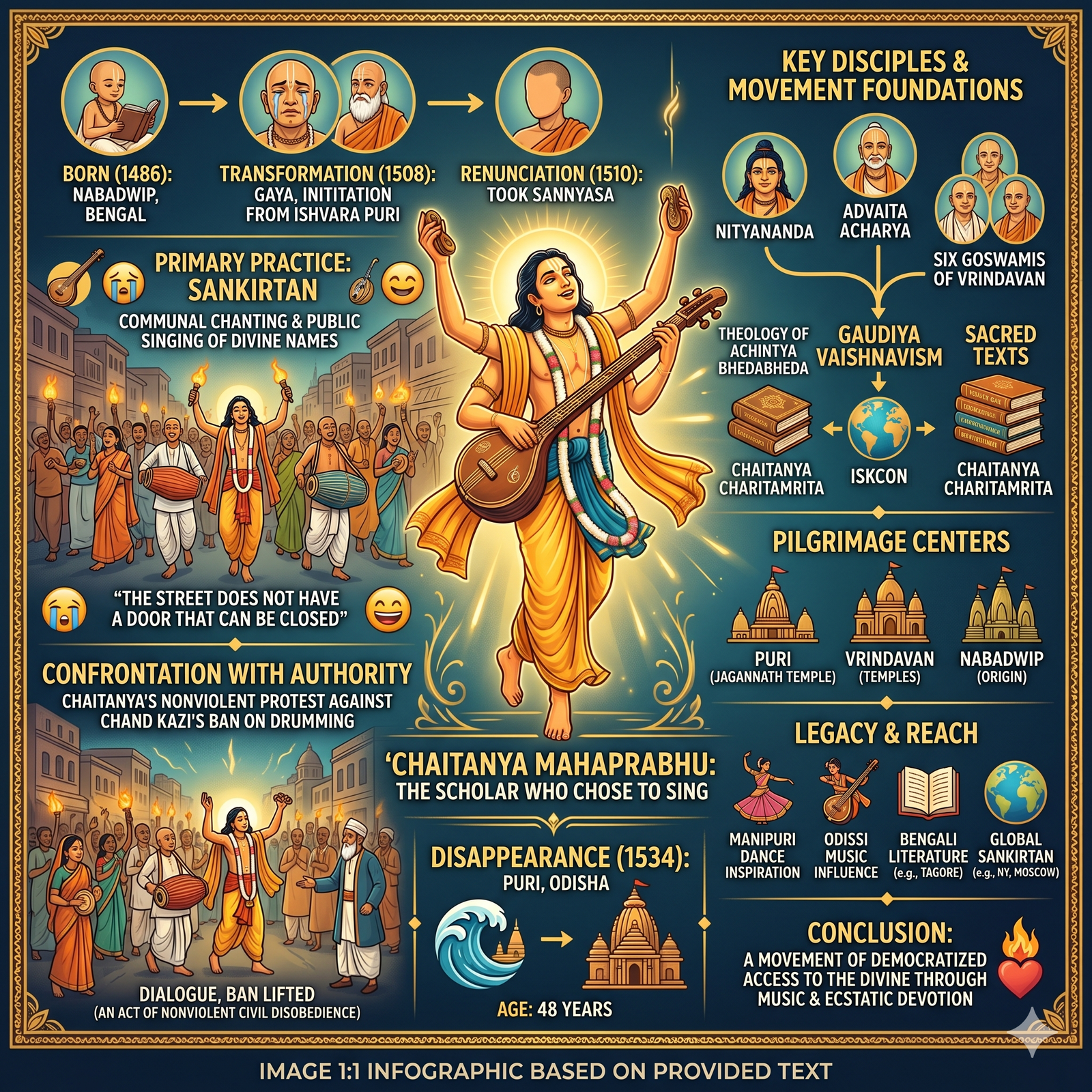
Chaitanya Mahaprabhu was a sixteenth-century Bengali saint and philosopher whose practice of sankirtan, the communal singing and chanting of divine names through public spaces, became the foundation of Gaudiya Vaishnavism and one of the most significant religious and social movements in Indian history. By placing music and ecstatic devotion at the center of spiritual life rather than ritual purity or caste privilege, he democratized access to the divine in a way that no formal theological argument could have achieved. This piece traces how a deeply learned young scholar became the dancing, singing mystic who permanently altered the shape of Indian devotion.| Detail | Information |
| Full Name | Vishvambhar Mishra |
| Spiritual Name | Chaitanya Mahaprabhu |
| Born | February 18, 1486, Nabadwip, Bengal (present-day West Bengal) |
| Died | June 14, 1534, Puri, Odisha |
| Parents | Jagannath Mishra (father), Sachi Devi (mother) |
| Deity of Devotion | Lord Krishna (as Radha Krishna) |
| Movement Founded | Gaudiya Vaishnavism |
| Primary Practice | Sankirtan (congregational chanting and music) |
| Key Disciples | Nityananda, Advaita Acharya, Six Goswamis of Vrindavan |
| Sacred Texts Inspired | Chaitanya Charitamrita, Chaitanya Bhagavata |
| Pilgrimage Centers | Nabadwip, Puri, Vrindavan |
| Age at Death | 48 years |
The Scholar Who Chose to Sing
In the early sixteenth century, Nabadwip was the intellectual capital of Bengal. It was a city of Sanskrit scholars, debaters, and logicians, men who measured their worth by the precision of their arguments and the depth of their command over the Nyaya school of philosophy. To be a respected scholar in Nabadwip was to occupy one of the highest positions available to a learned man in Bengal, and by his early twenties, Vishvambhar Mishra had achieved exactly that. He ran a tol, a Sanskrit school, that attracted students from across the region. He was known as a debater of exceptional sharpness, capable of dismantling any philosophical position put before him with the efficiency of someone who had been doing it since childhood.
Then something happened that Nabadwip’s academic establishment did not have a category for. The scholar came back from a pilgrimage to Gaya in 1508 transformed. He had encountered a Vaishnava saint named Ishvara Puri at Gaya, received initiation from him, and returned to Nabadwip as something entirely different from the man who had left. The debater was gone. In his place was a devotee who wept at the name of Krishna, who could not hear a song about the divine without entering states of ecstatic absorption that observers described with a mixture of awe and bewilderment.
He closed the school. He went into the streets. He began to sing.
How Bulleh Shah’s Poetry Transformed the Sufi World of Punjab
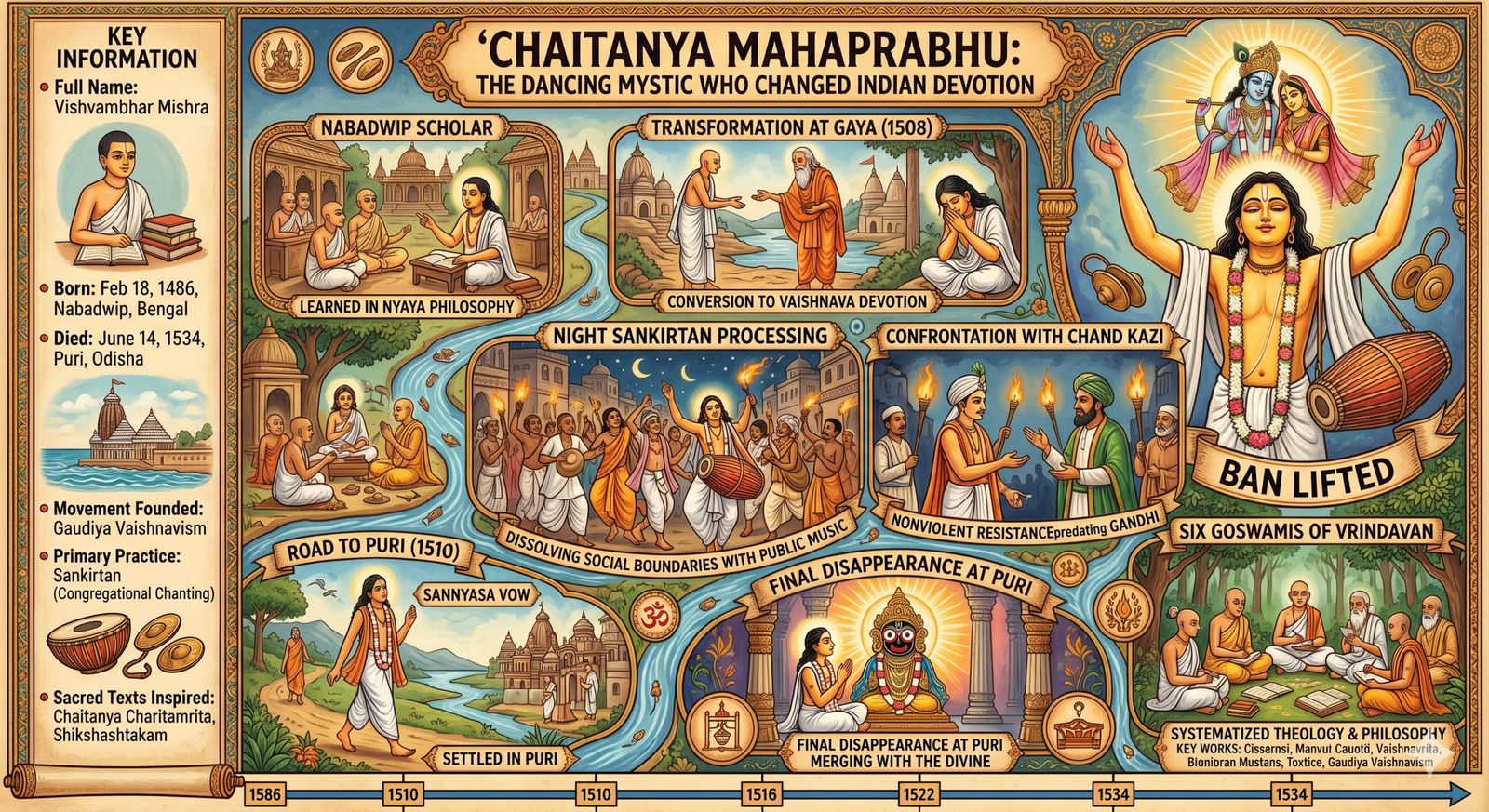
What Sankirtan Actually Was
Before understanding what Chaitanya built, it is worth understanding precisely what sankirtan meant in his hands, because it was not simply singing in the way that word is commonly understood.
Sankirtan, derived from the Sanskrit root meaning to proclaim or celebrate completely, was the practice of moving through public space in a group, singing the names and stories of Krishna with full-voiced intensity, accompanied by the rhythmic percussion of the mridanga drum and the clashing of hand cymbals called karatalas. It was participatory, communal, and deliberately public. It was designed to be heard and joined. It was not a performance for an audience. It was an invitation to a congregation that had no fixed membership requirements.
This last quality was the quietly explosive element. In a society organized around ritual purity and caste hierarchy, where access to temple worship was restricted, where the recitation of sacred texts was the exclusive preserve of Brahmin males, and where the spiritual worth of a human being was considered to be determined by birth, Chaitanya’s sankirtan operated on a completely different principle. The street does not have a door that can be closed. The sound of kirtan cannot be restricted to those with the correct genealogy. Anyone standing within earshot was inside the circle of devotion whether the social order approved or not.
Scholars at the Sahitya Akademi have documented how this structural quality of sankirtan made it one of the most effective instruments of social and spiritual democratization in Indian history, comparable in its impact to Kabir’s use of the doha couplet or Mirabai’s use of the bhajan as vehicles for a devotion that recognized no caste distinction. You can access related scholarly resources at Sahitya Akademi.
The Compassionate Teachings of Sant Tukaram in Maharashtra
The Night Kirtan That Changed Nabadwip
The story most often told about the beginning of Chaitanya’s public movement involves a night kirtan in Nabadwip that contemporaries described as something the city had never experienced before. Chaitanya organized a procession of devotees that moved through the streets of the town after dark, singing the names of Krishna with a collective intensity that drew people out of their houses and into the procession without quite knowing why they had moved.
The accounts preserved in the Chaitanya Bhagavata, composed by his disciple Vrindavan Das Thakur, describe townspeople of every background, including people who had no particular prior interest in Vaishnava devotion, finding themselves weeping and singing alongside the procession as it moved through the lanes. The sound itself seemed to do something to people that intellectual persuasion had not managed to do.
This phenomenon, the capacity of sustained communal music to dissolve social boundaries and produce states of collective emotional openness, is not merely a devotional claim. Musicological research published through the Journal of the Society for American Music and parallel research in the Indian context through institutions like the Sangeet Natak Akademi has documented the neurological and social effects of synchronized group vocalization, finding consistent evidence that communal singing reduces markers of social division and produces measurable shifts in emotional state among participants. Chaitanya intuited this with the precision of someone who understood human beings at a very deep level, and he built a movement on it.
For readers interested in the broader tradition of devotional music in India, the Curious Indian piece on How India’s Devotional Music Traditions Shaped the Subcontinent’s Spiritual Life provides essential historical context.
The Confrontation With Authority
Chaitanya’s public kirtans were not universally welcomed. The Nabadwip establishment, both the Muslim administration of the Nawab Chand Kazi and the conservative elements of the Hindu scholarly community, found the noise, the public ecstasy, and the socially mixed character of the processions difficult to accept.
The Chand Kazi, the local Muslim administrator, issued an order banning the public drumming associated with sankirtan on grounds that it disturbed public order. The response Chaitanya gave to this prohibition has been remembered for five centuries as one of the most elegant acts of nonviolent civil disobedience in Indian history, predating Gandhi’s salt march by four hundred years.
He organized the largest kirtan procession Nabadwip had ever seen, with accounts describing thousands of participants carrying torches through the streets in a river of light and sound. He then went personally to the home of the Chand Kazi and sat in dialogue with him. The conversation that followed, preserved in hagiographic accounts but carrying an internal logic that historians find consistent with the period, ended not in confrontation but in the Kazi’s personal acknowledgment of the beauty and spiritual sincerity of what he had witnessed. The ban was lifted.
Historians who have studied this episode, including scholars whose work is archived through the American Institute of Indian Studies, have noted that Chaitanya’s method of addressing authority through personal dialogue backed by the moral force of mass peaceful assembly was remarkably sophisticated for a religious leader of the early sixteenth century. You can explore the American Institute of Indian Studies’ resources at American Institute of Indian Studies.
Curious Indian’s detailed article on How the Bhakti Saints Challenged Power in Medieval India places this episode within the wider pattern of Bhakti era resistance to institutional authority.
The Renunciation and the Road to Puri
In 1510, at the age of twenty-four, Chaitanya took formal sannyasa, the vow of monastic renunciation. He received the name Krishna Chaitanya and was thereafter known as Chaitanya Mahaprabhu. The renunciation was emotionally devastating for his family, particularly for his mother Sachi Devi and his wife Vishnupriya, but for Chaitanya himself it represented the completion of a transformation that had begun at Gaya two years earlier.
He left Nabadwip and eventually settled in Puri, the ancient coastal city in Odisha that houses the Jagannath temple, one of the four sacred dhams of Hinduism. Puri became his home for the last twenty-four years of his life, and it was from Puri that the most fully developed expressions of his sankirtan movement radiated outward.
His relationship with the Jagannath temple at Puri is one of the most moving dimensions of his story. The temple, ancient and enormous, was a place where caste restrictions were technically observed but where the figure of Jagannath, the Lord of the Universe, had always carried a quality of radical inclusivity embedded in the temple’s own mythology. Chaitanya found in Jagannath a form of the divine perfectly suited to the theology of universal devotion he was living and teaching. His ecstatic dances before the Jagannath chariot during the annual Rath Yatra festival became legendary, drawing crowds who came not just to see the chariot but to watch the saint absorbed in a devotion that seemed to exceed the ordinary boundaries of the human.
UNESCO has recognized the Rath Yatra of Puri as one of India’s most significant expressions of intangible cultural heritage, and the tradition’s continuity across centuries is directly connected to the intensity of devotional engagement that Chaitanya brought to it during his lifetime. You can explore UNESCO’s documentation at UNESCO Intangible Cultural Heritage.
The Six Goswamis and the Architecture of a Movement
One of the most consequential decisions Chaitanya made was to send six of his most learned disciples to Vrindavan to systematize the philosophical and theological foundations of Gaudiya Vaishnavism. These six men, known as the Six Goswamis of Vrindavan, were Rupa Goswami, Sanatana Goswami, Jiva Goswami, Gopala Bhatta Goswami, Raghunatha Bhatta Goswami, and Raghunatha Das Goswami.
Between them they produced an extraordinary body of Sanskrit theological literature that gave Chaitanya’s experiential, music-centered movement the intellectual architecture it needed to survive and expand beyond the lifetime of its founder. Rupa Goswami’s Bhaktirasaamritasindhu, translated into English as the Nectar of Devotion, remains one of the most comprehensive treatises on devotional theology in any religious tradition. Jiva Goswami’s Sandarbhas are among the most sophisticated works of Vaishnava philosophy ever composed.
The combination of Chaitanya’s living, singing, dancing, street-level movement with the Six Goswamis’ intellectual systematization was what gave Gaudiya Vaishnavism its extraordinary resilience. It could speak simultaneously to the illiterate villager moved to tears by a kirtan procession and to the Sanskrit scholar examining the precise philosophical relationship between the individual soul and the supreme consciousness.
This dual capacity, to operate at the level of lived emotional experience and at the level of rigorous philosophical argument, is what distinguished the Gaudiya Vaishnava tradition from other contemporary movements and allowed it to survive, grow, and eventually reach a global audience in the twentieth century through organizations like ISKCON, the International Society for Krishna Consciousness, founded by A.C. Bhaktivedanta Swami Prabhupada in 1966.
Curious Indian’s exploration of The Six Goswamis of Vrindavan and Their Contribution to Indian Philosophy provides a detailed account of the intellectual legacy these disciples built.
The Fearless Verses of Kabir That Challenged Orthodox Society
The Theology Hidden Inside the Music
It would be a mistake to think of Chaitanya’s sankirtan movement as purely emotional or anti-intellectual. The music carried a precise theology inside it, one that Chaitanya articulated in the few written works attributed directly to him, most notably the eight verses of the Shikshashtakam, which represent the only compositions in his own hand that have survived.
The Shikshashtakam describes a progression of devotional states from the initial cleansing of the heart through the chanting of the divine name to the final state of complete surrender in which the devotee desires nothing for themselves and exists entirely in relationship with the beloved Krishna. This is sophisticated devotional psychology, and it maps precisely onto the experience that sankirtan was designed to produce.
The theology of Achintya Bhedabheda, the doctrine of inconceivable simultaneous difference and non-difference between the individual soul and the supreme, which Chaitanya’s Goswami disciples systematized into formal philosophy, was already present in embryonic form in the way Chaitanya sang. He sang as a devotee separate from Krishna, yearning for Krishna, because the yearning itself was the devotional state he valued above all others. The mood he inhabited and cultivated was that of Radha, the supreme devotee, eternally in loving separation from and union with Krishna simultaneously.
This theological subtlety, the idea that the highest spiritual state is not absorption into a formless absolute but an eternal loving relationship with a personal god, represented a significant departure from the Advaita Vedanta of Shankaracharya that had dominated Indian philosophical discourse. It gave the Gaudiya tradition its distinctive emotional and devotional character, and it is what made sankirtan not just a social practice but a precise spiritual technology.
The tank built at the center of Nabadwip remains an architectural testament to the community gatherings of the era. The Indira Gandhi National Centre for the Arts has published significant research on the philosophical dimensions of Chaitanya’s movement and its relationship to the broader Bhakti period in Indian intellectual history. That resource is available at Indira Gandhi National Centre for the Arts.
Chaitanya’s movement also directly influenced the development of Manipuri classical dance, Odissi music traditions, and the devotional poetry of Bengal in ways that the Archaeological Survey of India has documented through its studies of temple culture and performing arts heritage across eastern India. You can access their records at Archaeological Survey of India.
The Disappearance at Puri
Chaitanya died in Puri in 1534 at the age of forty-eight, though the circumstances of his death remain one of the quietly unresolved mysteries of Indian religious history. Some accounts describe a gradual physical decline in his final years, during which the ecstatic states he had experienced throughout his life became more continuous and more intense, as though the boundary between his personal consciousness and the consciousness he had devoted his life to was thinning progressively.
Other accounts, preserved within the Gaudiya Vaishnava tradition itself, describe his final disappearance as a merging with the Jagannath deity during a moment of intense devotional absorption at the Puri temple, a departure from visible existence that mirrors the accounts of Mirabai at Dwarka and reflects the tradition’s understanding that complete devotional surrender ultimately dissolves the distinction between the devotee and the divine.
What is historically certain is that after 1534 there are no further accounts of his presence, and that the movement he had set in motion continued to expand through his disciples and their disciples with a momentum that has not fully stopped in the five centuries since.
How Baba Farid Wove Spiritual Truths Into Early Punjabi Literature
The Sound That Did Not Stop
The most remarkable thing about what Chaitanya began is that it is still audible. The mridanga and the karatalas he made central to his movement still sound in temple courtyards across Bengal, Odisha, Vrindavan, and Manipur every day. The Hare Krishna movement, which carries his theology and his musical practice to countries that the sixteenth-century Bengali saint could not have imagined, has taken sankirtan to the streets of New York, London, Moscow, and Sydney.
He started with a group of devotees and a drum in the lanes of Nabadwip. The sound has been traveling outward ever since.
Quick Comparison Table
| Aspect | Chaitanya Mahaprabhu | Kabir | Tukaram |
| Era | 15th to 16th century | 15th to 16th century | 17th century |
| Region | Bengal, Odisha | Uttar Pradesh | Maharashtra |
| Primary Medium | Sankirtan, music, dance | Doha couplets, oral poetry | Abhangas, devotional songs |
| Deity of Devotion | Radha Krishna | Formless divine, Ram | Vithoba of Pandharpur |
| Social Challenge | Caste in temple worship and devotion | Religious hypocrisy and caste division | Brahminical exclusivity in Maharashtra |
| Institutional Legacy | Gaudiya Vaishnavism, ISKCON | Kabir Panth | Varkari tradition |
| Literary Legacy | Shikshashtakam, through Six Goswamis | Bijak, Kabir Granthavali | Gatha of Tukaram |
| Geographic Reach | Bengal, Odisha, Vrindavan, global via ISKCON | North India, diaspora communities | Maharashtra, Varkari pilgrimage |
Curious Indian: Fast Facts
- Chaitanya is believed by his followers to be a dual incarnation of both Radha and Krishna in a single form, which is why his movement places such emphasis on the Radha Krishna relationship as the highest expression of devotional love.
- He was a child prodigy in Sanskrit grammar and logic who reportedly defeated established scholars in debate while still a teenager, making his later abandonment of academic prestige all the more striking to contemporaries.
- The mridanga drum and karatalas hand cymbals that Chaitanya made central to his sankirtan practice remain the defining musical instruments of Gaudiya Vaishnava worship worldwide five hundred years after his lifetime.
- His disciple Nityananda, known as Nitai, was the companion who accompanied him most closely in the street kirtans of Nabadwip and whose own personality of unconditional love and inclusivity complemented Chaitanya’s ecstatic devotion.
- The Manipuri classical dance tradition, one of India’s eight classical dance forms, traces its deepest devotional inspiration directly to Chaitanya’s influence on Vaishnava culture in northeastern India.
- A.C. Bhaktivedanta Swami Prabhupada, who founded ISKCON in New York in 1966, explicitly understood his mission as the fulfillment of Chaitanya’s own stated desire to spread the sankirtan movement to every town and village in the world.
- Chaitanya’s mother Sachi Devi, who lived to an advanced age after his renunciation, is herself venerated within the Gaudiya tradition as a figure of extraordinary devotion and maternal love.
- The Chaitanya Charitamrita, composed by Krishnadasa Kaviraja Goswami in the late sixteenth century, is considered the most authoritative biography of Chaitanya and is itself regarded as a sacred text within the Gaudiya tradition.
- His influence on Bengali literature and culture extended far beyond religion, shaping the aesthetic sensibility of Bengal for centuries and leaving traces in the work of figures as different as Rabindranath Tagore and Bankimchandra Chattopadhyay.
- The annual Rath Yatra at Puri, during which Chaitanya’s ecstatic dances before the chariot became legendary in his own lifetime, now draws an estimated one million pilgrims each year and has been replicated in cities across the world by ISKCON communities.
Conclusion
Chaitanya Mahaprabhu understood something about music that most social reformers of his era did not. He understood that the architecture of a song is more democratic than the architecture of an argument. An argument requires a shared language, a shared set of premises, and a willingness to engage on intellectual terms. A song moving through a street at night requires nothing except ears and a heart that has not completely closed itself.
He used that understanding to build something that no court, no army, and no institutional structure could have built: a movement that entered people through their senses before they had time to check the entrant against the guest list of caste and social propriety. By the time a person standing in a street in sixteenth-century Nabadwip realized that the procession moving past them included people of every social category singing together without hierarchy, they were already part of it.
That was not an accident. That was the design.
The theology he carried and the philosophy his Goswami disciples systematized into one of India’s most intellectually sophisticated devotional traditions gave the movement its durability. But its initial force, the force that cracked open a socially rigid world and let something larger through, came from the music. From the mridanga and the karatalas and the human voice lifted in the name of Krishna on a night in Nabadwip when a former scholar decided that singing was a more honest response to the divine than debating.
Five centuries of unbroken practice suggest he was right.
How R.K. Narayan Built Malgudi From Real Memories
If you think you have remembered everything about this topic take this QUIZ
This quiz no longer existsWho was Chaitanya Mahaprabhu and why is he historically significant?
Chaitanya Mahaprabhu was a sixteenth-century Bengali saint, mystic, and philosopher born in Nabadwip in 1486 who founded the Gaudiya Vaishnava tradition and transformed Indian devotional life through his practice of sankirtan, the congregational singing of divine names. He is historically significant for several reasons simultaneously. He democratized devotional practice by making music in public space the primary vehicle of spiritual life, effectively removing caste as a prerequisite for participation in worship. He inspired a body of theological and philosophical literature through his disciples that represents one of the most sophisticated developments of devotional philosophy in Indian intellectual history. And he initiated a movement whose living continuity, from the Bengal Vaishnava tradition through to ISKCON’s global operations today, makes him one of the most consequential religious figures of the medieval period.
What is sankirtan and how did Chaitanya use it as a spiritual and social tool?
Sankirtan is the practice of congregational singing of the names and stories of the divine in public space, accompanied by drums and hand cymbals. Chaitanya elevated it from a devotional practice that existed within the broader Vaishnava tradition to the central spiritual method of his movement. He used it as a social tool by insisting that it happen in streets and public spaces accessible to everyone regardless of caste, effectively creating a form of collective worship from which no one could be officially excluded by birth. The participatory and auditory nature of sankirtan meant that its reach extended beyond willing participants to include bystanders who were drawn into the devotional atmosphere by proximity and sound. Chaitanya understood that this structural openness made sankirtan uniquely suited to his theological conviction that devotion to Krishna was the natural right of every human soul.
What was Chaitanya’s relationship with the caste system?
Chaitanya did not mount a systematic theoretical critique of the caste system in the manner of a modern social reformer. Instead he consistently acted in ways that made caste irrelevant within the space of devotional practice. He received people of all castes as spiritual equals within the sankirtan circle. He embraced and elevated disciples from lower castes, most famously Haridasa Thakur, a Muslim by birth who became one of his closest associates and whom he honored with the title Namacharya, the master of the holy name. He engaged with the Chand Kazi, a Muslim administrator, through personal dialogue rather than religious confrontation. His approach was practical and experiential rather than theoretical, which arguably made it more effective than argument could have been in the social context of sixteenth-century Bengal.
How did Chaitanya’s movement influence later Indian history and culture?
Chaitanya’s movement influenced Indian history and culture across multiple dimensions. Religiously, it established Gaudiya Vaishnavism as one of the major living traditions of Hinduism, with a continuous institutional presence in Bengal, Odisha, Vrindavan, and Manipur as well as a global presence through ISKCON. Culturally, it shaped the devotional music, poetry, and dance traditions of eastern India for five centuries, leaving traces in Manipuri classical dance, Odissi music, and Bengali devotional literature. Intellectually, the philosophical works of the Six Goswamis contributed substantially to the development of Indian aesthetic theory, particularly in the area of rasa theory as applied to devotional experience. Socially, the tradition’s consistent emphasis on devotional equality across caste lines contributed to a broader culture of devotional inclusivity in the regions most directly influenced by Chaitanya’s teaching.
What is the connection between Chaitanya Mahaprabhu and the modern Hare Krishna movement?
The modern Hare Krishna movement, formally known as the International Society for Krishna Consciousness or ISKCON, was founded in New York in 1966 by A.C. Bhaktivedanta Swami Prabhupada, a Bengali Vaishnava who understood his mission explicitly as the fulfillment of Chaitanya’s own stated desire to spread the sankirtan movement to every town and village in the world. ISKCON follows the Gaudiya Vaishnava theology systematized by Chaitanya’s Six Goswami disciples, uses the mridanga and karatalas in its public sankirtan in direct continuity with Chaitanya’s practice, and regards Chaitanya as the supreme avatara of the current age. The Hare Krishna maha-mantra that ISKCON devotees chant publicly is the same mantra that Chaitanya identified as the most powerful vehicle of devotion for the present era, making the connection between the sixteenth-century Bengali saint and the globally visible modern movement one of the most direct lineage relationships in the history of Indian religion.