
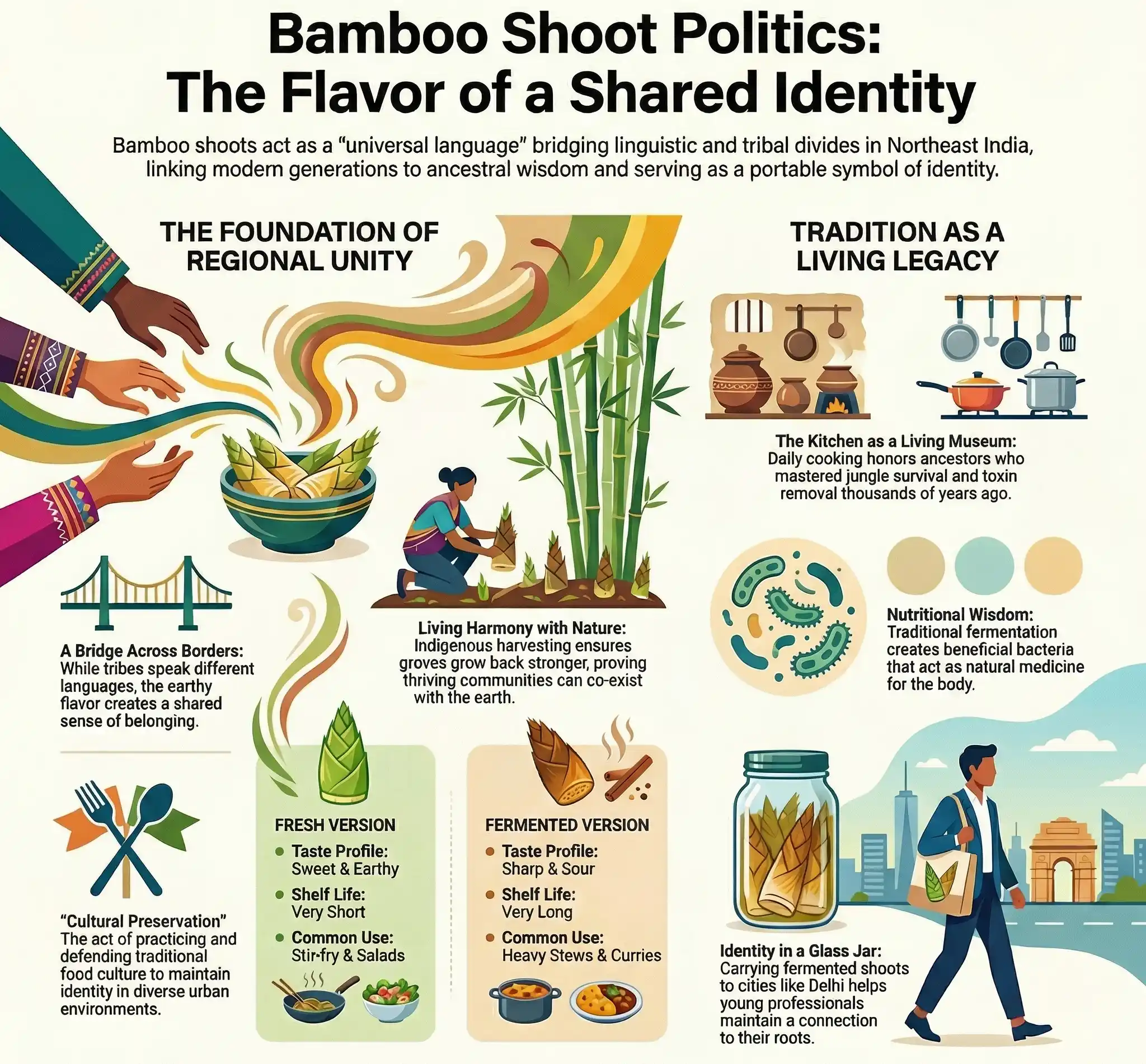
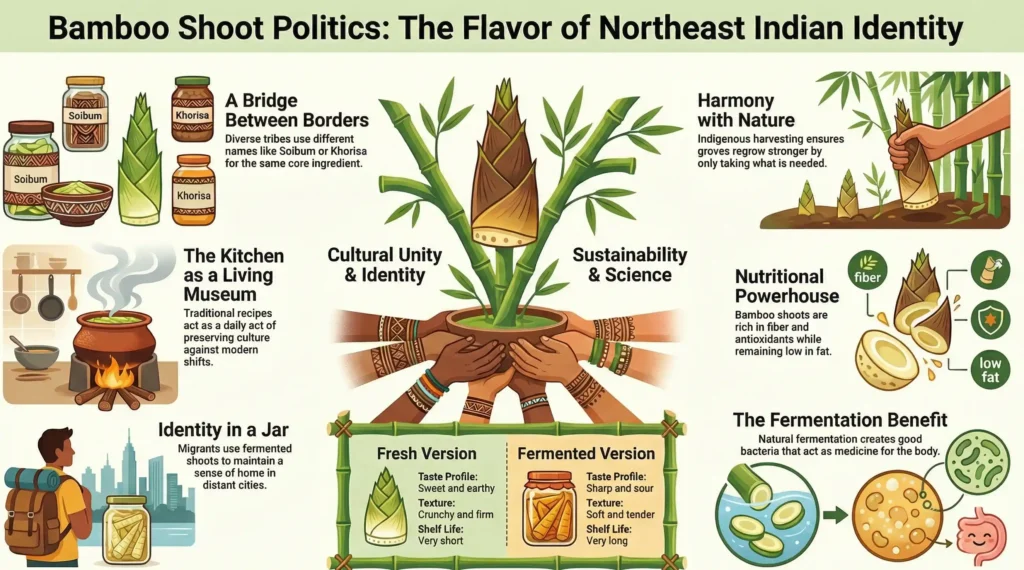
Fermented bamboo shoot tastes of home to millions in the north-east. In Delhi, for years, it was also the smell that got young people from the region into trouble with their landlords, and even into a police booklet
When a young person from Nagaland, Manipur or Assam packs to leave for college in Delhi or a job in Bengaluru, there is very often a jar in the suitcase.
Inside it is fermented bamboo shoot. It goes by different names across the region: khorisa in Assamese, soibum or soidon in Manipur, lung seij in Khasi, tama in Nepali. It comes wet and chunky, or sun-dried into threads, or smoked into curls. It goes into pork and fish, into chutneys, into the Manipuri mash called eromba. It is sour, earthy and strong.
And it smells. For the people who grew up with it, it smells like home. For almost everybody else, the first time, it smells like something has gone badly wrong.
For the people who grew up with it, it smells like home. For almost everybody else, the first time, it smells like something has gone wrong.
Shoot eaters
In the north-east, bamboo shoot is not a side dish. It is part of who people are. The Lotha Nagas, whose villages include Pangti, where the Amur falcons roost, even call themselves Rhuchak Etsoi: the fermented bamboo shoot eaters.
Making it is slow, patient work, and in many communities the knowledge of how to do it is held mostly by women. Fresh shoots are cut from the forest in the rainy season, peeled, sliced, and packed away to sour for weeks or months. Every family, every village, has its own way.
How Kiran Mazumdar Shaw Built Biocon From a Garage in Bengaluru
The Secret Letters Between G.D. Birla and Mahatma Gandhi
The flat in Delhi
Then the jar reaches the city.
The anthropologist Dolly Kikon, who studied in Delhi in the mid-1990s, has written about the anxiety of those years. Students from the north-east wanted to cook the food they had grown up with, and were afraid of what would happen if they did. So they improvised. One trick she remembers was soaking fermented soybeans in hot water before cooking, to take the edge off the smell.
It was not always enough. Neighbours complained, and landlords harassed their tenants. For young people from the region who were already singled out for their faces and their clothes, the food they had carried from home became one more thing to be harassed for.
The booklet
In 2007, a senior police officer from Arunachal Pradesh, Robin Hibu, put together a booklet for the Delhi Police called Security Tips for Northeast Students and Visitors in Delhi. It was meant to help. It gave advice on staying safe in the city, and on fitting in.
One line in it became famous. Bamboo shoot, akhuni and other “smelly dishes should be prepared without creating ruckus in neighbourhood.”
Hibu said he meant it as brotherly advice, from someone who knew what it was like. Many people from the north-east did not see it that way. To them, it looked as if the police were telling the people being harassed to change what they ate, instead of telling the people doing the harassing to change how they behaved.
To many, it looked as if the police were telling the people being harassed to change what they ate.
Struggle of Walchand Hirachand Against British Shipping Laws
The committee
Seven years later, in January 2014, a young man from Arunachal Pradesh, Nido Tania, was beaten in a Delhi market and died. The outcry that followed led the Ministry of Home Affairs to set up a committee, chaired by M.P. Bezbaruah, to look into the problems faced by people from the north-east living in other parts of India.
Among everything else in its report, the committee recorded what the students had been saying for years. Many landlords, it was told, thought of people from the north-east as difficult tenants because of their food habits, and resented the pungent smell of cooking with fermented bamboo shoots or soybeans.
A jar of bamboo shoot had made it into a government report.
The restaurant
Things have changed, slowly. The 2019 film Axone told the story of a group of friends from the north-east trying to cook a pungent fermented dish in a Delhi flat without upsetting the neighbours, and took that story to audiences across India. Restaurants in Delhi, Mumbai and Goa now put fermented bamboo shoot on their menus as a speciality, and diners who have never been east of Kolkata order it with curiosity.
That is what people mean by bamboo shoot politics. It is not about the shoot itself. It is about who gets to cook what they love in the place where they live, and who has to hide it.
Somewhere tonight, in a rented room in a big city, someone is opening a jar that came in their suitcase. The smell will fill the room. With luck, nobody will knock on the door.
Ram Prasad Bismil: The Last Chapter of India’s Most Fearless Poet
If you think you have remembered everything about this topic take this QUIZ
Results


#1. During which season is the fresh bamboo plant primarily harvested in Northeast India?
#2. What is the traditional name for fermented bamboo shoots used in the state of Manipur?
#3. According to the text, how did ancestors remove natural toxins from wild plants?
#4. Which nutritional benefit is associated with the traditional fermentation of bamboo shoots?
#5. What challenge do young professionals from the Northeast often face when cooking traditional food in big cities?
#6. How does the shelf life of the fermented version of bamboo compare to the fresh version?
#7. In local folk tales, what does the rapid growth of green shoots represent?
#8. How do indigenous communities ensure the bamboo groves grow back stronger the following year?
What exactly does this political food term mean?
It is a thoughtful phrase used to describe how a shared love for a traditional ingredient unites the many different tribes and communities across the northeastern states.
Is it safe to eat the plant raw straight from the forest?
No, it contains natural elements that can be harmful, so it must always be boiled thoroughly or fermented properly before it is eaten.
Why does the fermented version have such a very strong smell?
The unique smell comes from healthy bacteria breaking down the natural sugars during the long preservation process, which is completely natural and safe.
Can people outside the region learn to cook with it?
Absolutely, many friendly chefs encourage trying it in very small amounts to get used to the tangy flavor before adding it to larger curries or stews.
Where can someone buy this ingredient if they live in a big city?
Many specialty grocery stores and online markets now sell both the fresh and packaged versions to cater to people wanting to try amazing regional recipes.
Sources & References
Dolly Kikon, “Bamboo Shoot in Our Blood: Fermenting Flavors and Identities in Northeast India”, Current Anthropology 62, S24 (2021) — the names and forms of fermented bamboo shoot, the Lotha name Rhuchak Etsoi, students’ experiences in 1990s Delhi, and the police booklet.
Outlook, “Why Food Has Emerged As A Divisive Factor For People From Northeast” (18 October 2024) — the Delhi Police booklet, Robin Hibu’s view of it, and the Bezbaruah Committee’s finding on landlords.
Ministry of Home Affairs, Report of the Committee under the Chairmanship of Shri M. P. Bezbaruah (2014) — the committee’s findings on discrimination and violence faced by people from the Northeast.
Slurrp, “From Forest To Fermentation: How Bamboo Shoots Shape Northeast India’s Monsoon Cuisine” (18 July 2026) — dishes made with fermented bamboo shoot, including eromba.