Mahaviracharya opened his mathematics book by listing everywhere that counting turns up in a life, and then wrote the first Indian textbook that treats mathematics as a subject of its own
Before he gives you a single rule, he tells you what arithmetic is for.
It is used, he says, in worldly affairs and in religious ones. In love and in economics. In cooking and in medicine. In architecture, in prosody, in poetry, in logic and in grammar. In music and in drama. And, somewhere down the list rather than at the head of it, in working out where the sun and the planets are.
Every mathematician before him in India would have started with the planets. He put them near the end, after the cooking.
Indian mathematics up to this point lived inside astronomy. Ganita was the arithmetic you needed in order to do jyotisha, and it travelled in chapters attached to astronomical treatises. Aryabhata’s mathematics sits in thirty-three verses inside a work about the heavens. Brahmagupta’s sits in two chapters of a book of planetary tables.
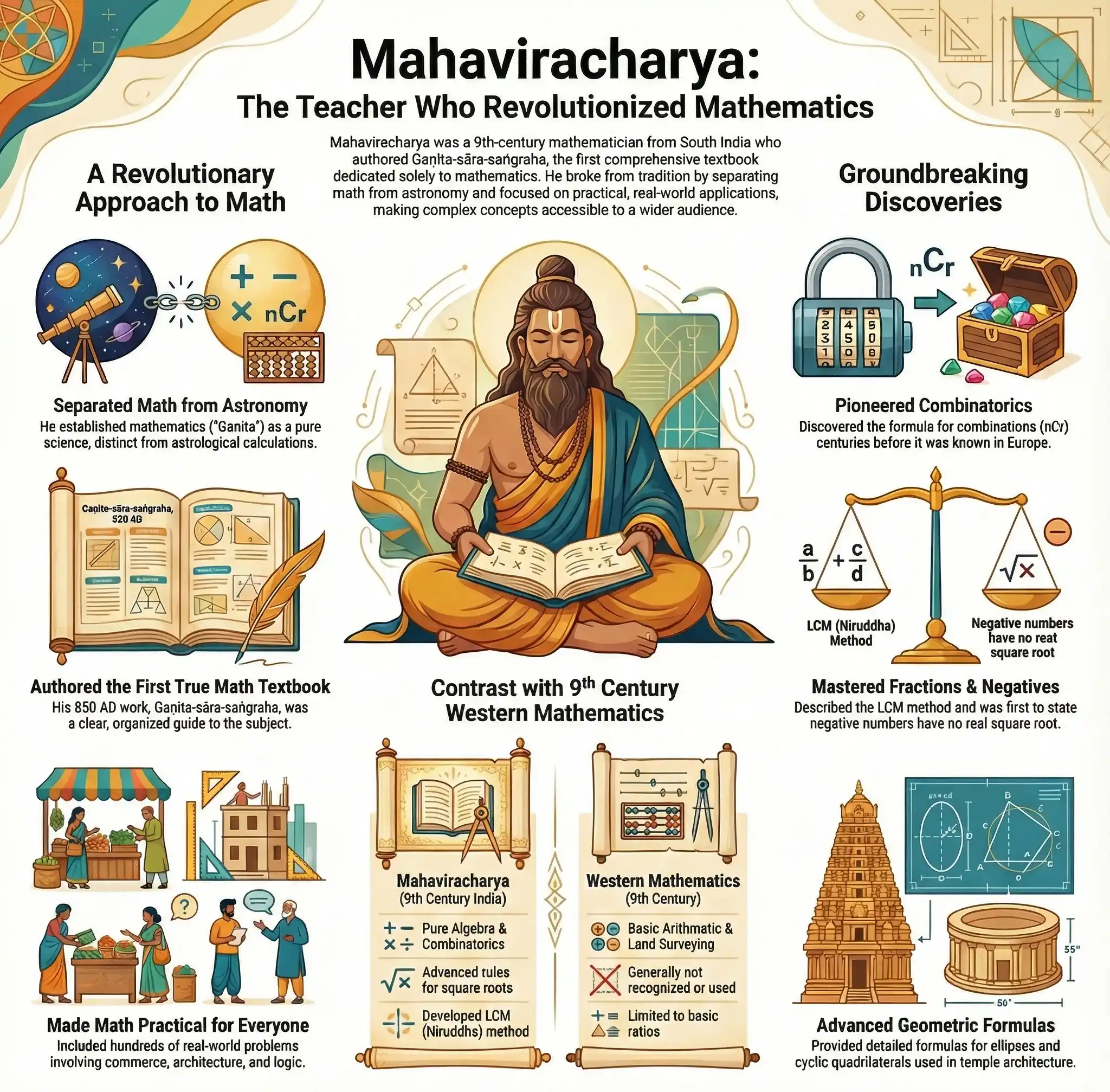
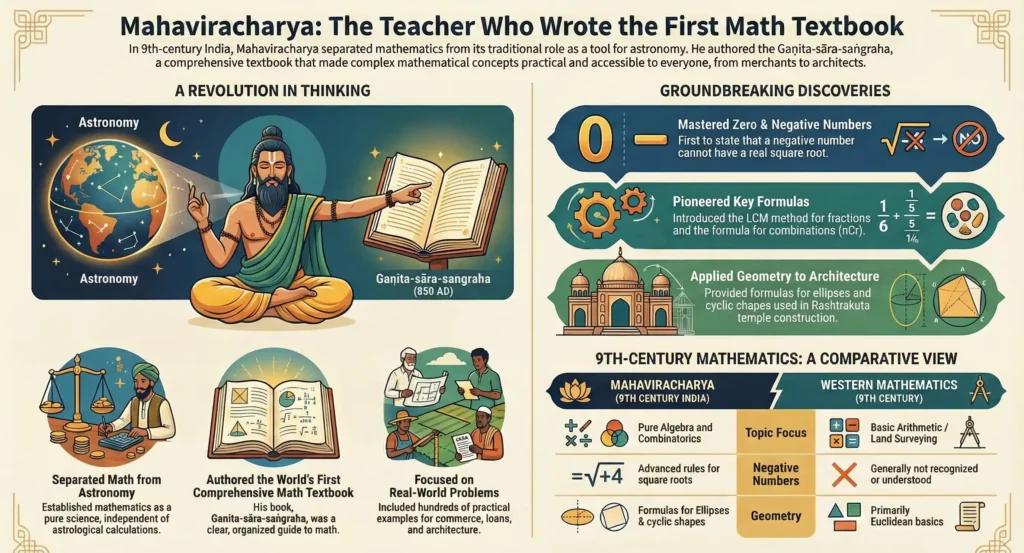
Around 850, at the Rashtrakuta court, a Jain scholar wrote a book with no astronomy in it at all. Not a reduced amount. None. The Ganita-sara-sangraha is arithmetic, fractions, series, algebra and mensuration, and it does not once look up.
This happened where it did for a reason. Amoghavarsha ruled the Deccan for something like sixty years from Manyakheta, and he was an unusual monarch: a Jain, by inclination a writer rather than a campaigner, credited with the first literary work in Kannada, and inclined to withdraw from the business of ruling when he could.
Mahavira opens with praise of him, as everybody did. The difference is that in this case the patron seems to have actually wanted the book.
Who the problems are for
Open the chapters and the world that comes out of them is not a sky. It is a market and a garden.
Bees settle on lotus flowers, and a fraction of the swarm goes to one bloom and a fraction to another, and you are asked how many bees there were. Elephants are counted. Peacocks. Garlands are strung, and the question is how many different garlands can be made from a given set of flowers. Jewellers sort gems. Merchants lend at interest and need the sum back. Grain fills a pit of a certain shape and somebody has to know how much.
These are not decorations on top of the mathematics. They are who the book was written for. A man who thinks arithmetic belongs to astronomers writes problems about eclipses. A man who thinks it belongs to everybody writes problems about garlands.
The combination formula arrives in this book attached to a question about how many kinds of necklace you can make.
Right, and wrong
He states, plainly and apparently first anywhere, that a negative number has no square root. His reasoning is exact: a square is what you get by multiplying a number by itself, that is always positive, so there is nothing whose square is negative.
He gives the general rule for combinations, the thing now written as nCr, as a working formula. He describes the method he calls niruddha for finding the lowest common multiple in order to handle fractions. He handles arithmetic and geometric series, and takes the first Indian run at the area of an ellipse, which he calls the elongated circle, and gets it wrong.
He also wrote that a number divided by zero is left unchanged, which is wrong too, and worth knowing about. Brahmagupta had said zero divided by zero is zero. Mahavira said division by zero changes nothing. Bhaskara, three centuries later, said the result is without end.
Three of the best mathematicians India produced, three different answers, all wrong, to the one question that does not have a right answer.
What happened to the book
It was used. That is the unglamorous and important part.
In the eleventh century Pavuluri Mallana put it into Telugu, and in that form it became the working arithmetic of the Andhra country for something like five hundred years, in the hands of people who had no Sanskrit and no interest in becoming scholars. In 1912 M. Rangacharya published it in Madras with an English translation, which is how it re-entered the modern record.
A thousand years after it was written, its problems were still being set to boys learning to keep accounts.
He said at the start that this was for the cook, the builder, the poet and the merchant. It ended up in their hands, which is more than most textbooks manage.
Did Mahaviracharya discover the Lowest Common Multiple (LCM)?
Yes, he was the first mathematician to describe the process of finding the LCM, which he called “Niruddha,” to simplify addition and subtraction of fractions.
What is Mahaviracharya’s most famous contribution?
His most famous contribution is the Gaṇita-sāra-saṅgraha, which is the first textbook dedicated solely to mathematics, separating it from the study of astronomy.
What did he say about negative numbers?
He correctly identified that a negative number does not have a real square root, as a negative number cannot be the result of a square.
Why is his work important for Indian history?
His work standardized mathematical education in South India and was used for centuries by merchants, architects, and scholars, bridging the gap between theory and practice.
How did he influence modern math?
His early work on combinations ($nCr$) and algebraic identities formed the early foundations for the development of probability and modern algebra centuries later.
Sources & References
Ganita-sara-sangraha of Mahaviracharya, translated by M. Rangacharya (Government Press, Madras, 1912) — the opening verses on the uses of calculation, and the rules on negative numbers, combinations and zero.
MacTutor History of Mathematics Archive, University of St Andrews (“Mahavira”) — his date, his patron and an assessment of his results.
Kim Plofker, Mathematics in India (Princeton University Press, 2009) — the separation of ganita from astronomical writing and the place of this text in it.
Encyclopaedia Britannica (“Mahavira, Indian mathematician”) — the Rashtrakuta setting and the later transmission of the work.
Exploring the Soul of Bharat through History, Science, Culture, and its Diversity
Our Mission
Curious Indian is a definitive knowledge portal dedicated to chronicling the events, personalities, and cultural shifts that defined the Indian subcontinent. From the ancient Vedic Period to the complexities of 21st-century politics, our goal is to provide deep-dive analysis that inspires.
Editorial Standards & E-E-A-T
Every article published under our brand undergoes a rigorous fact-checking process. We prioritize primary historical records, academic citations, and credible archives to ensure our readers receive accurate, high-authority information.
Historical IntegrityDirectly sourcing from ASI archives and academic journals.
Topical AuthorityComprehensive clustering of Indian Science, Biographies, and Wars.
Managed by Paripurna Datta and TEAM | Dedicated to the Knowledge of India.