A tenth-century scholar sat down to explain a book nobody could read any more, and named his explanation after the medicine Hanuman was sent to the mountain for
Everyone knows the scene. Lakshmana is down on the battlefield at Lanka and will not last the night. The physician says there is one herb that will bring him back, the sanjivani, and it grows on a particular mountain in the north, and it must be there before sunrise.
Hanuman goes. He reaches the mountain, cannot tell one plant from another in the dark, and so lifts the entire mountain and carries it back.
About two thousand years later, a scholar in central India finished a commentary on a book of Sanskrit prosody and called it the Mritasanjivani. The reviver of the dead.
You do not give your commentary that name unless you believe the text in front of you has actually died and you are bringing it back.
Pingala’s Chandahshastra had been written somewhere around the third or second century BC, in sutras: strings of two or three words, stripped to the bone, built to be memorised and then unpacked aloud by a teacher who already knew what they meant.
That system works beautifully for as long as the chain of teachers holds. When it breaks, what is left is a sequence of syllables that can be recited perfectly by people with no idea what they are saying.
By Halayudha’s time the syllables were intact and the meaning was gone. Twelve hundred years of compression had turned the most important book on Sanskrit metre into a locked box with the key mislaid.
Here is the extreme case. One sutra in the eighth chapter runs to four words: pare purnam iti. Something like, in the next, the full.
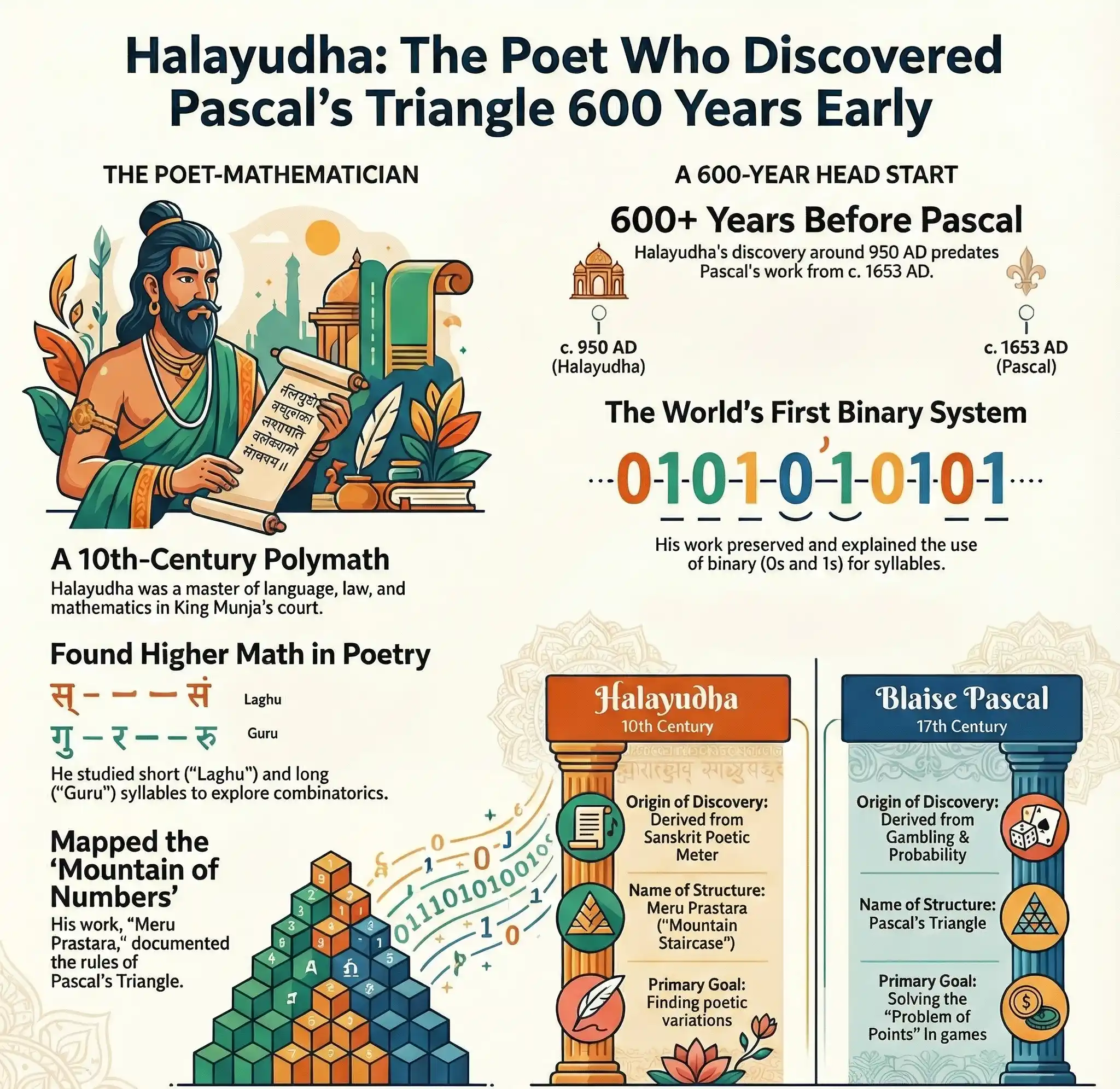
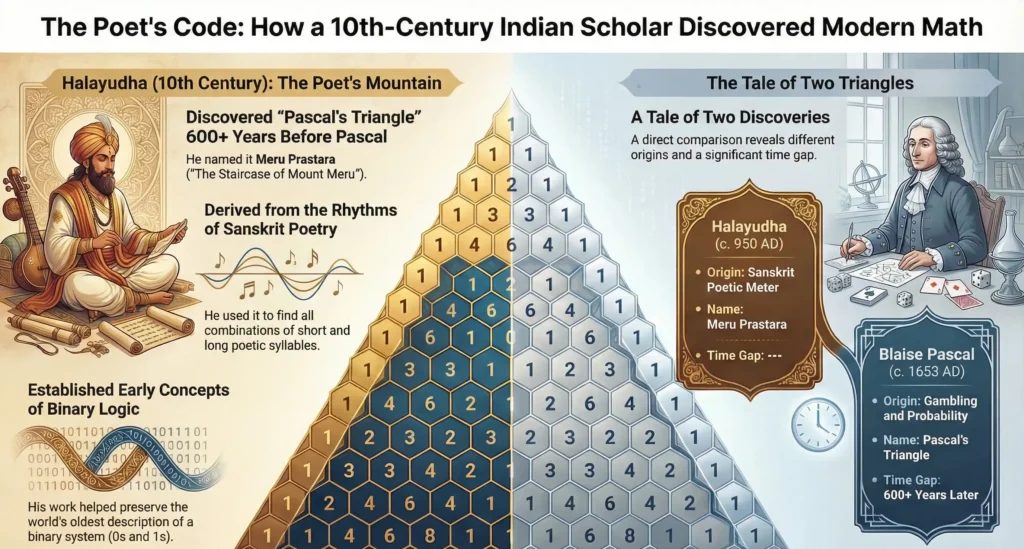
That is the entire instruction. Out of it Halayudha reconstructed a complete procedure, and wrote it out the long way: draw one square in the top row, two in the row below, three below that, and so on. Put a one in the top square and a one at each end of every row. Fill each remaining square with the sum of the two squares above it.
He called the result the meru-prastara, the arrangement like Mount Meru, because it climbs in steps like a hill. It is the triangle of binomial coefficients that Europe would meet through Blaise Pascal about seven hundred years later.
A four-word sutra, a tenth-century commentator with a piece of squared layout, and the numbers come out right.
Why commentary was not a minor art
It is worth being clear about what a commentator was in a manuscript culture, because the modern sense of the word does the job no favours.
Palm leaf does not last. A text stays in the world only as long as somebody keeps copying it, and people copy what is being taught. A book that stops being understood stops being taught, and a book that stops being taught is three careless generations from disappearing entirely.
The commentator is not a parasite on the original. In a great many cases he is the reason there is an original.
The rest of his desk
He was not only doing this. He compiled the Abhidhanaratnamala, a Sanskrit lexicon that scholars went on using for centuries, and which still circulates under his name as the Halayudha Kosha.
He also wrote the Kavirahasya, a poem in praise of the Rashtrakuta king Krishna III which doubles, verse by verse, as a drill in Sanskrit verb conjugation. Flattery of a monarch and grammar homework, in the same composition, and the joins do not show. He later worked at Ujjain under the Paramara king Munja, and the commentary is associated with that part of his life.
A warning, because this one catches people. There is more than one Halayudha in the record, and the two most often confused are separated by two centuries.
This one is the tenth-century prosodist and lexicographer. The other is a Bengali scholar and minister at the court of Lakshmana Sena in the twelfth century, who wrote on religious law. Pages that credit the mathematician with treatises on dharmashastra have merged the two, and the mistake travels easily.
What happened to him
The herb worked. Pingala’s text became legible again and has stayed legible, and every modern account of binary enumeration and the Indian binomial triangle rests on being able to read it.
Pingala gets the credit, which is correct, since he did the thinking. Halayudha appears in the small print, in the clause that begins as explained by his commentator.
The man who carried the mountain does not get the statue. The patient who sat up does.
Halayudha was a 10th-century mathematician, poet, and scholar who served in the court of King Munja. He is best known for his mathematical commentary on the rules of Sanskrit poetry.
What is the Meru Prastara?
The Meru Prastara is the Indian name for what is now known as Pascal’s Triangle. It is a triangular array of numbers where each number is the sum of the two above it, used to solve problems in combinations.
Did Halayudha invent binary numbers?
While the roots of binary systems go back to Pingala (c. 3rd century BCE), Halayudha’s 10th-century commentary provided the clear mathematical framework that made these binary concepts usable.
What is the significance of the book Mritasanjeevani?
It is a commentary on Pingala’s Chhandasastra. The name means “That which gives life to the dead,” symbolizing how it revived and clarified ancient scientific knowledge.
Why is Halayudha called a polymath?
Because he excelled in multiple unrelated fields, including advanced mathematics, linguistics (lexicography), law, and classical poetry.
Sources & References
Chandahshastra of Pingala with the Mritasanjivani commentary of Halayudha (Kashi Sanskrit Series) — the text of the commentary and the construction of the meru-prastara.
Kim Plofker, Mathematics in India (Princeton University Press, 2009) — the mathematical content of the commentary and its place in Indian combinatorics.
Maurice Winternitz, A History of Indian Literature, Volume III — his works, his lexicon and the distinction between authors of the same name.
Ganga Prasad Yadava, Dhanapala and His Times (1982) — his patrons and the reconstruction of his career between the Rashtrakuta and Paramara courts.
Exploring the Soul of Bharat through History, Science, Culture, and its Diversity
Our Mission
Curious Indian is a definitive knowledge portal dedicated to chronicling the events, personalities, and cultural shifts that defined the Indian subcontinent. From the ancient Vedic Period to the complexities of 21st-century politics, our goal is to provide deep-dive analysis that inspires.
Editorial Standards & E-E-A-T
Every article published under our brand undergoes a rigorous fact-checking process. We prioritize primary historical records, academic citations, and credible archives to ensure our readers receive accurate, high-authority information.
Historical IntegrityDirectly sourcing from ASI archives and academic journals.
Topical AuthorityComprehensive clustering of Indian Science, Biographies, and Wars.
Managed by Paripurna Datta and TEAM | Dedicated to the Knowledge of India.