Saturday, December 27, 2025
Everything About India
  • Arts & Culture
  • Festivals of India
  • Indian History
  • Indian Politics
  • Biography
    • Entertainment Personalities
    • Science Personalties
  • More
    • Unsolved India
No Result
View All Result
  • Arts & Culture
  • Festivals of India
  • Indian History
  • Indian Politics
  • Biography
    • Entertainment Personalities
    • Science Personalties
  • More
    • Unsolved India
No Result
View All Result
Everything About India
No Result
View All Result
Home Arts & Culture

Shalihotra: (3rd century BCE)

The Ancient Veterinarian Who Wrote the Book on Horses

Lucy Ghosal by Lucy Ghosal
in Arts & Culture, Biography, Science Personalties
Reading Time: 5 mins read
0 0
A A
Shalihotra: (3rd century BCE)

Shalihotra: (3rd century BCE)

Share on FacebookShare on Twitter

Shalihotra, the venerable sage and physician of ancient India, stands as the undisputed Father of Veterinary Science in the subcontinent, and arguably, the world. While modern medicine often focuses on the latest lab coats and gleaming technology, Shalihotra’s story reminds us that the compassionate care for animals—especially the majestic horse—has a profound and scientific history rooted deeply in Indian civilization.

His masterpiece, the Shalihotra Samhita, composed likely in the 3rd century BCE, is not just an ancient text; it is a foundational pillar of knowledge, a twelve-thousand-verse encyclopedia on animal health that speaks volumes about the advanced state of scientific achievements in ancient India. His legacy is an enduring inspiration for students and researchers, proving that a deep-seated respect for all life is the most fundamental ingredient in scientific discovery.

Table of Contents

Toggle
      • RelatedPosts
      • Daulat Singh Kothari : (1906–1993)
      • Shivkar Bapuji Talpade: (1864- 1916)
      • Venkatraman Ramakrishnan: (1952- Present)
  • 🌅 Early Life and Education: The Whisper of the Horse
  • 🔬 Journey into Science: The Birth of a New Discipline
  • 🌟 Major Achievements and Contributions: The Shalihotra Samhita
  • 🧗 Challenges and Turning Points: Proving a New Science
  • 💡 Legacy and Inspiration: The Enduring ‘Shalihotri’

RelatedPosts

Daulat Singh Kothari : (1906–1993)

Shivkar Bapuji Talpade: (1864- 1916)

Venkatraman Ramakrishnan: (1952- Present)

🌅 Early Life and Education: The Whisper of the Horse

While the sands of time have obscured many personal details, the tradition holds that Shalihotra was born the son of a sage named Hayagosha, a name that itself contains the word haya, meaning “horse.” This suggests that a connection to equine life was woven into the very fabric of his family background. He is believed to have lived in Sravasti (modern Sahet-Mahet in Uttar Pradesh) during a vibrant era that saw a flowering of thought and knowledge.

Imagine a young Shalihotra, not merely watching horses, but listening to them. In ancient India, horses were not just beasts of burden; they were the engines of empire, the swift couriers of commerce, and symbols of nobility. A healthy horse was vital to a kingdom’s security and prosperity. This environment provided the perfect backdrop for a curious mind to develop a specialized interest.

His early influences must have been steeped in the holistic philosophy of Ayurveda, the “Science of Life.” In those days, the distinction between a doctor for humans and a doctor for animals was not as rigid as it is today; the core principle of maintaining balance and treating the whole organism was universal. This comprehensive, all-encompassing approach to health, combined with a meticulous observation of animal behaviour and anatomy, set the stage for his revolutionary career. It wasn’t just a career choice; it was a calling to extend the sacred knowledge of healing to creatures unable to speak for themselves.

🔬 Journey into Science: The Birth of a New Discipline

Shalihotra’s path into the specialized field of veterinary medicine was groundbreaking. Ancient texts suggest he was a pupil of the same esteemed teacher as the famous sage Agnivesha, whose work formed the basis of the Charaka Samhita, one of the core texts of human medicine. This connection highlights a critical point: Shalihotra’s veterinary practice was built on the same rigorous, systematic, and philosophical foundations as the most advanced human medicine of his time.

His formal education would have involved intensive study of herbs, anatomy, pathology, and surgery—adapted for the animal body. But his true mentor was the vast, vibrant world around him, particularly the stables and battlefields of powerful kingdoms. Working with royal horse masters, observing different breeds, and treating a constant stream of ailments, he honed his craft through pure, dedicated clinical experience.

His initial career experiences were likely hands-on and demanding, dealing with everything from minor injuries to highly infectious diseases, especially among the prized horses of the military. This practical, trial-by-fire environment pushed him to systematize his knowledge, moving beyond mere folk remedies to establish a formal, predictable, and teachable science.

He didn’t just practice medicine; he saw the need to document it, to create a system that would endure. This dedication to codification is what transformed him from a brilliant practitioner into the foundational figure of Indian science.

🌟 Major Achievements and Contributions: The Shalihotra Samhita

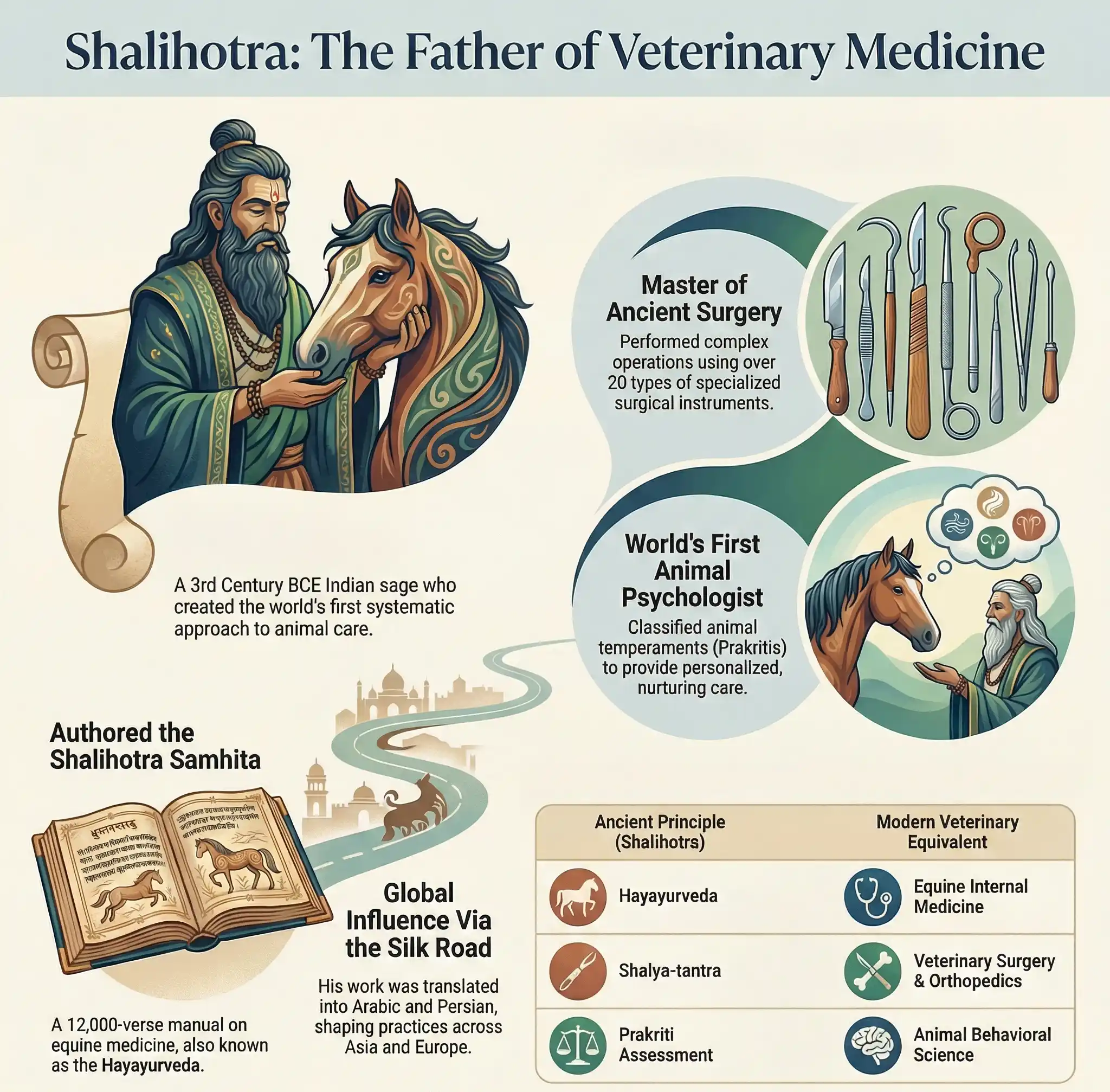
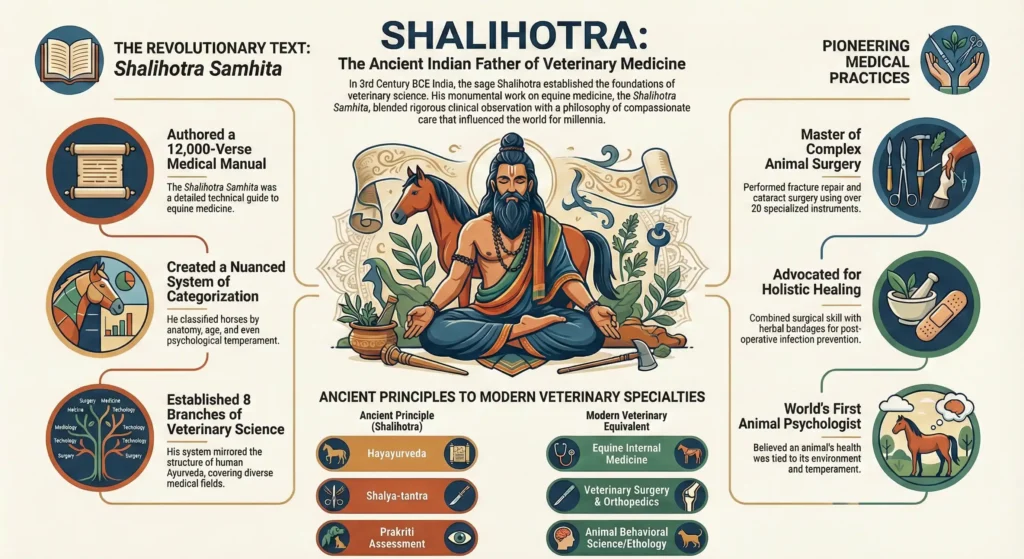
The singular, monumental contribution of Shalihotra is the Shalihotra Samhita, or the ‘Encyclopedia of the Physician Shalihotra.’ This incredible Sanskrit text, comprising approximately 12,000 verses (shlokas), is not merely a handbook but a fully realized medical treatise.
A Comprehensive Veterinary Text

The Shalihotra Samhita meticulously covers:

* Equine Anatomy and Physiology: It details the structural body of a horse, providing a foundation for understanding function and dysfunction. It even elaborates on how to determine a horse’s age by examining its teeth and other physical features—a technique still central to veterinary practice today.

* Pathology and Diagnosis: Shalihotra categorized and described a vast array of equine diseases, complete with their causes (nidana), symptoms (lakshana), and prognosis. This systematic approach—based on the Ayurvedic principles of humoral imbalance—was a massive leap forward.

* Treatment and Pharmacology: The treatise is a treasure trove of remedies using medicinal plants, decoctions, and ointments. He advocated a largely herbal approach, reflecting the deep connection between Indian medicine and the natural world.

* Preventive Care and Husbandry: Crucially, he focused on health maintenance, discussing horse breeding, diet, auspicious and inauspicious physical markings (Asva-lakshana sastram), and daily care—emphasizing that prevention is paramount.

Global and National Importance

The importance of these scientific achievements for India and the world cannot be overstated.

* A Global Standard: The Shalihotra Samhita was so authoritative that it was translated into Persian, Arabic, and Tibetan, spreading Indian veterinary science across Asia and the Middle East. The word for a horse doctor in Persian and Urdu, Shalotri, directly derives from his name—a powerful testament to his global influence.

* State-Sponsored Healthcare: His work provided the intellectual and practical framework for the establishment of organized animal care. It is believed that later rulers, such as Emperor Ashoka, established the first known veterinary hospitals in India, setting aside lands for the cultivation of herbal medicines for both men and animals. Shalihotra’s text was the de facto operating manual for these institutions.

* Foundation for Future Science: Subsequent authors and practitioners based their own veterinary works on his Samhita, ensuring a continuous tradition of knowledge. He provided a discipline, a specialized branch of Ayurveda, focused solely on animal well-being.

🧗 Challenges and Turning Points: Proving a New Science

Shalihotra faced the perennial challenge of the pioneer: establishing the legitimacy of a new, specialized field. Before him, animal care was often intertwined with human medicine or relegated to the status of simple craft. The turning point in his life must have been the moment he dedicated himself to separating and systematizing this knowledge.

Imagine the resistance he might have faced. Why dedicate 12,000 verses to horses when human ailments were so numerous? The challenge was convincing an established medical community and a skeptical royal court that animal health was an equally complex, vital science, essential for the stability of the kingdom.

His success, and the ultimate turning point, lay in the sheer efficacy of his methods. Anecdotes from the time would likely revolve around horses—priceless assets—being saved from certain death by his remedies, validating his complex diagnostic and treatment protocols. These successes established hippiatrics (horse medicine) as a respected, separate branch of knowledge, forever changing the way India viewed its animal wealth. This determination, fueled by a commitment to data and compassionate results, is what solidified his place in history.

💡 Legacy and Inspiration: The Enduring ‘Shalihotri’

Shalihotra’s legacy endures not just in libraries containing ancient manuscripts, but in the enduring respect for animals that defines Indian culture and its traditional medical systems. He championed the idea that the well-being of the realm is inextricably linked to the health of its non-human inhabitants—a concept that predates modern ‘One Health’ philosophy by millennia.

His work, often referred to today when studying the history of Indian science, is a powerful inspiration for students and young learners across India. His journey teaches us invaluable lessons:

* The Power of Specialization: He demonstrated that deep, focused study can create an entirely new discipline that contributes immensely to society.

* Holistic Thinking: His reliance on Ayurveda shows that the most effective science considers the whole organism—diet, environment, and mindset—not just isolated symptoms.

* The Compassionate Scientist: Above all, Shalihotra’s biography is a testament to the fact that the greatest scientists are driven by the deepest compassion. His love for the magnificent horse transformed into a scientific system that has stood the test of time.

In conclusion, Shalihotra’s name is synonymous with the origins of veterinary care. Every time a veterinarian treats an animal with care and systematic knowledge, they are, in a sense, upholding the tradition of the original Indian scientist who first gave the horse a scientific voice—the great Shalihotra. His story is a powerful reminder that some of the world’s most vital sciences were pioneered on the soil of ancient India.

Read More: https://curiousindian.in/uddalaka-aruni-7th-century-bce/

Tags: AchievementsAncient IndiaAncient PhysicianAnimal HusbandryAyurvedaEquine MedicineHippiatricsHistory Of MedicineHistory of ScienceIndian InnovationIndian scientistScientific LegacyShalihotraShalihotra SamhitaSravastiStudent InspirationVeterinarianVeterinary Science
ShareTweetPin
Lucy Ghosal

Lucy Ghosal

Related Posts

Daulat Singh Kothari : (1906–1993)
Biography

Daulat Singh Kothari : (1906–1993)

December 15, 2025
Shivkar Bapuji Talpade: (1864- 1916)
Biography

Shivkar Bapuji Talpade: (1864- 1916)

December 14, 2025
Venkatraman Ramakrishnan: (1952- Present)
Biography

Venkatraman Ramakrishnan: (1952- Present)

December 14, 2025
No Result
View All Result
December 2025
MTWTFSS
1234567
891011121314
15161718192021
22232425262728
293031 
« Nov    

TAGS

Akbar Ancient India Architectures of India Ayurveda Biography Bollywood biography Bollywood legends British East India Company Buddhism Chandragupta Maurya Civil Disobedience colonial India Dadasaheb Phalke Award Events That Changed History Festivals History History Of Medicine History of Science India Indian cinema Indian cinema icons Indian freedom struggle Indian History Indian National Congress Indian Nationalism Indian Science Indian scientist Inspiration Inspirational stories Kalinga War Mahatma Gandhi Mauryan Empire Mughal decline Mughal Empire Nationalism Partition of India Pataliputra Rigveda Scientific achievements Sikh history Swadeshi Movement Ujjain Unsolved India War elephants ​Indian Mathematician

Archives

  • December 2025
  • November 2025
  • October 2025
  • September 2025
  • August 2025
  • April 2025
  • March 2025
  • July 2017
Facebook Twitter Youtube RSS
Curious Indian TRicolor logo

Explore the soul of Bharat with Curious Indian. A definitive guide to Indian history, arts, culture, biographies, and the events that defined our future.

Follow us on social media:

Recent News

  • Daulat Singh Kothari : (1906–1993)
  • Shivkar Bapuji Talpade: (1864- 1916)
  • Venkatraman Ramakrishnan: (1952- Present)

Category

  • Arts & Culture
  • Battles of India
  • Biography
  • Entertainment Personalities
  • Festivals of India
  • Indian History
  • Indian Politics
  • Places
  • Science Personalties
  • Uncategorized
  • Unsolved India

© 2025 Curious Indian- Everything about India

Welcome Back!

Login to your account below

Forgotten Password?

Retrieve your password

Please enter your username or email address to reset your password.

Log In

Add New Playlist

No Result
View All Result
  • Arts & Culture
  • Festivals of India
  • Indian History
  • Indian Politics
  • Biography
    • Entertainment Personalities
    • Science Personalties
  • More
    • Unsolved India

© 2025 Curious Indian- Everything about India

This website uses cookies. By continuing to use this website you are giving consent to cookies being used. Visit our Privacy and Cookie Policy.
Are you sure want to unlock this post?
Unlock left : 0
Are you sure want to cancel subscription?