He reasoned his way to the indivisible particle without performing a single experiment
Take a stone and break it. Break the pieces. Keep going.
The question Kanada asks is whether that process ever has to stop, and his answer is an argument rather than a demonstration. Suppose it does not stop. Then a mustard seed contains an infinite number of parts, and so does a mountain, and if both contain infinitely many parts there is no reason for one to be larger than the other.
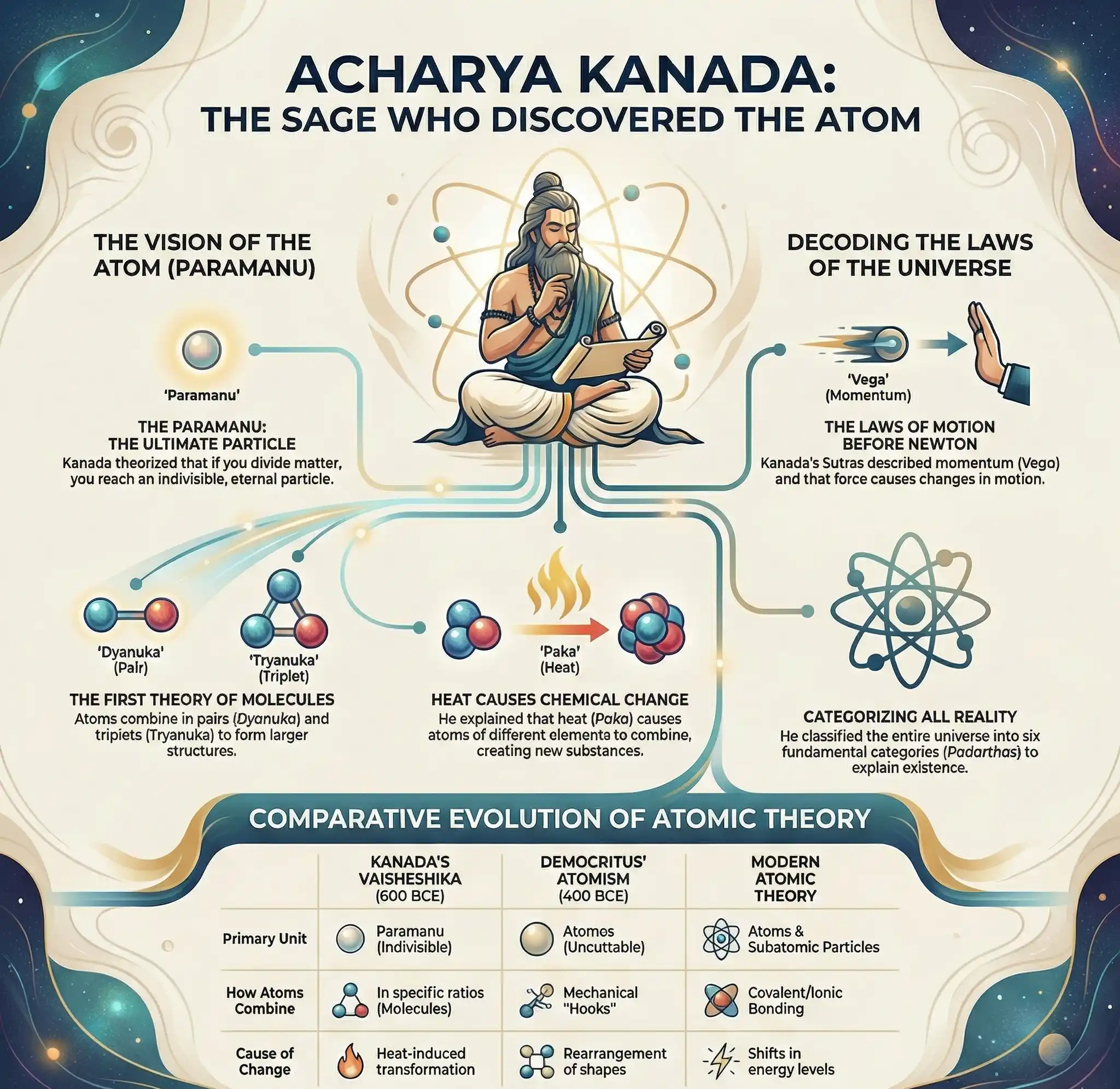
A mustard seed is not the size of a mountain. Therefore the dividing stops somewhere, and what it stops at is the paramanu, the thing with no parts.
No stone was broken. The whole proof happens in the head, which is the most interesting fact about it.
What he said they were like
These particles are indivisible, eternal and imperceptible. They come in four kinds, matching earth, water, fire and air, and each kind carries a quality of its own: earth has smell, water has taste, fire has colour, air has touch.
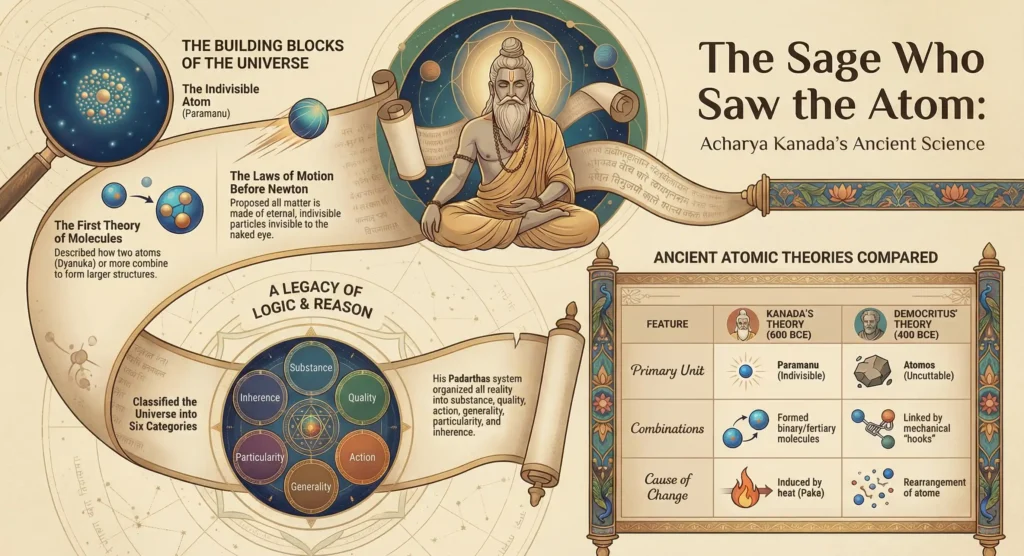
Two of them join to make a dyad, still invisible. Three dyads make a triad, and the triad is the smallest thing an eye can see. The standard example of it is the mote drifting in a beam of sunlight through a window.
Notice which end that was built from. The mote is the smallest visible thing, so the model is constructed backwards from it: three dyads down from a speck of dust, and you arrive at the particle. It is careful, and it is entirely deductive.
10 Remarkable Facts About Meghnad Saha Life and Achievements
Why this is not Dalton
The popular claim is that Kanada beat John Dalton to the atom by two thousand six hundred years. It is worth being straight about why that is the wrong compliment.
Dalton’s atoms came out of weighing. Chemists had found that substances combine in fixed proportions by mass, and the atom was the explanation that fitted the numbers, and the numbers could be checked by anyone with a balance.
Kanada’s came out of an argument about infinity. His particles carry smell and taste as intrinsic properties, which is not a thing a chemical atom does, and their combining is attributed in part to adrishta, an unseen force with a moral character to it. This is a different kind of claim about the world, made for different reasons, and it is not a draft of nineteenth-century chemistry.
Calling it early chemistry flatters it in the wrong direction. It is first-rate metaphysics, and that is a harder thing to do.
What the book is actually about
The Vaisheshika Sutra is not a physics text with some philosophy attached. It is an inventory of everything there is, sorted into categories: substance, quality, action, the universal, the particular, and the relation by which a quality inheres in a thing.
Nine substances are listed, and they include time, space, the self and the mind alongside the four material elements and ether. The atoms occupy one corner of a much larger filing system.
The school takes its name from vishesha, particularity, which is the category answering the question of what makes one atom different from another when they are identical in every describable respect. That problem is still live in philosophy.
Dr. A.P.J. Abdul Kalam: (1931-2015)
The particle eater
Kanada is a nickname. Kana is a grain or a particle and the name means something like one who eats particles. One story has him living on single grains gleaned from harvested fields. Another has him simply preoccupied with the smallest things there are.
He is also called Kashyapa, and the school is sometimes called Aulukya after another of his names. Nothing about his life is known, and the sutras are dated anywhere between the sixth and the second century BC, which is a range of four hundred years and an honest reflection of how little there is to go on.
What was still out of reach
The sutras also deal with motion, with contact as its cause, and with gurutva, heaviness, as the reason things fall. These are not laws in the later sense and no quantity is attached to any of them, but they show a mind treating the ordinary behaviour of matter as something that requires an explanation rather than a story.
He asked the right question and answered it with the only instrument he had. The answer had to wait about twenty-three centuries for somebody with a set of scales.
Two millennia before anyone could weigh an atom, he worked out that there had to be one.
6 Unfoldings in the Subrahmanyan Chandrasekhar Biography
7 Secrets of Padmanabhaswamy Temple Treasure
If you think you have remembered everything about this topic take this QUIZ
Results


#1. What earned the philosopher Kashyapa the name ‘Kanada’ in ancient Indian tradition?
#2. In the Vaisheshika Sutra, what term did Kanada use to describe the ultimate, indivisible point of matter?
#3. How did Kanada describe the formation of new substances through chemical transformation?
#4. Which concept, famously formalized by Isaac Newton, was described by Kanada as the ‘falling of objects due to the quality of weight’?
#5. Among the ‘Six Padarthas’ (categories) of the universe, which one refers to ‘Quality’, such as color or taste?
#6. According to the ‘Quick Comparison’ table, how did Kanada’s theory differ from Democritus’ regarding the cause of motion?
#7. Kanada correctly identified that which two phenomena are different forms of the same essential substance (Tejas)?
#8. For Acharya Kanada, what was the ultimate spiritual goal of understanding the physics of the world?
Is Acharya Kanada the real father of atomic theory?
While Democritus is often credited in the West, Kanada’s Vaisheshika Sutra (600 BCE) provides an earlier and more mathematically detailed description of atomic combinations and chemical changes.
What is a Paramanu?
According to Kanada, a Paramanu is the smallest possible particle of matter that cannot be divided further. It is eternal, invisible, and is the building block of all substances.
Did Kanada talk about gravity?
Yes, he described Gurutva (gravity) as the quality of weight that causes objects to fall to the earth, identifying it as a specific property of earth and water substances.
How did he explain chemical changes?
He proposed the theory of Paka-vada, which suggests that heat causes atoms to rearrange and change their qualities, transforming one substance into another (like clay turning into a pot)
Why is his school called Vaisheshika?
The name comes from the word Vishesha, meaning “particularity.” The school focuses on understanding the unique characteristics that distinguish one substance or atom from another.
Read More: https://curiousindian.in/pa%e1%b9%87ini-mid-1st-millennium-bce/
Sources & References
Encyclopaedia Britannica (“Vaisheshika”) — the school’s categories, its nine substances and the place of the atom within them.
Internet Encyclopedia of Philosophy (“Nyaya-Vaisheshika”) — the argument from infinite divisibility and the dyad and triad structure.
Vaisheshika Sutra of Kanada, translated by Nandalal Sinha (Sacred Books of the Hindus, 1911) — the sutras on substance, atoms, motion and heaviness.
Wilhelm Halbfass, On Being and What There Is: Classical Vaisesika and the History of Indian Ontology (SUNY Press, 1992) — the dating of the text and the philosophical status of its atomism.
Author


Exploring the Soul of Bharat through History, Science, Culture, and its Diversity
Our Mission
Curious Indian is a definitive knowledge portal dedicated to chronicling the events, personalities, and cultural shifts that defined the Indian subcontinent. From the ancient Vedic Period to the complexities of 21st-century politics, our goal is to provide deep-dive analysis that inspires.
Editorial Standards & E-E-A-T
Every article published under our brand undergoes a rigorous fact-checking process. We prioritize primary historical records, academic citations, and credible archives to ensure our readers receive accurate, high-authority information.
Historical Integrity Directly sourcing from ASI archives and academic journals.Topical Authority Comprehensive clustering of Indian Science, Biographies, and Wars.Managed by Paripurna Datta and TEAM | Dedicated to the Knowledge of India.