The story of why he wrote his arithmetic for a girl named Lilavati was first told four centuries after he died
The story goes like this. Bhaskara cast his daughter’s horoscope and found that she would marry only if the wedding took place in one particular hour of one particular day.
To catch the moment he built a water clock, a cup with a small hole in its base floating in a vessel, set to fill and sink exactly at the auspicious time. He left it in a room and told the girl to keep away from it. She looked anyway, and a pearl came loose from her dress and fell into the cup and stopped the hole. The cup never sank. The hour went past.
Unable to give her a marriage, he gave her a book with her name on it, so that the name would outlast her.
It is a beautiful story. The first person known to tell it was writing four hundred and thirty-seven years after the book was finished.
Where the story comes from
The Lilavati was completed in 1150. The tale of the pearl appears in the Persian translation made in 1587 by Faizi, brother of Akbar’s minister Abul Fazl, at the emperor’s request. No earlier source has it, and nothing contemporary confirms that Bhaskara had a daughter of that name at all.
It has been repeated in every popular account since, including the ones that present it as fact, and it is easy to see why. The book invites it.
1971 Nagarwala Case: India’s Great Bank Heist Mystery
What the book actually does
Lilavati is the first of the four parts of the Siddhanta Shiromani, which Bhaskara finished at thirty-six. We know his age because he says so in the fourth part, along with the year of his birth.
It is arithmetic and mensuration in two hundred and seventy-eight verses, and it is written in the second person, to a young woman. Tell me, it says. Say, fawn-eyed girl. The problems are about bees settling on lotus flowers, a snake and a peacock, and a necklace that breaks so that a third of the pearls fall on the floor and a fifth stay on the bed.
A mathematician wrote his arithmetic as verse addressed to a girl, and four centuries later somebody invented a reason why.
Ujjain
He was born in 1114 at Vijjadavida, in the Deccan, and was taught by his father Maheshwara, who was a scholar himself. He ended up running the astronomical observatory at Ujjain, which is the chair Brahmagupta had held five hundred years earlier, and he is the last of the great figures in that line.
Dr. A.P.J. Abdul Kalam: (1931-2015)
The algebra
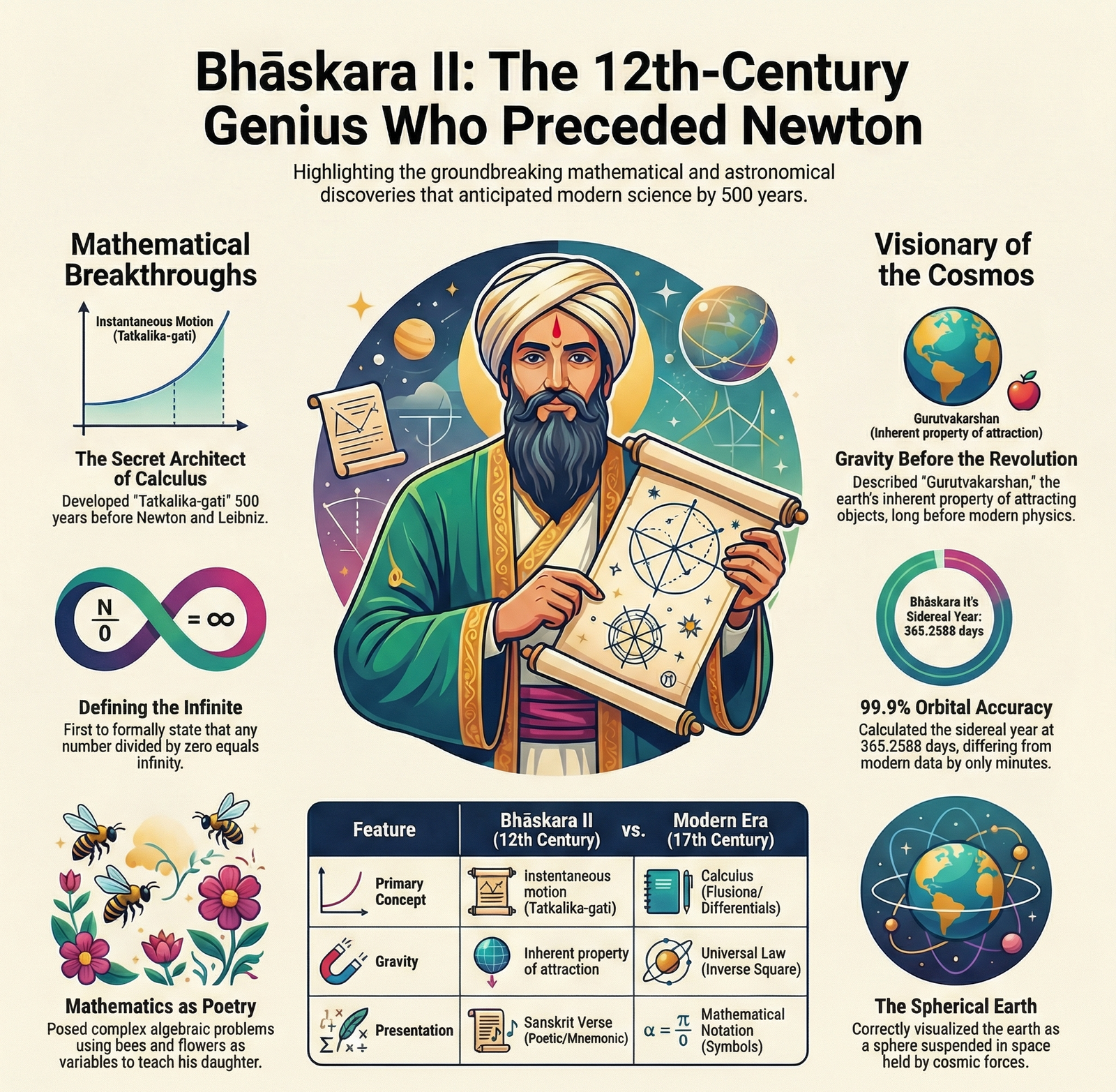
The second volume, Bijaganita, is where the serious work is. He develops the chakravala, a cyclic method for finding whole-number solutions to equations of the form Nx squared plus one equals y squared.
He applies it to the case where N is sixty-one, and finds the smallest solution: x is 226,153,980 and y is 1,766,319,049. The numbers are worth looking at twice. In 1657 Pierre de Fermat posed that exact case as a challenge problem to the mathematicians of Europe, believing it hard.
He also worked out the surface area and volume of a sphere, wrote on the Pythagorean relation, and handled quadratic and indeterminate equations as a matter of routine.
Things moving
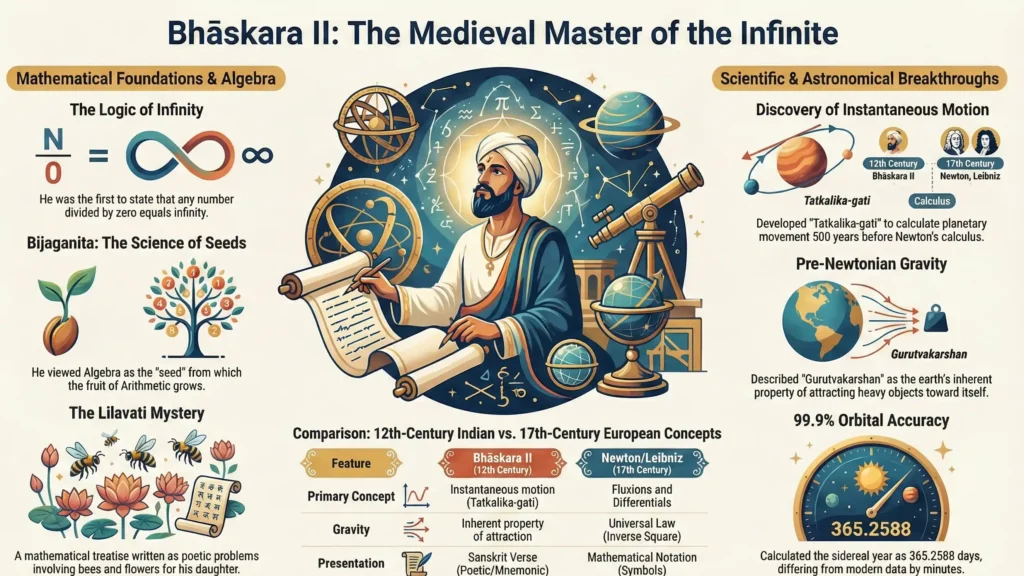
In the astronomical volumes he does something stranger. To find where a planet is at a given instant, rather than on average over a day, he works with the change in position over an interval that he allows to become vanishingly small, and he notes that at the point where a planet’s apparent motion turns around, this rate of change goes to nothing.
That is the germ of the derivative, and of the result Europe later attached to Rolle’s name. It is not calculus, because nothing was built on top of it and the tradition did not continue. It is a man reaching the right idea five hundred years early and having nowhere to take it.
He also returned to the question Brahmagupta had got wrong, and said that a quantity divided by zero is a quantity without end, which he compared to the infinite and unchanging. It is not the modern answer either, but it is a better wrong answer.
Seven hundred years
Lilavati was the standard arithmetic textbook across much of India until the nineteenth century. Faizi translated it for Akbar in 1587, Colebrooke and Taylor put it into English in 1816 and 1817, and the International Mathematical Union’s prize for communicating mathematics to the public is named after it.
The daughter may well be a legend. The second life the legend says he promised her happened anyway.
8 Defining Chapters in the Vikram Sarabhai Biography
The Roopkund Skeleton Lake Mystery: Why Were Greeks Dying in the Indian Himalayas?
If you think you have remembered everything about this topic take this QUIZ
Results


#1. What is the title of Bhāskara II’s magnum opus, which includes sections on Arithmetic and Algebra?
#2. Bhāskara II wrote the book Lilavati to console his daughter after what unfortunate event?
#3. Which mathematical truth regarding zero was Bhāskara II the first to clearly state?
#4. What term did Bhāskara II use to describe “instantaneous motion,” anticipating the principles of calculus?
#5. In the Siddhanta Shiromani, which section is dedicated to Algebra?
#6. How did Bhāskara II explain the concept of gravity (Gurutvakarshan) in his work Goladhyaya?
#7. Bhāskara II calculated the length of the Earth’s orbit (sidereal year) with remarkable precision to be:
#8. Bhāskara II calculated the value of Pi ($\pi$) to be approximately:
Why is Bhaskara II called the Father of Calculus?
While Newton and Leibniz popularized it, Bhāskara used the principles of “instantaneous motion” and derivatives to calculate planetary positions 500 years earlier.
What is the significance of the book Lilavati?
It is a foundational text on arithmetic and geometry, uniquely written in poetic form and named after his daughter to immortalize her name.
Did Bhaskara II know about gravity?
Yes, he wrote about Gurutvakarshan, stating that the earth has a natural power of attraction that pulls objects toward its surface.
What did he say about dividing by zero?
He was the first to mathematically define that any number divided by zero results in infinity (Khachahara).
Read More: https://curiousindian.in/bhaskara-i-c-600-c-680-ce/
Sources & References
Encyclopaedia Britannica (“Bhaskara II”) — his works and the identification of the Lilavati story as a legend first recorded in a sixteenth-century Persian translation.
MacTutor History of Mathematics Archive, University of St Andrews — Faizi’s telling of the story and the chakravala solution for the case of sixty-one.
Bhaskara II, Lilavati, translated in H.T. Colebrooke, Algebra with Arithmetic and Mensuration (1817) — the verses addressed to the reader and the form of the problems.
Kim Plofker, Mathematics in India (Princeton University Press, 2009) — the structure of the Siddhanta Shiromani and his treatment of instantaneous planetary motion.
Author


Exploring the Soul of Bharat through History, Science, Culture, and its Diversity
Our Mission
Curious Indian is a definitive knowledge portal dedicated to chronicling the events, personalities, and cultural shifts that defined the Indian subcontinent. From the ancient Vedic Period to the complexities of 21st-century politics, our goal is to provide deep-dive analysis that inspires.
Editorial Standards & E-E-A-T
Every article published under our brand undergoes a rigorous fact-checking process. We prioritize primary historical records, academic citations, and credible archives to ensure our readers receive accurate, high-authority information.
Historical Integrity Directly sourcing from ASI archives and academic journals.Topical Authority Comprehensive clustering of Indian Science, Biographies, and Wars.Managed by Paripurna Datta and TEAM | Dedicated to the Knowledge of India.