Bhāskara I was far more than just a mathematician; he was the vital bridge that connected the cryptic genius of Aryabhatta to the rest of the world. Living in the 7th century, he took complex, poetic scientific verses and transformed them into accessible knowledge through his masterful commentaries. By perfecting the decimal system and creating an ingenious sine approximation formula, he ensured that India’s scientific revolution didn't just flicker and fade but instead became a beacon for future scholars like Bhāskara II and the Arab world.| Feature | Details |
| Name | Bhāskara I |
| Era | c. 600 – c. 680 CE |
| Role | Mathematician, Astronomer, Commentator |
| Major Work | Āryabhaṭīya Bhāṣy, Mahābhāskarīya |
| Key Innovation | Sine Approximation Formula, Place-Value System |
| Legacy | Preserved the works of Aryabhatta for future generations |
Bhāskara I: The Compassionate Commentator Who Saved Genius
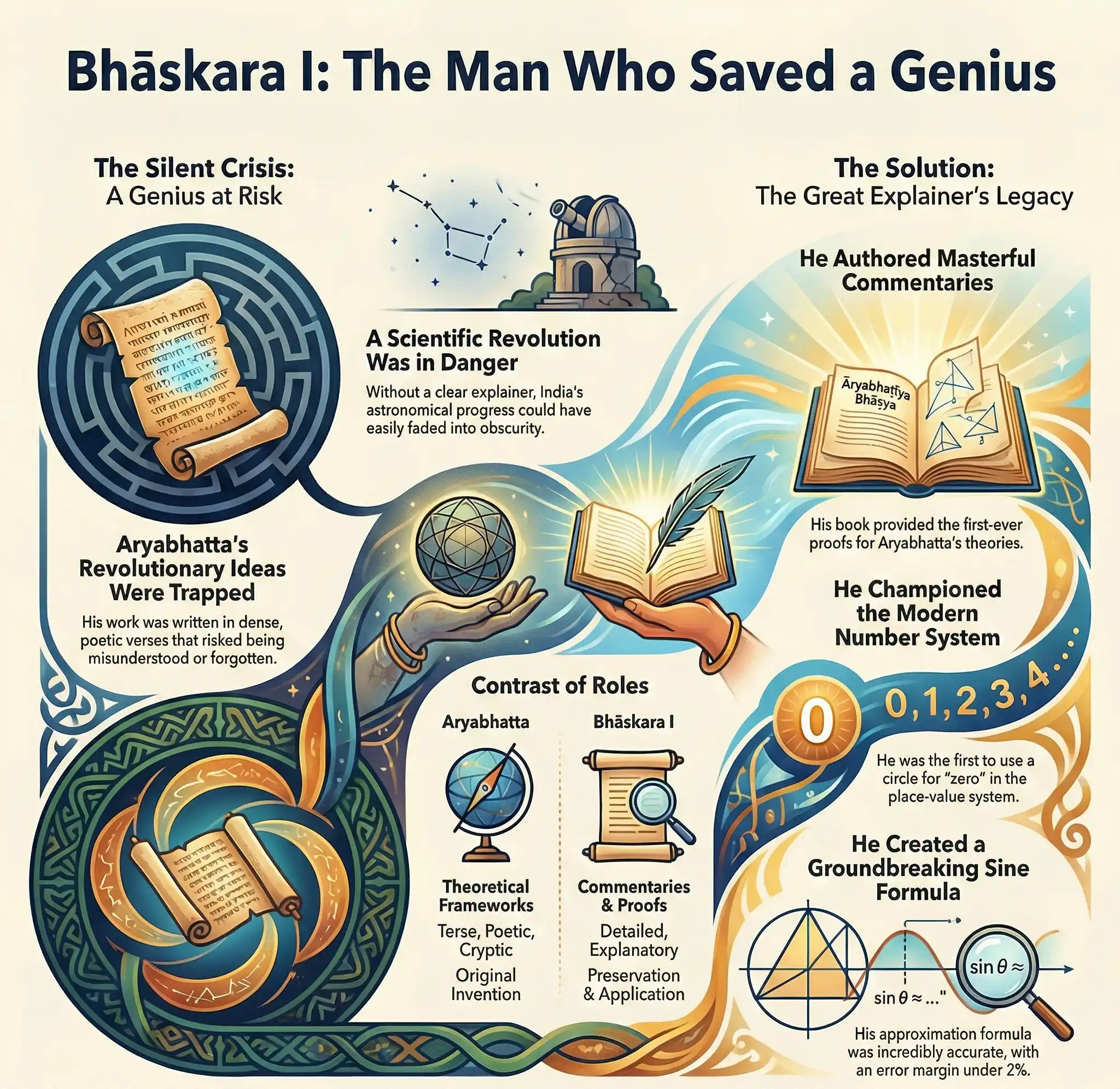
In the quiet corridors of 7th-century India, a silent crisis was brewing in the world of science. The revolutionary ideas of the great astronomer Aryabhatta—the man who first suggested the Earth rotates on its axis—were so dense and poetic that they risked being misunderstood or, worse, forgotten. This is the moment Bhāskara I stepped into the light. He wasn’t just a scholar; he was a guardian of truth who realized that for knowledge to survive, it must be understood by the many, not just the few.
The Roots of a Mathematical Giant Born around 600 CE, likely in the vibrant intellectual hubs of Gujarat or Maharashtra, Bhāskara I grew up during the twilight of the Gupta Empire. This was a “Golden Age” where numbers were more than just figures on a page; they were the heartbeat of society, used for everything from mapping the stars to timing sacred rituals. While we don’t know the name of his childhood home, we know the fire that lit his mind: the Āryabhaṭīya. He saw in these verses a future for humanity, but he also saw a challenge. The text was cryptic, almost like a secret code of the universe.
The Great Explainer: Journey into Science Bhāskara I’s career was defined by a beautiful act of intellectual humility. Instead of seeking only his own fame, he dedicated his life to being the “Great Explainer.” In his seminal work, the Āryabhaṭīya Bhāṣya, he didn’t just repeat what had been said before. He breathed life into it. He provided the first-ever proofs for Aryabhatta’s theories, used relatable stories to explain complex logic, and turned a difficult poem into a working textbook. This was ancient Indian astronomy in its most accessible form.
The Roopkund Skeleton Lake Mystery: Why Were Greeks Dying in the Indian Himalayas?
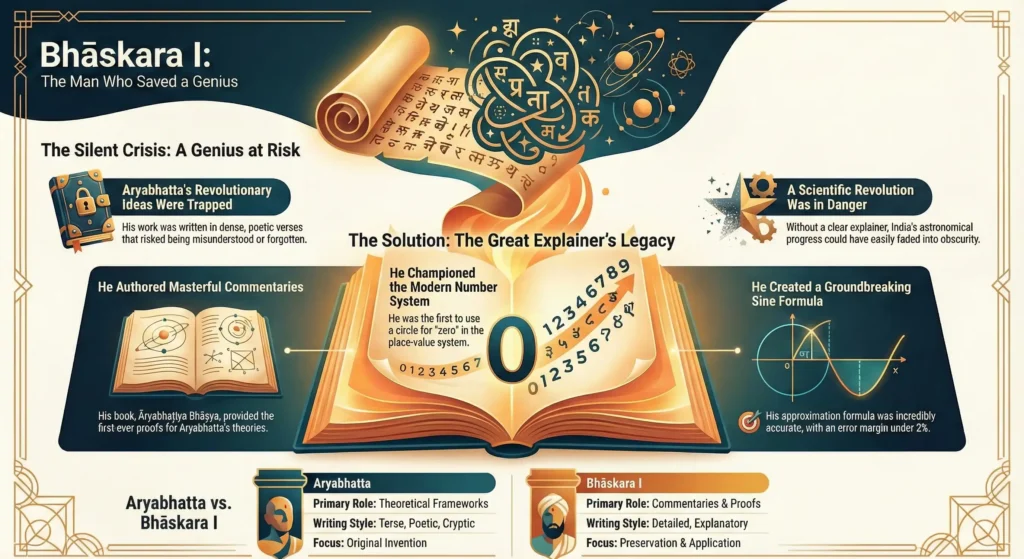
A Formula That Defied the Ages One of his most breathtaking achievements was the creation of a unique sine approximation formula. Imagine trying to calculate the curve of a circle without a calculator or a computer. Bhāskara I developed a formula so accurate—with an error margin of less than 2%—that it remains a marvel of mathematical history today. He wrote this formula in verse, making the rigid world of mathematics feel like a beautiful song.
The Protector of the Zero and the Decimal We often take the numbers 0 through 9 for right, but Bhāskara I was one of the first to champion the Hindu-Arabic numeral system in a way that made sense for daily use. He used the place-value system to describe massive numbers, reaching into the trillions (10^18). By documenting these systems so clearly, he helped solidify the foundation of modern mathematics, ensuring that the concept of “Sunya” (zero) would eventually travel from India to the rest of the world.
1971 Nagarwala Case: India’s Great Bank Heist Mystery
Standing Tall Amidst Controversy Life wasn’t always easy for Bhāskara I. He lived in a time of fierce academic debate. Scholars like Brahmagupta often attacked Aryabhatta’s theories. Bhāskara I stood his ground, not with anger, but with logic. He became the shield for Aryabhatta’s legacy. By providing undeniable proofs and clear examples, he made it impossible for the critics to erase the progress that had been made. He was a bridge-builder in an age of walls.
An Inspiration for the Modern Student Today, the story of Bhāskara I reminds us that the greatest gift we can give is the gift of understanding. He teaches us that being a “commentator” or a “teacher” is just as heroic as being an “inventor.” His meticulousness, his passion for detail, and his friendly writing style serve as a reminder that science is a human story, filled with emotion, struggle, and the tireless pursuit of light.
Quick Comparison: Bhāskara I vs. Aryabhatta
| Feature | Aryabhatta | Bhāskara I |
| Primary Contribution | Theoretical Frameworks | Commentaries & Proofs |
| Writing Style | Terse, Poetic, Cryptic | Detailed, Explanatory, Friendly |
| Trigonometry | Introduced Sine Tables | Created Sine Approximation Formula |
| Focus | Original Invention | Preservation & Application |
Curious Indian: Fast Facts
- The “I” is Important: He is called Bhāskara I to distinguish him from the 12th-century mathematician Bhāskara II (Bhāskarāchārya).
- First Decimal Use: He is the first to use a circle for zero in the Indian place-value system in a documented way.
- Planetary Models: His book Mahābhāskarīya includes a section on the longitudes of planets that was incredibly advanced for the 7th century.
- The Verse Formula: His famous sine formula was written as a Sanskrit poem to help students memorize it.
Exploring The Deep Namdapha National Park Rainforest
Conclusion
Bhāskara I remains a silent hero of the scientific world. He understood that genius is only as powerful as its ability to be shared. By translating the complex into the simple, he didn’t just write books; he saved a civilization’s worth of knowledge. Every time we use a decimal or calculate a curve, we are walking on the path he helped pave over 1,400 years ago.
The Heritage Of Northeast India Local Brews Unveiled
If you think you have remembered everything about this topic take this QUIZ
Results


#1. What was Bhāskara I’s primary role in the preservation of ancient Indian scientific knowledge?
#2. Which mathematical innovation is Bhāskara I most famous for, particularly for its incredible accuracy in calculating curves?
#3. In the 7th century, Bhāskara I was one of the first to document the use of a specific symbol for zero. What was that symbol?
#4. How did Bhāskara I defend Aryabhaṭa’s legacy against contemporary critics like Brahmagupta?
#5. What is the primary difference between the writing styles of Aryabhaṭa and Bhāskara I?
#6. Bhāskara I’s work ‘Mahābhāskarīya’ is particularly noted for its advanced sections on what subject?
#7. In the context of Indian mathematics, what does the designation ‘I’ in ‘Bhāskara I’ signify?
#8. Which large numbers did Bhāskara I use the place-value system to describe, reaching as far as trillion?
Why is Bhāskara I called “The Great Commentator”?
He earned this title because his commentary on the Āryabhaṭīya was the most comprehensive and influential, making Aryabhatta’s complex theories understandable for the first time.
What is Bhāskara I’s most famous formula?
His sine approximation formula is his most famous contribution, allowing for the calculation of sines of acute angles with remarkable accuracy without using tables.
Did Bhāskara I invent the number zero?
While he didn’t “invent” it, he was one of the earliest mathematicians to use the Hindu-Arabic decimal system with a circle representing zero in a positional context.
Where was Bhāskara I from?
Historical evidence suggests he was likely from the Gujarat or Maharashtra region of India, though he worked within the broader tradition of Indian mathematics.
What are his main books?
His three primary works are the Mahābhāskarīya, the Laghubhāskarīya, and the Āryabhaṭīya Bhāṣya.