How freedom and Partition arrived together, and why India must hold both
At the stroke of midnight on 15 August 1947, two things happened to India at the very same moment, and no one has ever been able to pull them apart.
One was a triumph beyond measure. After nearly two hundred years under a foreign flag, a fifth of the human race became free. In Delhi that night, grown men and women wept with joy in the streets.
The other was a catastrophe. At that same hour, a line freshly drawn across the map of the subcontinent was setting loose the largest, and one of the cruellest, movements of people the world has ever seen. Even as the celebrations rang out, the killing had already begun.
India woke to freedom and to horror in the same breath. This is the story of that midnight, and of the two truths it holds, which every generation of Indians since has had to learn to carry together.
The rush to the door
By 1947, the British simply wanted out.
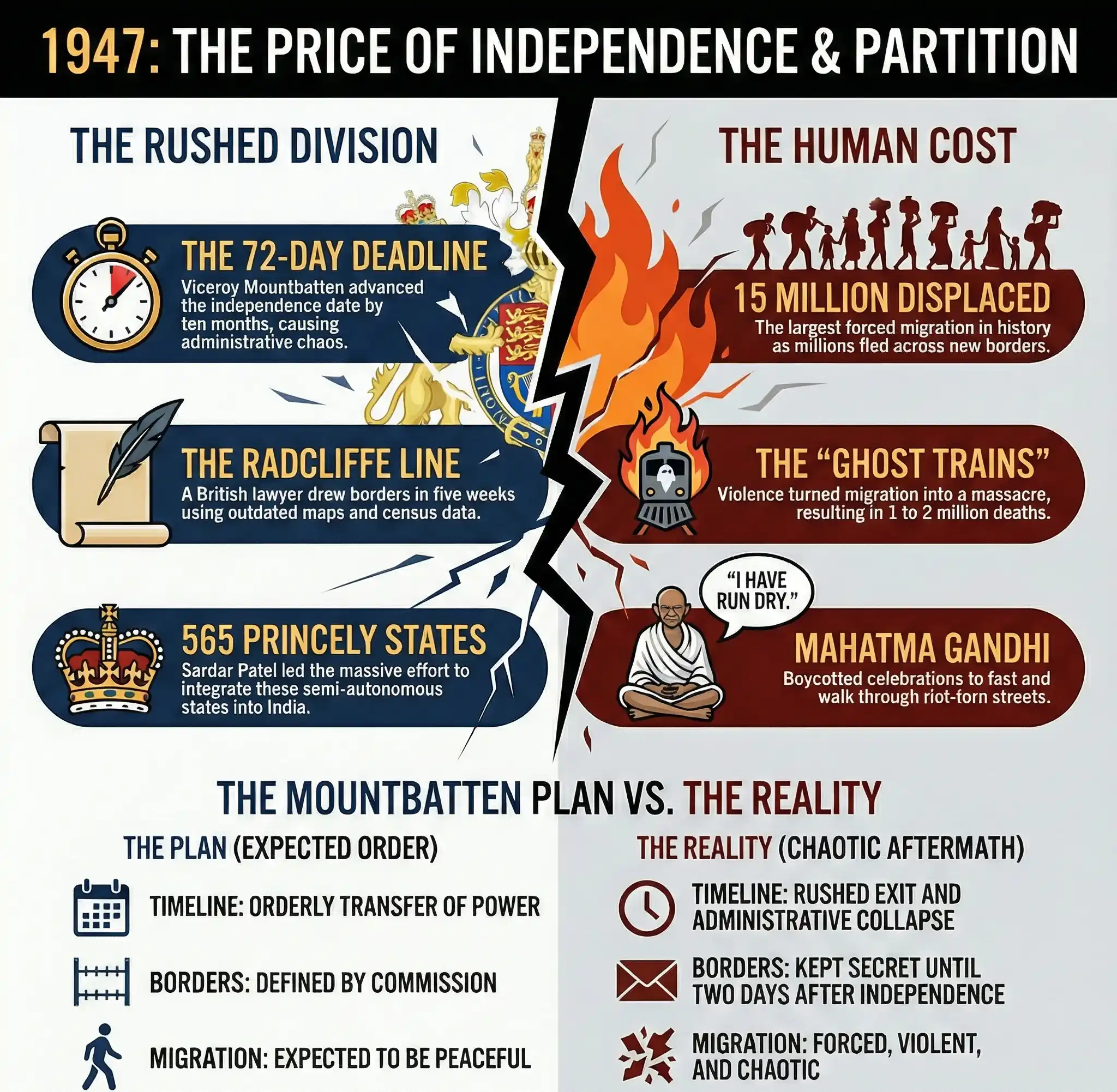
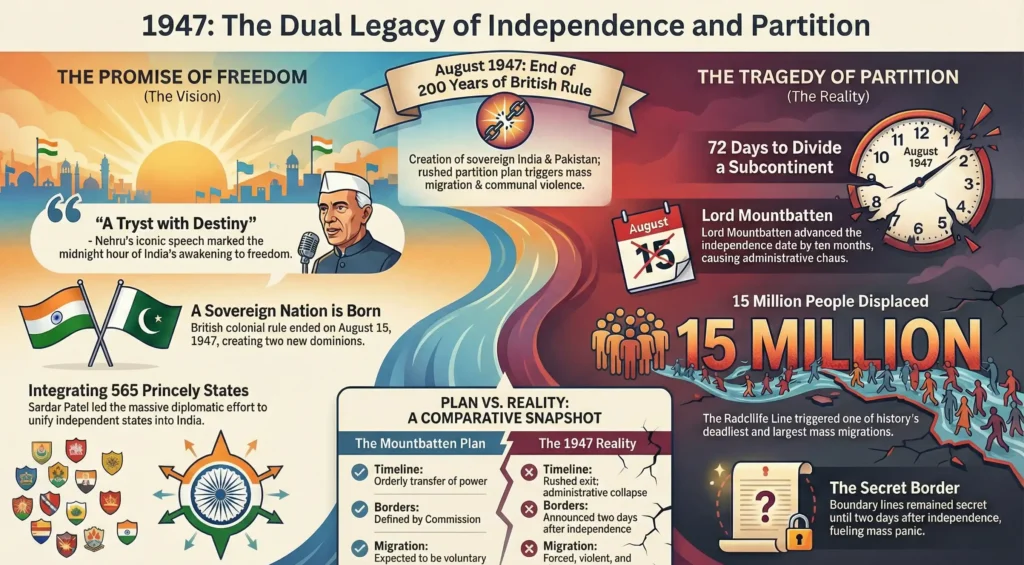
The Second World War had left Britain broke and exhausted, and after the Quit India revolt and the mutinies that followed, the will to hold India was gone. The last Viceroy, Lord Mountbatten, arrived and quickly concluded that any delay would only mean a slide into civil war. So he made a fateful decision. He brought the date of independence forward by some ten months, to 15 August 1947.
It was a decision that would be blamed for much of the horror to come. It left barely ten weeks to cut a country of four hundred million people in two: to divide an army, a railway network, a treasury, and above all the tangled lives of families and villages that had shared the same land for centuries. Such a thing could not be done carefully in ten weeks. It was not done carefully.
The Constitution of India: How 299 Visionaries Scripted a Nation’s Destiny
The line no one could see
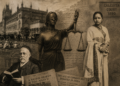
The job of drawing the actual border was handed to a British lawyer named Sir Cyril Radcliffe, a man who had never once set foot in India.
He was given about five weeks, some out-of-date maps and census tables, and the task of deciding, in the sweltering heat of a Delhi bungalow, exactly where to cut through the living provinces of Punjab and Bengal. Where his pencil fell, families would be split, farms severed, and millions turned overnight into strangers in their own homeland.
The line that would decide the fate of millions was drawn in a few weeks by a man who had never seen the country, and then kept secret until two days after freedom itself.
That last detail is the cruellest of all. The border was not announced until 17 August, two days after independence. So on the day of freedom, millions of people living in the border districts did not yet know which of the two new countries they were in, or whether they were about to become a hunted minority. Into that terrible uncertainty, the violence came flooding.
The tryst with destiny
And yet the joy was real, and it was earned.
In the Constituent Assembly in Delhi, as the clock reached midnight, Jawaharlal Nehru rose to speak, and gave the new nation words it has never forgotten.
At the stroke of the midnight hour, he said, when the world sleeps, India will awake to life and freedom.
The Union Jack came down. The tricolour went up. For that moment, at least, it was pure triumph, and it deserved to be. A hundred years of struggle had led to this, from the first cautious meetings of the Congress, through the sacrifices of countless ordinary people, to the mass movements that had finally made the country impossible to rule. Freedom had been fought for, and suffered for, and now it had come. No one should ever be made to feel ashamed of the joy of that night.
Assassination of Mahatma Gandhi: The Shot That Silenced a Nation
While Delhi celebrated
But hundreds of miles from the speeches and the flags, the same midnight wore a very different face.
While Delhi celebrated, Punjab was on fire, and Bengal was bleeding. The dividing of the country had triggered a migration of almost unimaginable size, as some fifteen million people fled across the new borders: Hindus and Sikhs pouring toward India, Muslims pouring toward Pakistan, whole communities abandoning homes their families had lived in for generations.
And on those roads and rails, they were slaughtered. Trains set out across the new border and reached the other side filled with the dead. Neighbours who had lived peacefully beside one another for a lifetime turned killers overnight. Countless women were seized and abused. By the time the worst had passed, perhaps a million people were dead, and possibly more.
The killing ran in every direction. Hindu, Muslim and Sikh all died, and all killed, and no community came through those weeks with clean hands. It was not one people’s crime. It was a shared catastrophe.
This is the hardest part of the story to sit with, and the most important neither to flinch from nor to twist. The horror of Partition was not something done by one community to another. It was something a whole society did to itself, in a fever of fear and revenge, and every side both suffered it and inflicted it.
Where Gandhi was
Perhaps the truest measure of that night is where the father of the nation chose to be.
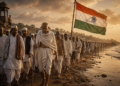
Mahatma Gandhi, the man more responsible than any other for India’s freedom, was not in Delhi for the celebrations. He wanted no part in them. He was far away in Calcutta, a city torn by communal killing, fasting and walking its wounded streets, trying with nothing but his own frail body and his moral authority to make Hindus and Muslims stop murdering one another. And for a while, astonishingly, in that one city, he succeeded.
Asked to send a message to the new and free nation on its first day, Gandhi had almost nothing to give. I have run dry, he said.
He understood, more clearly than the men making speeches under the bright lights, that this freedom had arrived wrapped in a shroud, and that there could be no true celebration while the trains were still coming in full of the dead.
1991 Economic Reforms: How India Pledged Gold to Buy a Future
The unfinished map
Even the shape of the new country was not fully settled that night.
More than five hundred princely states had to be knitted into India, a vast and delicate task carried through mostly by the iron will of Sardar Patel and his adviser V.P. Menon. Most joined quickly. But a few did not, and one of them, Kashmir, would become a wound between India and Pakistan that has never fully healed, and the cause of wars still to come. The line that Radcliffe drew in 1947 was not the end of the story of borders in the subcontinent. In some places, it was only the beginning.
Two truths
So what is a nation to do with a single date that holds both its greatest joy and one of its deepest sorrows?
There are two easy answers, and both of them are lies. One is to remember only the freedom, to wave the flag each 15 August and quietly forget the ghost trains and the million dead. That is a comfortable forgetting, and it dishonours the ones who paid the price. The other is to remember only the horror, to let the grief of Partition swallow the triumph whole. That is a counsel of despair, and it dishonours everyone who struggled and sacrificed for the freedom that was, truly, won.
The harder path, and the only honest one, is to hold both truths at once.
India was born free, and India was born wounded, in the very same midnight. To remember only the freedom is to forget the cost. To remember only the wound is to forget the victory.
A mature nation, like a mature person, is one that can carry a great joy and a great grief in the same heart, without letting either one cancel out the other. And so every 15 August, the tricolour should rise with real, unembarrassed joy, because the freedom was real, and hard-won, and precious beyond price. And in the same breath, the country should fall silent for a moment for the million who died and the fifteen million who lost their homes, whatever their religion, because that price was real too, and it was paid by people of every faith.
That is the whole truth of 1947, and the whole inheritance. Freedom and the wound, together, forever. The work of every Indian generation since has been, and still is, the same quiet task: to honour the freedom, and to keep healing, patiently, the wound that came with it.
The 1969 Bank Nationalization: How Indira Gandhi Seized the Vaults
If you think you have remembered everything about this topic take this QUIZ
Results


#1. Which plan officially formalized the partition of India and Pakistan?
#2. Which British Viceroy advanced the date of independence by ten months to August 1947?
#3. Where was Mahatma Gandhi on the night of August 14, 1947, instead of celebrating in Delhi?
#4. What was the name of the iconic speech delivered by Jawaharlal Nehru on the eve of independence?
#5. Which leader, along with V.P. Menon, was responsible for integrating the 565 Princely States into the Indian Union?
#6. What term was used to describe the trains arriving at stations filled with corpses during the partition violence?
#7. Why did Sir Cyril Radcliffe refuse his fee of £3,000 after drawing the boundary line?
#8. Who was the British lawyer responsible for drawing the boundary line (Radcliffe Line) between India and Pakistan?
Why was August 15 chosen as Independence Day?
Lord Mountbatten chose August 15 because it was the second anniversary of Japan’s surrender in World War II, an event he considered lucky for his career.
Who drew the border between India and Pakistan?
Sir Cyril Radcliffe, a British lawyer, chaired the Boundary Commissions that drew the “Radcliffe Line” dividing Punjab and Bengal.
Why did Mahatma Gandhi not celebrate independence?
Gandhi was distressed by the communal violence and partition. He spent the day in Calcutta, fasting and praying for peace between Hindus and Muslims.
How many people died during the Partition?
Estimates vary widely, but historians generally agree that between 1 million and 2 million people were killed in the communal riots and migration violence.
What was the “Tryst with Destiny”?
It was the historic speech delivered by Jawaharlal Nehru to the Indian Constituent Assembly on the eve of independence, marking the end of British rule.
Sources & References
- UK legislation records (Indian Independence Act 1947) — the law that ended British rule and created the two dominions of India and Pakistan.
- Encyclopaedia Britannica (“Partition of India”) — the Mountbatten Plan, the advanced timetable, the Radcliffe Line, and the scale of the migration.
- The Partition Museum, Amritsar — the human experience of Partition, the migration, and the violence.
- Encyclopaedia Britannica (“Mahatma Gandhi”) — Gandhi’s absence from the celebrations and his work for peace in Calcutta.
Author


Exploring the Soul of Bharat through History, Science, Culture, and its Diversity
Our Mission
Curious Indian is a definitive knowledge portal dedicated to chronicling the events, personalities, and cultural shifts that defined the Indian subcontinent. From the ancient Vedic Period to the complexities of 21st-century politics, our goal is to provide deep-dive analysis that inspires.
Editorial Standards & E-E-A-T
Every article published under our brand undergoes a rigorous fact-checking process. We prioritize primary historical records, academic citations, and credible archives to ensure our readers receive accurate, high-authority information.
Historical Integrity Directly sourcing from ASI archives and academic journals.Topical Authority Comprehensive clustering of Indian Science, Biographies, and Wars.Managed by Paripurna Datta and TEAM | Dedicated to the Knowledge of India.