How India’s first emperor learned that having everything is not the same as being free
He was born a nobody. He died a starving monk on a lonely hill, with nothing at all to his name. And in between those two very humble endings, he became the single most powerful man in all of India, the first person in history to rule over almost the entire subcontinent.
This is the astonishing life of Chandragupta Maurya, a man who climbed all the way from nothing to everything, and then made a discovery that changed him completely: that “everything” was, in fact, a kind of prison. And so, in the end, he gave the whole of it up, in order to set himself free.
The nobody
Chandragupta was not born to greatness at all. By the old accounts, his mother was a woman of humble birth, and as a young man he was an outsider, even driven for a time into exile. In the eyes of the world of his day, he was a nobody from nowhere in particular.
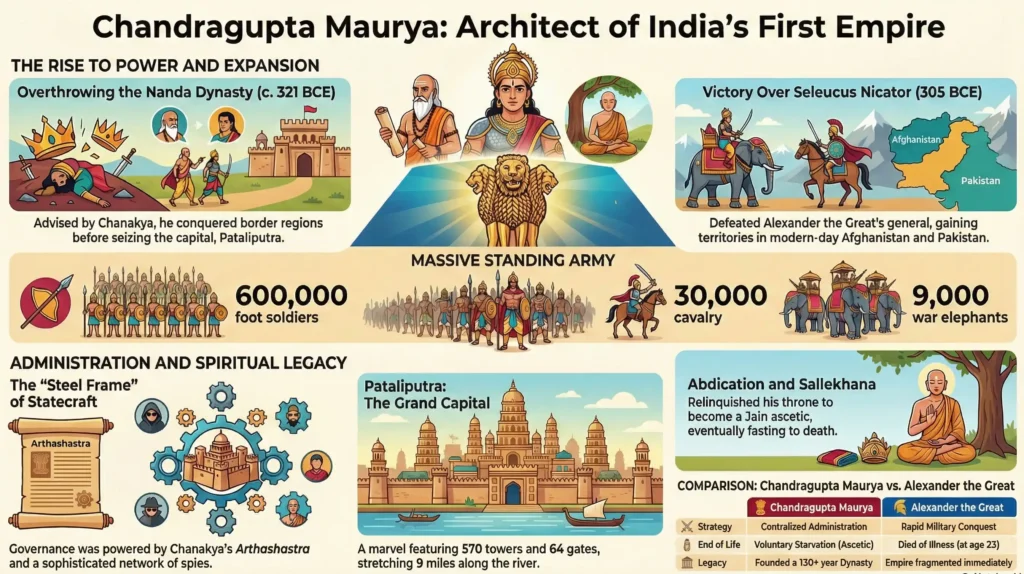
But he had a fierce will and a sharp mind, and, most importantly of all, he found himself a brilliant and utterly ruthless teacher named Chanakya, who somehow saw the hidden emperor inside the outcast boy. Together, through long years of cunning and hard war, the two of them did the impossible.
A nobody, the son of a humble woman and once an exile, clawed his way up to become the first man in all of history to rule almost the whole of India.
They overthrew the powerful king who then ruled the land, and this nobody, this former exile, placed the crown of an empire upon his own head. He went on to build the first great empire that India had ever seen, one that stretched all the way from Afghanistan in the west to Bengal in the east. He had, quite literally, made himself from nothing into the most powerful man in the entire world that he knew.
Reign of Samudragupta 335-375 CE: The Napoleon of India
The prison of power
And here the story takes a turn that most people never get to hear. We have a rare and precious window into what Chandragupta’s life at the very top was actually like, because a Greek ambassador named Megasthenes came to live at his court, and carefully wrote down what he saw there.
What he saw was not a happy, contented king enjoying the fruits of his power. What he saw was a man living in fear.
The most powerful man in all of India, it turned out, was quietly terrified, terrified of being murdered. And who, in truth, could really blame him? He had taken his throne by force, and he knew perfectly well that others might one day try to take it from him in exactly the same way. So he lived like a hunted animal inside his own grand palace.
He was so afraid of being murdered that he kept tasters to check his food for poison, was guarded day and night by a bodyguard of armed women, and never dared to sleep in the same room two nights running.
He rarely left the palace at all, except to go off to war, or to hunt, or to sit in judgment over his people. And perhaps most haunting of all is that one small, sad detail: that he was so afraid of assassins creeping up on him in the dark that he never once slept in the same room two nights in a row. Just imagine it for a moment. The master of a whole empire, the richest and mightiest man in all the land, and he could not even lie down and sleep in peace in his own bed. He had won everything there was to win, and everything had slowly turned into a cage.
Reign of Ashoka: The Emperor Who Chose Peace
The escape
So how does a man ever escape from a prison that is built out of his own power? In the end, Chandragupta found the one door that led out of it.
In his later years, a terrible famine is said to have struck his land, and the suffering of his people moved him very deeply. By this time, too, he had been drawn steadily toward the gentle, world-renouncing faith of Jainism. And so he made the most extraordinary decision of his whole extraordinary life. He decided, quite simply, to give it all away.
He took off his crown and handed the empire to his son. He walked away from the palace, the guards, the tasters, and the gold, became a wandering monk, and ended his life fasting quietly to death on a lonely hill.
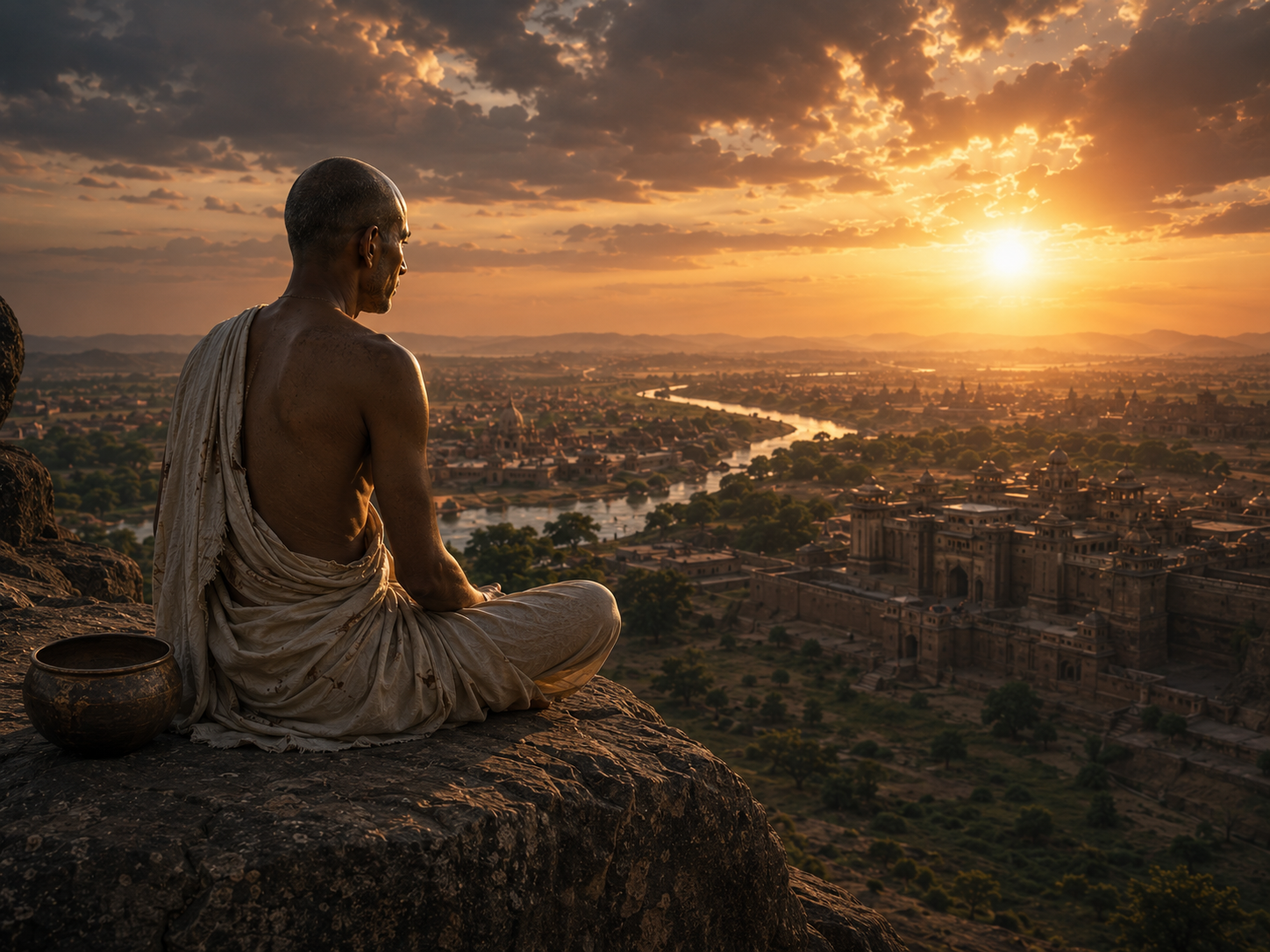
He lifted the heavy crown from his own head and handed the entire empire over to his son. He walked away from the palace, from the armed guards, from the food tasters, from the mountains of gold, from all of it. And, following a Jain holy man, he travelled far away to the south of India, where he became a simple, wandering monk who owned nothing at all. There, upon a quiet hill, following the very strictest path of his new faith, he brought his own life gently to an end, by fasting slowly and peacefully until he died.
Reign of Akbar 1556-1605: The Golden Age of the Mughal Empire
From nothing to nothing
And so the great circle of his life quietly closed. He had begun with absolutely nothing, a poor, exiled nobody. He had then gained, by sheer force of his own will, very nearly everything that a single person could possibly gain, the throne of all India. And at the very end, he chose, entirely of his own free will, to have nothing once again: a thin, starving monk on a bare hillside, owning not even the clothes upon his own back.
It is easy enough to see his story as a tragedy, or simply as a grand and pious renunciation of the world. But there may be something gentler, and far stranger, hidden inside it than that. Chandragupta had learned, the very hardest way there is, a lesson that all of his power had slowly taught him: that having everything is not at all the same thing as being free. Upon his throne, as master of millions, he could not so much as sleep for fear. On that lonely southern hill, with nothing left to lose and nothing left to guard, he could at last simply rest. Perhaps the poor monk who died fasting in the forest was, in the end, a freer man than the great emperor had ever been. And perhaps that is the truest and most surprising thing of all about the man who built India’s very first empire: that his final, and wisest, act was to give the whole of it away.
Foundation of the Vijayanagara Empire: The Rise of Hampi
If you think you have remembered everything about this topic take this QUIZ
Results


#1. Who was the mentor and prime minister who guided Chandragupta Maurya to overthrow the Nanda dynasty?
#2. In 305 BCE, Chandragupta Maurya defeated which Greek general, securing territories in Afghanistan?
#3. Which Greek ambassador visited Chandragupta’s court and wrote the book ‘Indica’?
#4. In his later years, Chandragupta abdicated the throne and traveled to which place to become a Jain ascetic?
#5. Which ancient Greek name is used to refer to Chandragupta Maurya in historical texts?
#6. Chandragupta Maurya overthrew which oppressive dynasty to seize the throne of Magadha?
#7. The practice of fasting to death adopted by Chandragupta in his final days is known in Jainism as:
Who was the mentor of Chandragupta Maurya?
Chanakya (also known as Kautilya or Vishnugupta) was his mentor and Prime Minister.
Which Greek general did Chandragupta defeat?
He defeated Seleucus Nicator in 305 BCE.
What book provides detailed information about Mauryan administration?
The Arthashastra by Chanakya (Kautilya).
How did Chandragupta Maurya die?
He died by performing Sallekhana (ritual fasting to death) at Shravanabelagola as a Jain ascetic.
What was the capital of the Mauryan Empire?
The capital was Pataliputra (modern-day Patna).
Sources and references
- 1911 Encyclopaedia Britannica and Britannica (“Chandragupta Maurya”) — his birth to a woman of humble origin, his early exile, his identification by the Greeks as Sandracottus, and Megasthenes’ description of him living in fear of assassination and never sleeping two nights in the same room.
- Macrohistory (fsmitha.com) and Megasthenes’ Indica fragments — the network of spies, the food tasters against poison, the bodyguard of women, and the emperor rarely leaving his palace except for war, hunting, judgment or sacrifice.
- Connect Civils / RajRAS and Curious Indian’s own overview — Chandragupta’s guidance by Chanakya, the overthrow of the Nandas, the defeat of Seleucus and the 500 war elephants, the centralized administration, and Megasthenes as Seleucus’s ambassador at Pataliputra.
- Connect Civils and Jain-tradition sources (Hemachandra’s Parishishtaparvan) — his later initiation by the Jain monk Bhadrabahu, the abdication in favour of Bindusara amid a twelve-year famine, and his death by Sallekhana (ritual fasting) at Shravanabelagola in Karnataka.
- General histories of the Mauryan period — the extent of the empire from Afghanistan to Bengal, and the identification of Sandrocottus with Chandragupta Maurya by William Jones in 1793.
Author


Exploring the Soul of Bharat through History, Science, Culture, and its Diversity
Our Mission
Curious Indian is a definitive knowledge portal dedicated to chronicling the events, personalities, and cultural shifts that defined the Indian subcontinent. From the ancient Vedic Period to the complexities of 21st-century politics, our goal is to provide deep-dive analysis that inspires.
Editorial Standards & E-E-A-T
Every article published under our brand undergoes a rigorous fact-checking process. We prioritize primary historical records, academic citations, and credible archives to ensure our readers receive accurate, high-authority information.
Historical Integrity Directly sourcing from ASI archives and academic journals.Topical Authority Comprehensive clustering of Indian Science, Biographies, and Wars.Managed by Paripurna Datta and TEAM | Dedicated to the Knowledge of India.