The Homi Bhabha death mystery explores the suspicious 1966 crash of Air India Flight 101 on Mont Blanc, which killed the "Father of India's Nuclear Program." While official reports blame pilot error, persistent theories suggest a CIA-led assassination aimed at halting India's rapid nuclear advancements. The lack of a recovered black box and the suspicious timing of the crash—just days after the death of PM Lal Bahadur Shastri—continue to make this one of India's most debated historical conspiracies.| Feature | Details |
| Date of Incident | January 24, 1966 |
| Location | Mont Blanc, Alps (French-Italian Border) |
| Primary Figure | Dr. Homi Jehangir Bhabha |
| Flight Name | Air India Flight 101 (The Kanchenjunga) |
| Key Controversy | Alleged sabotage to halt India’s nuclear progress |
If the death of Lal Bahadur Shastri in Tashkent was a tragedy, what followed just 13 days later (The Homi Bhabha Death Mystery) was a catastrophe that brought India to its knees.
On January 24, 1966, the chilling winds of the Alps whispered a secret that remains buried under snow and silence. Dr. Homi Jehangir Bhabha, the “Oppenheimer of India” and the man who promised to give India an atomic bomb in 18 months, boarded Air India Flight 101.
Named ‘Kanchenjunga’, the Boeing 707 was en route to London. It never arrived.
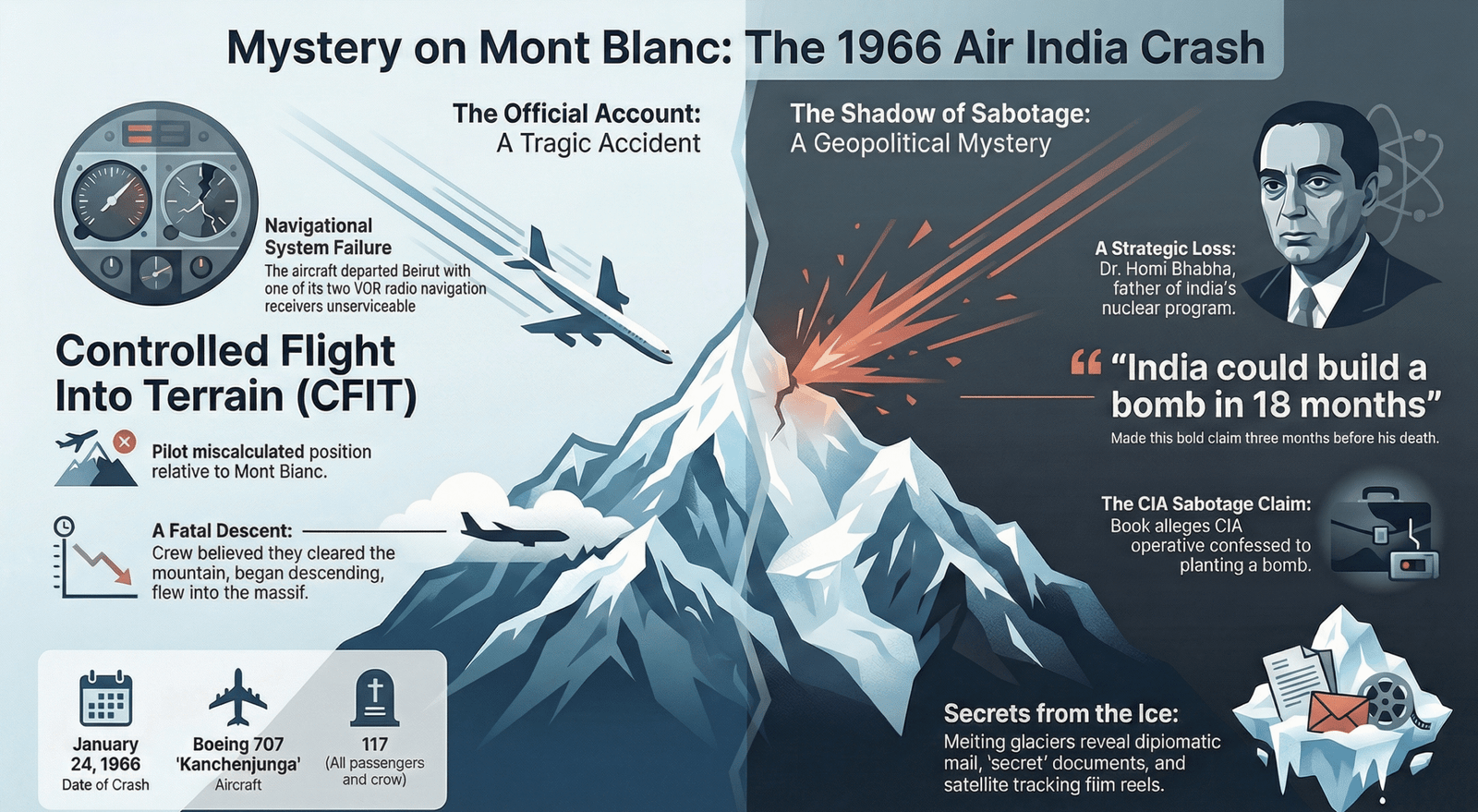
It crashed into the Mont Blanc massif in France, killing all 117 people on board. The official verdict was “pilot error.” But for decades, intelligence insiders and historians have asked a terrifying question: Was this a calculated strike to cripple India’s strategic future?
Welcome to the Unsolved India, where we climb the frozen peaks of Mont Blanc to find the truth behind the death of India’s nuclear architect.
The Man Who Scared the Superpowers
To understand the Homi Bhabha death mystery, you must understand the threat he posed to the global order. Homi Bhabha was not just a scientist; he was the visionary architect of India’s nuclear sovereignty.
As the founder of the Atomic Energy Commission (AEC), he was building the infrastructure that would define India’s future. But it was his confidence that alarmed the West.
In October 1965, just three months before the crash, Bhabha made a bold declaration that sent shockwaves through the CIA and KGB: India possessed the capability to build an atomic bomb within 18 months if it chose to do so.
This was the height of the Cold War. The US and USSR were drafting the Nuclear Non-Proliferation Treaty (NPT) to stop new nations from getting the bomb. Bhabha’s declaration made him a direct obstacle to their agenda.
Dr. A.P.J. Abdul Kalam: (1931-2015)
The Crash: January 24, 1966
Air India Flight 101 was flying from Bombay to London, with a stop scheduled in Geneva. The pilot, Captain Joe T. D’Souza, was an 18-year veteran.
As the plane approached Geneva, a deadly chain of errors began.
The Equipment Failure: The aircraft had taken off from Beirut with one of its VOR receivers (a critical navigation aid) unserviceable.
The Miscalculation: Captain D’Souza calculated his position and reported it to the tower. He was under the mistaken impression that he had already passed the Mont Blanc ridge.
The Impact: Believing the path was clear, he initiated a descent. At 8:02 AM, the ‘Kanchenjunga’ slammed into the Rocher de la Tournette ridge at 15,000 feet.
The impact was so violent that the aircraft shattered into small pieces, killing everyone instantly.
Parameter | Detail |
Aircraft Registration | VT-DMN |
Aircraft Type | Boeing 707-437 (Named ‘Kanchenjunga’) |
Date and Time of Crash | 24 January 1966, 8:02 CET |
Crash Location | Mont Blanc massif, France (Rocher de la Tournette ridge) |
Fatalities | 117 (106 Passengers, 11 Crew) |
The “Crow” Confession: Was it a Bomb?
While the French investigation ruled it a “Controlled Flight Into Terrain” (CFIT), a far darker narrative emerged years later from the shadows of the espionage world.
In the book Conversations with the Crow, journalist Gregory Douglas interviewed former CIA officer Robert Crowley. In these alleged conversations, Crowley implied that the CIA was responsible for eliminating Bhabha to stop India’s nuclear rise.
Crowley reportedly said:
“That one was dangerous, believe me. He was flying to Vienna to stir up more trouble when his Boeing 707 had a bomb go off in the cargo hold.”
Crowley even allegedly justified the location, stating, “We decided the high mountains were much better for the bits and pieces to come down on”.
While Douglas’s credibility has been questioned by historians, the geopolitical motive was undeniable. The US State Department was actively assessing India’s bomb capability in March 1966. Removing Bhabha created a vacuum that delayed India’s nuclear program and gave the superpowers time to push the NPT.
8 Defining Chapters in the Vikram Sarabhai Biography


The Glacier Spits Out Secrets
The most fascinating part of this mystery is that the mountain is still talking. The glaciers of Mont Blanc move, and over the decades, they have churned out debris from the crash, offering clues that the flight was carrying more than just passengers.
1. The Bag of Gems (2013) In 2013, a climber found a bag containing emeralds, sapphires, and rubies on the glacier. While this proves high-value cargo was on board, it was just the tip of the iceberg.
2. The “Secret” Document (2021) For years, it was believed that sensitive diplomatic mail was carried in the cabin. But in 2021, a “Secret” document from the Indian Ministry of External Affairs (MEA) was recovered from the wreckage. This confirmed that critical state secrets were being transported in the cargo hold.
3. The Spy Satellite Films (2024) The most explosive find came recently. Debris recovered included film reels from the Smithsonian Astrophysical Observatory. These reels were part of a US satellite tracking program used for Cold War intelligence.
This proves that Air India 101 was not just a civilian flight; it was carrying strategic intelligence assets of interest to the US government.
Factor Category | Official Conclusion | Supporting Detail |
Primary Cause | Controlled Flight Into Terrain (CFIT) | Accidentally flew into the Mont Blanc massif |
Equipment Failure | Navigational Aid Unserviceability | One VOR receiver was unserviceable upon departure from Beirut |
Crew Performance | Miscalculation and Judgment Error | Pilot mistakenly initiated descent, thinking the aircraft had passed Mont Blanc |
ATC Interaction | Positional Discrepancy | Controller noted aircraft position differently than pilot’s estimate, but pilot proceeded with descent |
Conclusion: A Strategic “Accident”?
The official investigation paints a picture of a tragic accident caused by a broken radio and a pilot’s mistake. And technically, that may be true.
But in the world of covert operations, a “technical failure” is the perfect cover. A sophisticated sabotage operation could have involved jamming navigation signals to confuse the crew, guiding them into the mountain without a single explosive being used.
The facts remain:
India’s Prime Minister died on January 11.
India’s Nuclear Chief died on January 24.
Both deaths occurred exactly when India was threatening the global nuclear monopoly.
Whether it was a bomb in the cargo hold or a ghost in the navigation machine, the crash of Flight 101 ensured that the “18-month” deadline for India’s bomb was never met.
The Roopkund Skeleton Lake Mystery: Why Were Greeks Dying in the Indian Himalayas?
Curious India: Fast Facts
The Second Crash: Strangely, Air India Flight 101 crashed only 200 meters away from where another Air India flight (AI 245) had crashed in 1950.
The Unserviceable Part: The plane was allowed to take off from Beirut despite having a broken VOR receiver, a critical violation of safety for a mountain route.
The Newspaper: A copy of The Hindu dated Jan 21, 1966, was found in the glacier perfectly preserved. It carried headlines about Indira Gandhi becoming PM.
If you think you have rememberd everything about this topic take this QUIZ
Results


#1. What was the official cause of the Air India Flight 101 crash in 1966, according to the French investigation? ? Hint
Consider the combination of human factors and the aircraft’s technical condition during its final approach.
#2. The Boeing 707 operating as Air India Flight 101 was named after what? ? Hint
The aircraft’s name is shared with a famous Himalayan peak.
#3. What recent discovery from the melting Bossons glacier confirmed the flight was carrying sensitive Cold War-era strategic materials for a US organization? ? Hint
Think about what kind of technology was crucial for monitoring adversaries from space during the 1960s.
#4. According to the book “Conversations with the Crow,” what method was allegedly used by the CIA to assassinate Homi Bhabha? ? Hint
The theory described in the book points to an explosive device hidden somewhere on the plane.
#5. A diplomatic mailbag recovered from the crash site in 2012 contained readable newspapers from January 1966. What major political event in India did they report? ? Hint
The news concerned a significant leadership change in India.
#6. The crash of Air India Flight 101 in 1966 was eerily similar to what previous incident? ? Hint
Look for another Air India flight that met its end in the French Alps.
#7. What was the primary reason for the renewed interest and frequent discovery of wreckage from Flight 101 decades after the crash? ? Hint
Think about the environmental changes affecting high-altitude, icy regions.
#8. What geopolitical statement made by Homi Bhabha just three months before his death is often cited as a motive in assassination theories? ? Hint
The statement involved a specific timeline for India to develop a powerful weapon.
What was the official cause of Dr. Homi Bhabha’s death?
The official French inquiry concluded the cause was “Controlled Flight Into Terrain” (CFIT). It was attributed to the pilot miscalculating his position and initiating a descent before clearing the Mont Blanc summit, worsened by a faulty VOR receiver.
Why do people believe the CIA killed Homi Bhabha?
The theory stems from a claim by former CIA officer Robert Crowley, who allegedly admitted that the CIA bombed the plane to stop India’s nuclear program. Bhabha had recently announced India could build a bomb in 18 months, which threatened US/Soviet non-proliferation goals.
What strange items have been found in the crash wreckage?
Over the years, the glacier has revealed a bag of precious gems (emeralds/rubies), “Secret” documents from the Indian Ministry of External Affairs, and film reels from a US spy satellite tracking program.
Is there any physical evidence of a bomb?
No verifiable forensic evidence of an explosion (like chemical residue or fragmentation) was found by the official investigation. However, the challenging terrain and the total destruction of the aircraft made detailed forensic analysis difficult.
This article is part of our exclusive series Unsolved India. Read the previous chapter: The Lal Bahadur Shastri Death Mystery.