This article explores the extraordinary life of Sushruta, the ancient Indian sage who laid the foundations of surgical science in Kashi over 2,600 years ago. By examining the Sushruta Samhita, we uncover a world of advanced medical procedures, from the first recorded plastic surgeries to complex cataract removals. Sushruta’s meticulous approach to anatomy, anesthesia, and sterilization proves that the "Wandering Surgeon" was millennia ahead of his time. His legacy is not just a part of Indian heritage but a cornerstone of global medical history, proving that the art of healing through the scalpel has deep, ancient roots in the Indian soil.| Category | Details |
| Name | Sushruta |
| Known As | The Father of Plastic Surgery |
| Era | Circa 600 BCE |
| Primary Work | Sushruta Samhita |
| Specialization | Shalya-Tantra (Surgical Science) |
| Major Discovery | Reconstruction of the nose (Rhinoplasty) |
The First Surgeon: Unveiling the Mastery of Sushruta
Imagine walking through the bustling streets of ancient Kashi in 600 BCE. While the rest of the world was largely reliant on prayers and primitive potions to heal wounds, a group of students sat gathered around a master on the banks of the Ganges. This master was not teaching philosophy or poetry; he was teaching the art of the blade. This was Sushruta, the man whose work, Sushruta Samhita Surgery, would eventually earn him the title of the Father of Plastic Surgery. His classroom was a place of radical innovation, where the human body was mapped with a precision that would not be replicated in the West for nearly two thousand years.
The mystery of Sushruta lies in his fearless approach to the physical form. As an Ancient Indian Surgeon, he did not shy away from the sight of blood or the complexity of internal organs. He understood that while internal medicine—like that of his peer Charaka—was vital, there were moments when only a steady hand and a sharp instrument could save a life. This was the birth of Shalya-Tantra, the surgical branch of Ayurveda, which transformed the way humanity approached trauma and deformity.
7 Secrets of Padmanabhaswamy Temple Treasure
The Brilliance of the Sushruta Samhita
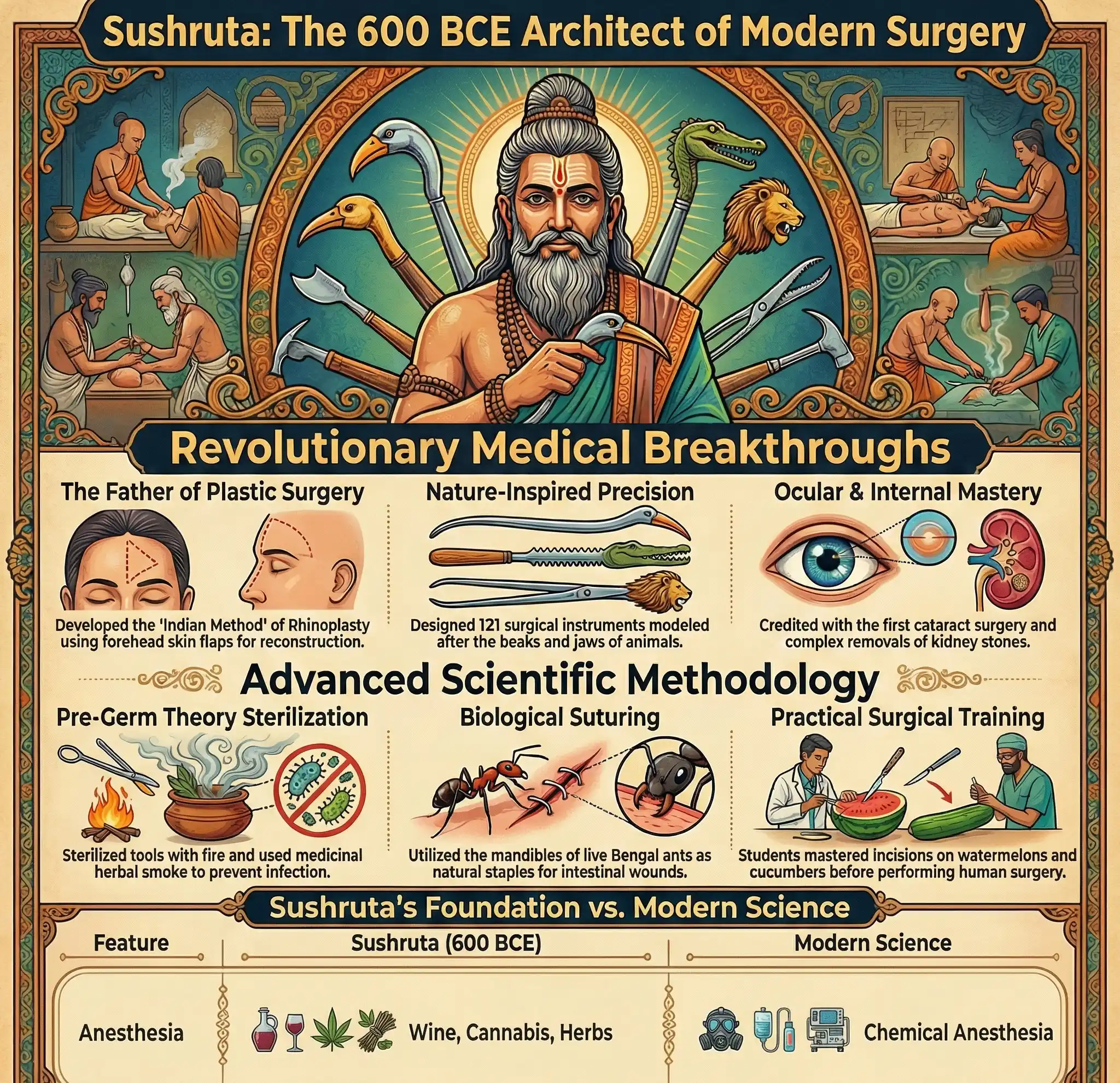
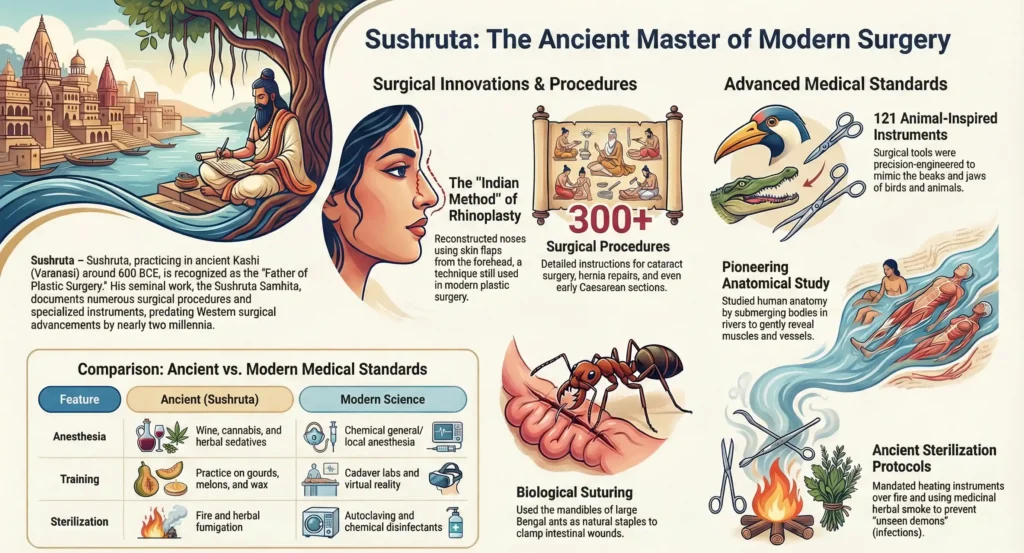
The Sushruta Samhita is more than just a medical textbook; it is a comprehensive manual for the brave. It describes over 1,120 illnesses, 700 medicinal plants, and, most impressively, 121 ancient surgical instruments. Sushruta insisted that a surgeon must be like a lion in courage but have the hands of a maiden in delicacy. He designed his tools to mimic the beaks and jaws of animals and birds, ensuring they were perfectly shaped for specific tasks, from probing deep wounds to extracting foreign objects.
What makes Sushruta Samhita Surgery truly legendary is its documentation of over 300 different surgical procedures. He didn’t just suggest how to cut; he detailed how to prepare the patient, how to manage pain using substances like wine or cannabis, and how to ensure the wound healed without infection. His techniques for “Sarshtika” (the suturing of wounds) involved using threads of hemp, hair, or even the heads of large ants whose mandibles acted as natural staples.
The Pioneer of Reconstructive Arts
Sushruta is perhaps most famous globally for the Sushruta Rhinoplasty Method. In ancient India, the nose was considered a symbol of honor, and its removal was a common punishment for crimes or adultery. Driven by compassion for those “de-nosed,” Sushruta developed a technique to reconstruct the nose using a flap of skin from the cheek or forehead.
This procedure, known today as the “Indian Method” of Rhinoplasty, remained virtually unchanged for centuries. It was eventually witnessed by British surgeons in the 18th century in India, who brought the knowledge back to Europe, effectively birthing the modern history of plastic surgery. When we look at the evolution of modern surgery, the lineage leads directly back to the banks of the Ganges and the meticulous sutras of Sushruta.
7 Untold Stories of Battle of Asal Uttar 1965 Victory
Mapping the Human Temple
To be a master of Sushruta Samhita Surgery, one had to be a master of anatomy. In a time when touching a corpse was often considered taboo, Sushruta found a way to study the body without violating social norms. He would place a body in a cage and submerge it in a slow-flowing river for seven days. As the layers of skin softened and decayed, he would use brushes made of grass to gently peel back the layers, revealing the muscles, bones, and vessels beneath.
This hands-on approach allowed him to identify 107 “Marmas” or vital points in the body. He warned his students that a single wrong cut on a Marma could lead to instant death or permanent paralysis. This ancient knowledge was so advanced that it included procedures for cataract surgery, hernia repair, and even Caesarean sections. Sushruta was also an expert in lithotomy—the removal of kidney stones—a procedure so dangerous that few dared to attempt it until the modern era.
A Legacy of Sterilization and Ethics
Long before the “germ theory” of disease was established in the 19th century, this surgeon understood the importance of cleanliness. He advocated for the sterilization of instruments by heating them over a flame and emphasized that a surgeon must keep his nails short and his hair covered. He believed that the environment of the operating room should be purified with the smoke of medicinal herbs to keep “unseen demons” (infections) away.
As a pioneer of Indian heritage and science, his work reflects a profound ethical commitment. He taught his students that surgery was not just about technical skill but about the restoration of dignity. Whether he was fixing a broken limb or reconstructing a face, Sushruta’s goal was to return the patient to a state of wholeness.
6 Unfoldings in the Subrahmanyan Chandrasekhar Biography
Quick Comparison: Ancient vs. Modern Surgery
| Feature | Sushruta Samhita Surgery | Modern Surgical Science |
| Anesthesia | Wine, cannabis, and herbal sedatives. | General and local chemical anesthesia. |
| Instruments | 121 tools (modeled on animal beaks). | Thousands of specialized steel/laser tools. |
| Key Innovation | Forehead flap Rhinoplasty. | Microsurgery and 3D printing. |
| Sterilization | Fire and medicinal herbal fumigation. | Autoclaving and chemical disinfectants. |
| Training | Practice on gourds, melons, and wax. | Virtual reality and cadaver labs. |
Curious Indian: Fast Facts
- The First Trainer: Sushruta made his students practice incisions on watermelons, cucumbers, and dead skins before touching a human.
- Ocular Master: He is credited with performing the first-ever cataract surgery, using a curved needle to push the opaque lens.
- The Ant Staple: For intestinal surgeries, he used the jaws of live Bengal ants to clamp the wound before cutting off their bodies.
- Prosthetics: The Samhita mentions the use of artificial limbs made of iron to help those who lost legs in battle.
- Global Influence: His texts were translated into Arabic in the 8th century (as the Kitab-I-Susrud), reaching the West through the Silk Road.
Conclusion
Sushruta was not just a healer; he was a revolutionary who refused to accept the limitations of the human body. Through Sushruta Samhita Surgery, he proved that the ancient mind was capable of incredible scientific rigor and creative problem-solving. Every time a modern plastic surgeon restores a face or an ophthalmologist clears a cataract, they are echoing the movements of a man who sat on the banks of the Ganges 2,600 years ago. For the “Curious Indian,” Sushruta is a reminder that our history is carved not just in stone, but in the very survival and health of the human race.
8 Defining Chapters in the Vikram Sarabhai Biography
If you think you have remembered everything about this topic take this QUIZ
Results


#1. Sushruta is widely recognized by modern historians and medical professionals as the:
#2. Sushruta designed his 121 surgical instruments to mimic which of the following?
#3. The “Indian Method” of Rhinoplasty, developed by Sushruta, involved reconstructing the nose using:
#4. How did Sushruta study human anatomy to bypass the taboo of touching corpses?
#5. According to Sushruta, what are “Marmas”?
#6. What unique method did Sushruta use to staple intestinal wounds?
#7. To train his students in the art of incision, what objects did Sushruta have them practice on?
#8. Sushruta is credited with performing the first-ever surgery for which eye condition?
Why is Sushruta called the Father of Plastic Surgery?
He developed the first documented technique for reconstructive surgery of the nose (rhinoplasty) around 600 BCE, which is still the basis for some modern methods.
What is the main subject of the Sushruta Samhita?
The main subject is Shalya-Tantra (Surgery), detailing anatomy, over 1,120 diseases, and hundreds of surgical procedures.
How did Sushruta manage pain during surgery?
He used strong wine and various herbal sedatives, like cannabis, to dull the patient’s senses during invasive procedures.
Did Sushruta study human anatomy?
Yes, he used a unique non-invasive method of decomposing bodies in river water to study the muscles and organs without direct dissection.
Read More: https://curiousindian.in/bhaskara-ii-1114-c-1185-ce/