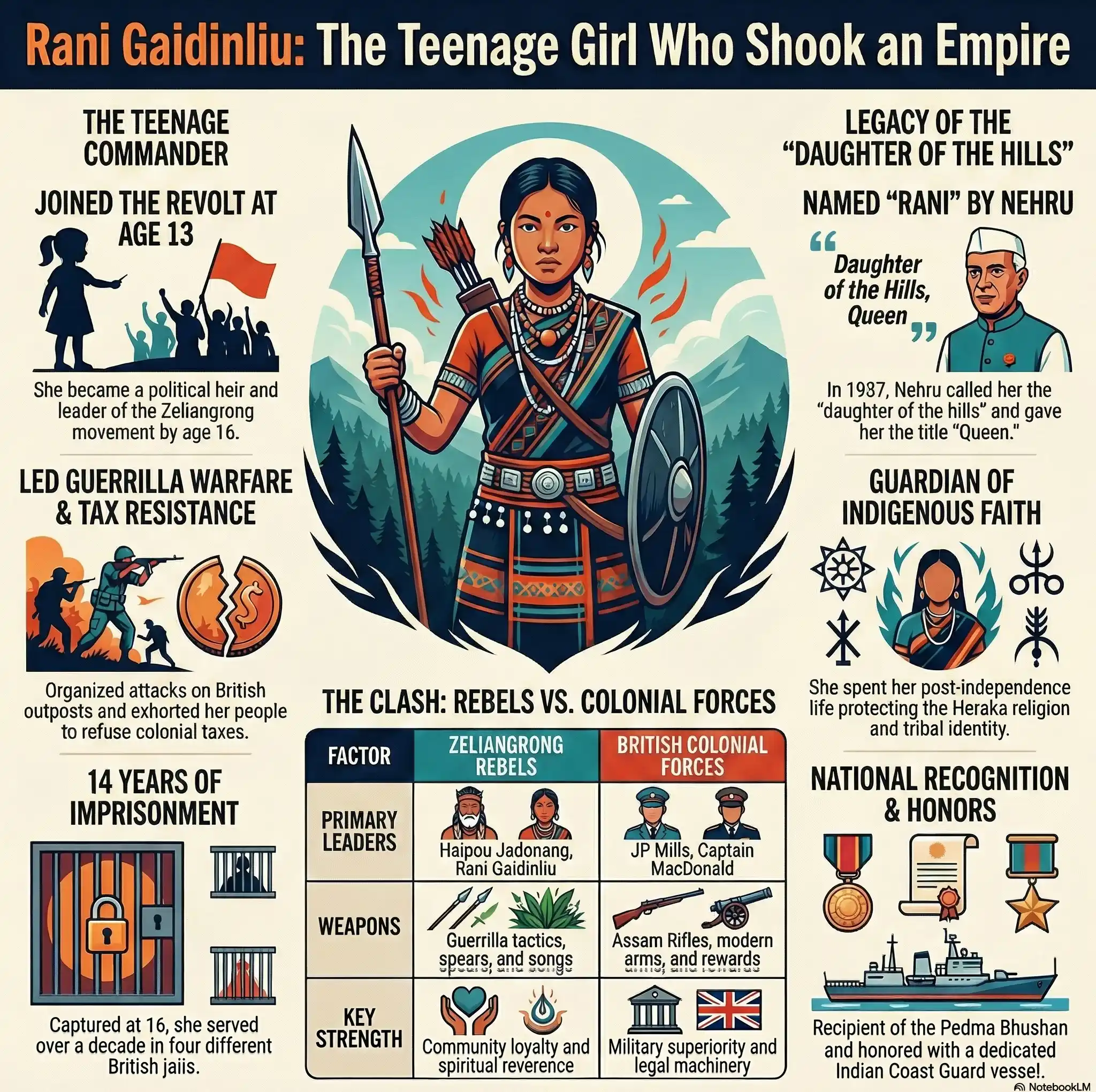
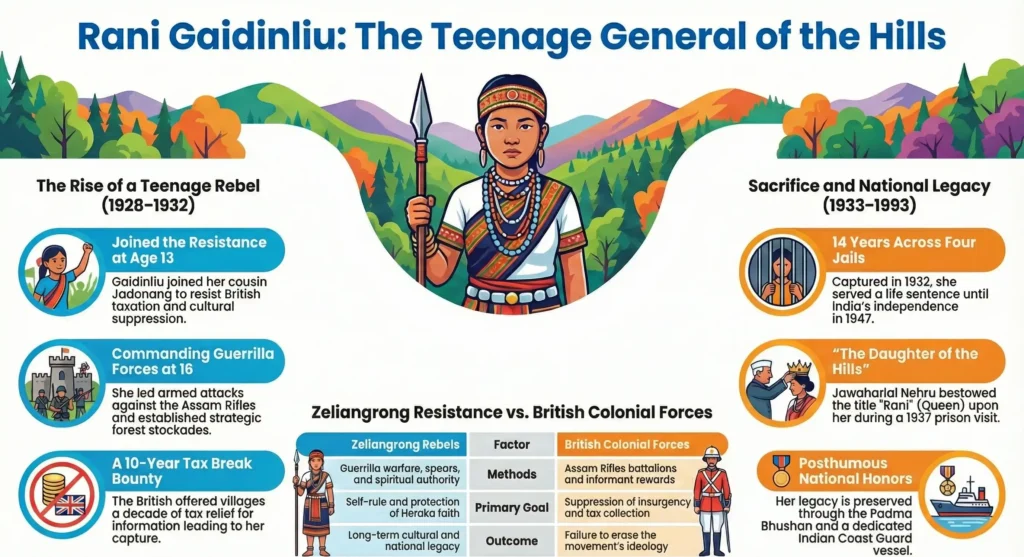
In the forest-draped hills of present-day Manipur, Nagaland, and Assam, a spiritual and political rebellion burned through the 1930s and 1940s that most of India has never heard of. At its heart stood a teenage girl named Gaidinliu — born on 26 January 1915, the daughter of a Rongmei Naga farming family — who at just thirteen joined a movement to expel the British from her homeland. When her mentor and cousin, the visionary Haipou Jadonang, was executed by the British in 1931 after a politically motivated trial, Gaidinliu stepped forward without hesitation to lead the Zeliangrong people's resistance alone. She urged her tribe not to pay colonial taxes, organised guerrilla attacks on British outposts, and moved like a shadow across three regions while the Assam Rifles hunted her. Captured in 1932 at just sixteen and sentenced to life imprisonment, she endured fourteen years across four jails — in Guwahati, Shillong, Aizawl, and Tura — before India's independence finally set her free. Jawaharlal Nehru, moved deeply by her story, gave her the title "Rani" — Queen — and called her the "daughter of the hills." She lived until 1993, still fighting. And India still barely knows her name.| Detail | Information |
|---|---|
| Full Name | Gaidinliu Pamei (Rani Gaidinliu) |
| Born | 26 January 1915, Nungkao (Longkao) village, Tamenglong, Manipur |
| Tribe | Rongmei Naga (Zeliangrong community) |
| Movement | Zeliangrong Uprising / Heraka Movement |
| Mentor | Haipou Jadonang (cousin, executed 1931) |
| Age at Joining Revolt | 13 years |
| Age at Arrest | 16 years (October 17, 1932) |
| Sentence | Life imprisonment |
| Jails Served | Guwahati, Shillong, Aizawl, Tura |
| Years in Prison | 14 years (1933–1947) |
| Title Bestowed | “Rani” — by Jawaharlal Nehru (1937) |
| Awards | Tamra Patra (1972), Padma Bhushan (1982), Vivekananda Seva Award (1983) |
| Postage Stamp | Issued by Government of India, 1996 |
| Died | 17 February 1993, Longkao, Manipur |
The Zeliangrong Uprising and the Teenage Girl Who Shook an Empire
Before the Rebellion — A People at Breaking Point
To understand why a thirteen-year-old girl took on the British Empire, you first need to understand what life looked like in the Zeliangrong hills in the 1920s and 1930s.
The British were especially oppressive with their forced porter system, heavy hill house taxes of Rs. 3 per year, and the imposition of new laws that disrupted every corner of tribal life. The Zeliangrong people — the Zeme, Liangmai, and Rongmei Naga tribes spread across the hills of present-day Assam, Manipur, and Nagaland — had their own faith, their own governance, their own language. None of it was being protected. All of it was under quiet, grinding attack.
Christian missionaries were moving through the hills, converting communities, replacing oral traditions with foreign scripture. The Heraka Movement was started by Jadonang to resist the infiltration of Christian missionaries as well as the reforms imposed by the British government, who forced the tribals into harsh labour and imposed high yearly revenue tax on every household.
Into this world, Gaidinliu Pamei was born on 26 January 1915 — the fifth of eight children — in a small Rongmei Naga village. She never went to school. She grew up listening to the land, the elders, and the quiet rage of a people who had once been free.
The Man Who Lit the Fire — Haipou Jadonang
Before Gaidinliu, there was Jadonang.
Haipou Jadonang established the Heraka religious movement, based on the ancestral Naga religion, and declared himself the “messiah king” of the Nagas. He also espoused the cause of an independent Naga kingdom — “Makam Gwangdi” or “Naga Raj” — which brought him into direct conflict with the colonial British rulers.
Heraka, which simply means pure, was more than a religion. It was a declaration. It was a monotheistic religion where followers worshipped Tingkao Ragwang — their supreme ancestral God. The movement aimed to revitalise indigenous worship and resist the cultural invasion of colonial rule.
Jadonang was magnetic. The political ideology of Jadonang, under the banner “Makaamei Rui Gwangh Tu Puni” — meaning the sons of the soil will reign — was a direct challenge to the British Empire. He raised a standing army of five hundred trained men and women. He toured village after village, building allegiances. He composed anti-colonial songs. He told his people: pay taxes to me, not to them. We will rule ourselves.
The British noticed. And they moved quickly to destroy him.
On 19 February 1931, Jadonang was imprisoned in Silchar Jail, arrested while returning from the Bhuvan cave with Gaidinliu and 600 other followers. The charges were fabricated — he was accused of masterminding the murders of four Manipuri traders, despite being in another village entirely when the killings took place. He was hanged to death on 29 August 1931 at 6 am, on the bank of the Nambul River behind the Imphal jail.
He was twenty-six years old.
In the Zeliangrong hills, people wept. And a sixteen-year-old girl stood up.
The Teenager Who Became a Commander
Gaidinliu emerged as Jadonang’s spiritual and political heir. She openly rebelled against the British Raj, exhorting the Zeliangrong people not to pay taxes. She received donations from the local people, many of whom also joined her as volunteers.
She did something else, too — something just as powerful. She wove Gandhi’s non-cooperation message into her own people’s resistance. The Zeliangrong tribe came together to resist colonial rule and several repressive measures imposed by the police and the Assam Rifles, refusing to pay fines. This was seen as their own version of the Non-Cooperation Movement in the Northeast.
But Gaidinliu was not a passive protester. She was a fighter. At the age of 17, Gaidinliu valiantly led many guerrilla warfare tactics against the British. On 18 March 1932, about 50 to 60 fighters from the village of Hangrum rushed down a slope and attacked the sepoys positioned below at their post.
The British were now dealing with something they hadn’t anticipated — a teenage spiritual leader whom her own people believed was divinely protected. Rumours swirled through the hills that she could appear in two places at once. The colonial administration laughed — but quietly dispatched reinforcements. The Governor of Assam sent the 3rd and 4th battalions of the Assam Rifles against her, under the supervision of the Naga Hills Deputy Commissioner JP Mills. Monetary rewards were declared for information leading to her arrest, including a declaration that any village providing information on her whereabouts would get a 10-year tax break.
Think about that. An empire offering an entire decade of tax relief — just to catch one teenager.
The Manhunt, the Betrayal, the Capture
the Kamarupa Kingdom — the ancient root of Assam’s civilisational pride
For months, Gaidinliu outran them. She moved across villages in what are now Assam, Nagaland, and Manipur — always one step ahead, always sheltered by communities who loved her. She built stockades, stored grain, manufactured weapons. The forests protected her as much as her people did.
Then came the inevitable betrayal.
As soon as Captain MacDonald received a report of Gaidinliu and her followers being located in a village called Pulomi, he launched a surprise attack by sending a large force in the opposite direction — to mislead her. Perplexed by the raid, Gaidinliu and her followers were captured without any resistance on October 17, 1932.
She was sixteen years old, handcuffed, and marched on foot to Kohima.
Her trial went on for 10 months and she was convicted of murder and her attack on the Assam Rifles. While most of her associates were either executed or jailed, she was sentenced to life imprisonment.
Fourteen Years Behind Bars — and a Title from Nehru
From 1933 to 1947, she served time at Guwahati, Shillong, Aizawl, and Tura jails. She was moved from prison to prison as if the British couldn’t decide what to do with the quiet force of her presence. She wasn’t violent in captivity. She didn’t break. She waited.
In 1937, Jawaharlal Nehru visited Manipur and heard her story. He was shaken. Nehru wrote about her: “What suppression of spirit they have brought to her who in pride of her youth dared to challenge the Empire… And India does not even know of this brave child of her hills.
He gave her a name that would outlast both of them — Rani. Queen.
She was released from Tura Jail when India became independent in 1947, on Nehru’s orders. She was thirty-two. She had spent nearly half her life in British jails for doing nothing more than asking to be free
After Freedom — A Fight That Never Ended
Rani Gaidinliu’s story doesn’t end with independence. In many ways, it only gets more complicated.
After her release, she continued fighting — this time for a separate Zeliangrong administrative unit within India, a homeland for her fractured people who lived across three different states. She faced opposition from other Naga leaders. She went underground again in the 1960s. She made her case to Prime Ministers — Nehru, Indira Gandhi, Rajiv Gandhi — again and again.
In 1966, after six years of hard underground life in old age, under an agreement with the Government of India, Rani Gaidinliu came out from her jungle hideout to work for the betterment of her people through peaceful, democratic and non-violent means.
She received the Padma Bhushan in 1982. The Government of India issued a postage stamp in her honour in 1996. The Indian Coast Guard named a Fast Patrol Vessel ICGS Rani Gaidinliu in 2016.
In 1991, Gaidinliu returned to her birthplace of Longkao, where she died on 17 February 1993 at the age of 78.
She died with her dream of a Zeliangrong Homeland still unfulfilled. But she died having lived — wholly, fiercely, and on her own terms.
Quick Comparison Table: Zeliangrong Uprising vs. British Colonial Response
the Garo tribe’s ancient cultural legacy in Northeast India
| Factor | Zeliangrong Rebels | British Colonial Forces |
|---|---|---|
| Primary Leaders | Haipou Jadonang, Rani Gaidinliu | JP Mills, JC Higgins, Captain MacDonald |
| Ideology | Heraka faith + Naga self-rule (Makam Gwangdi) | Suppress insurgency, maintain tax revenue |
| Weapons & Methods | Guerrilla warfare, spears, arrows, songs, spiritual authority | Assam Rifles battalions, informant rewards, scorched-earth |
| Key Strength | Community loyalty, forest terrain, spiritual reverence | Military superiority, legal machinery |
| Key Weakness | Internal informants, lack of modern arms | Underestimated cultural depth of the movement |
| Turning Point | Jadonang’s execution (1931) + Gaidinliu’s capture (1932) | Even after arrests, ideology could not be erased |
| Legacy | National freedom fighter, Padma Bhushan, postage stamp | Last major colonial attempt to suppress Naga tribal identity |
Curious Indian: Fast Facts
- The Youngest General: Rani Gaidinliu joined the freedom struggle at 13 and was commanding guerrilla operations by 17. She may be the youngest armed resistance leader in modern Indian history.
- The British Were Afraid of a Rumour: Colonial troops genuinely believed Gaidinliu could appear in two places simultaneously. Her followers cultivated this belief — and it bought her precious escape time.
- Nehru’s Guilt: When Nehru visited her in Shillong Jail in 1937 and gave her the title “Rani,” he also wrote in his letters that India’s indifference to her sacrifice was a source of national shame.
- Her Name Sails the Sea: In 2016, the Indian Coast Guard commissioned a Fast Patrol Vessel named ICGS Rani Gaidinliu — one of the highest posthumous honours India gives to freedom fighters.
- Museum in Her Honour: In 2021, Union Home Minister Amit Shah laid the groundwork for the Rani Gaidinliu Tribal Freedom Fighters Museum at her birthplace in Tamenglong, Manipur.
- Born on Republic Day: Gaidinliu was born on 26 January 1915 — the same date that would later become India’s Republic Day. Her birth anniversary is now observed as a day of remembrance in Manipur and Nagaland.
- Fighting Two Invasions: Gaidinliu didn’t just fight the British. She spent her entire post-independence life resisting forced religious conversion and protecting the Heraka faith of her people.
- Stamp of Recognition: The Government of India issued a commemorative postage stamp in her honour in 1996 — three years after her death.
Conclusion
the Khasi tribe’s matrilineal traditions and resistance to outside rule
History loves its heroes large — generals on horseback, poets at podiums, politicians in Parliament. But sometimes the truest act of courage happens quietly, in a forest, in a prison cell, in a courtroom where nobody speaks your language.Rani Gaidinliu never commanded an army in the way textbooks describe. She had no cannon, no cavalry, no formal training. What she had was something rarer and more powerful — the absolute conviction that her people’s way of life, their God, their songs, their soil, deserved to survive.She was thirteen when she decided that. She was seventy-eight when she died, still believing it. The Zeliangrong Uprising didn’t end British rule by itself. But it did something equally important — it told the people of the Northeast hills, in their own language, that resistance was not just possible. It was sacred.And in the hills of Manipur, Nagaland, and Assam, they still remember. Every 26th of January — on the date she was born — the mist rolls in from the mountains, and somewhere in a village called Longkao, the daughter of the hills lives on.
If you think you have remembered everything about this topic take this QUIZ
Who was Rani Gaidinliu?
Rani Gaidinliu (1915–1993) was a Naga spiritual and political leader from the Rongmei tribe of Manipur. She led the Zeliangrong Uprising against British colonial rule beginning at age 13, was sentenced to life imprisonment at 16, and served 14 years across four jails before being released after India’s independence in 1947. The title “Rani” (Queen) was given to her by Jawaharlal Nehru
What was the Zeliangrong Uprising about?
The Zeliangrong Uprising was a socio-religious and political revolt by the Zeliangrong Naga people — comprising the Zeme, Liangmai, and Rongmei tribes — against British colonial taxation, forced labour, religious interference, and suppression of indigenous culture. It was rooted in the Heraka movement founded by Haipou Jadonang, which sought to revive ancestral Naga traditions and establish self-rule.
Who was Haipou Jadonang and what happened to him?
Haipou Jadonang was a Rongmei Naga spiritual leader and the founder of the Heraka movement. He envisioned an independent Naga kingdom called “Makam Gwangdi” or Naga Raj. He was arrested by the British in February 1931 on fabricated murder charges and hanged on 29 August 1931 at just twenty-six years old. His movement was then carried forward by his cousin Rani Gaidinliu.
How was Rani Gaidinliu captured?
She was captured on 17 October 1932 through a deliberate British military deception. Captain MacDonald sent a large force in the wrong direction to mislead her, then surrounded her village of Pulomi. She was arrested without resistance, handcuffed, and marched on foot to Kohima before being tried in Imphal and sentenced to life imprisonment.
What awards and recognition did Rani Gaidinliu receive?
Rani Gaidinliu received the Tamra Patra in 1972, the Padma Bhushan in 1982, the Vivekananda Seva Award in 1983, and the Bhagwan Birsa Munda Puraskar posthumously. The Government of India issued a commemorative postage stamp in 1996. In 2016, the Indian Coast Guard named a Fast Patrol Vessel ICGS Rani Gaidinliu in her honour.