This article explores the life and monumental work of Pāṇini, the ancient Indian linguist who revolutionized how we understand human speech. By delving into the Ashtadhyayi, we uncover a world where grammar meets mathematics. Pāṇini didn’t just write a rulebook; he created a self-contained, logical "machine" of 4,000 sutras that could generate every valid word in the Sanskrit language. His work remains a bridge between ancient spiritual wisdom and modern computational logic, proving that the roots of our digital age are far older than we often imagine.| Category | Details |
| Name | Pāṇini |
| Era | Mid-1st Millennium BCE (c. 4th Century BCE) |
| Location | Gandhara (Present-day Pakistan/Afghanistan border) |
| Major Work | Ashtadhyayi (Eight Chapters) |
| Contribution | Formal descriptive linguistics and Sanskrit morphology |
| Legacy | Father of Modern Linguistics & Precursor to Computer Logic |
The Architect of Language: Unlocking the Genius of Pāṇini
Deep in the ancient region of Gandhara, during a time when the world was beginning to awaken to the complexities of philosophy and science, a man named Pāṇini was busy decoding the very fabric of human communication. His obsession was not with wealth or conquest, but with the rhythmic purity of the spoken word. The result of his life’s work, known as Panini Sanskrit Grammar, would go on to become the foundation for linguistics across the globe, influencing everyone from 19th-century European scholars to the pioneers of modern computer programming.
The story of Pāṇini is one of profound intellectual mystery. Living around the 4th Century BCE, he looked at the vast, sprawling beauty of the Sanskrit language and saw a hidden order. At a time when other civilizations were barely documenting their history, Pāṇini was constructing a complex system of rules that functioned with the precision of a mathematical algorithm. This was the birth of the Ashtadhyayi, a text that remains unparalleled in its brevity and depth.
8 Defining Chapters in the Vikram Sarabhai Biography
The Mystery of the Ashtadhyayi
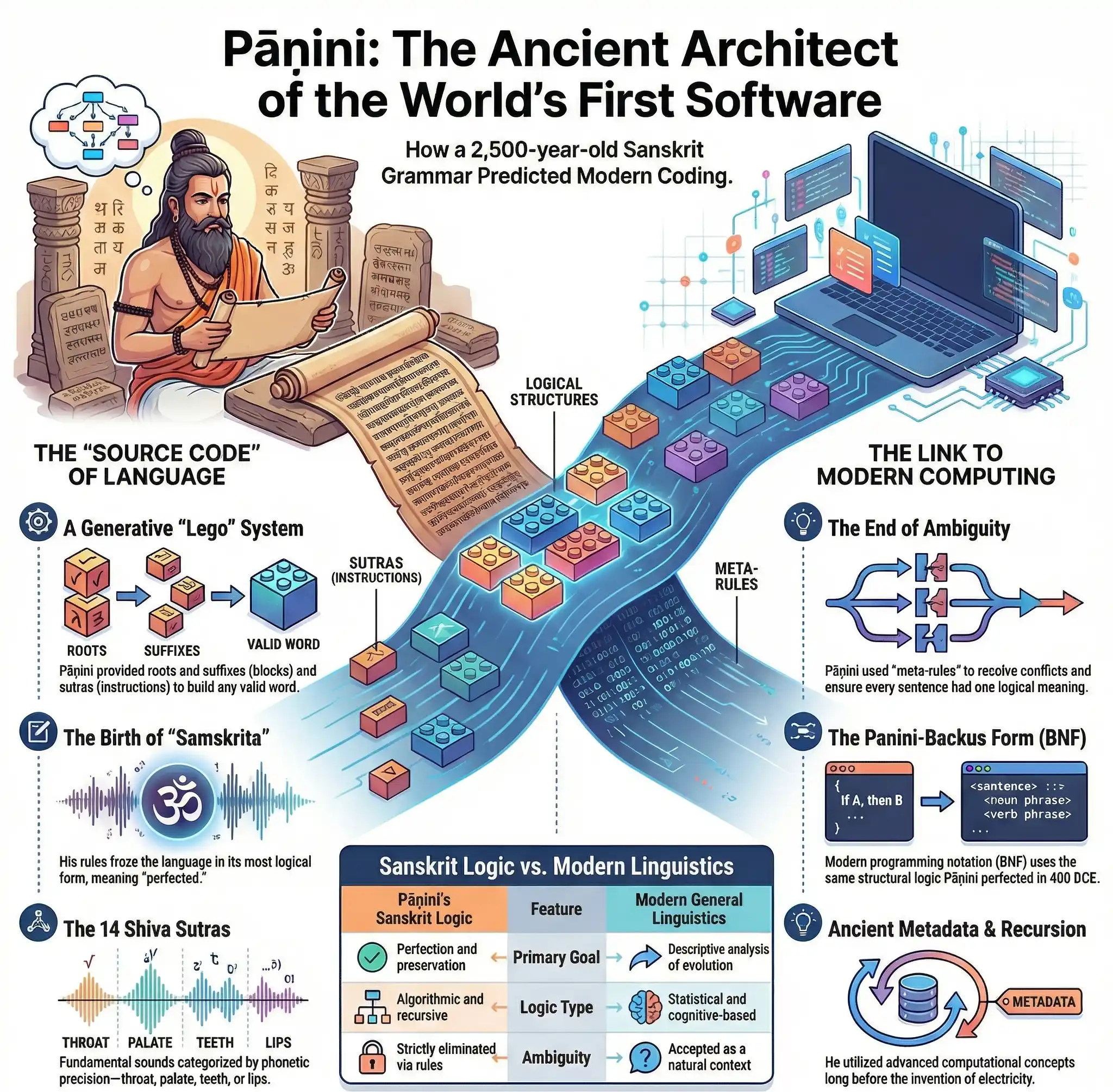
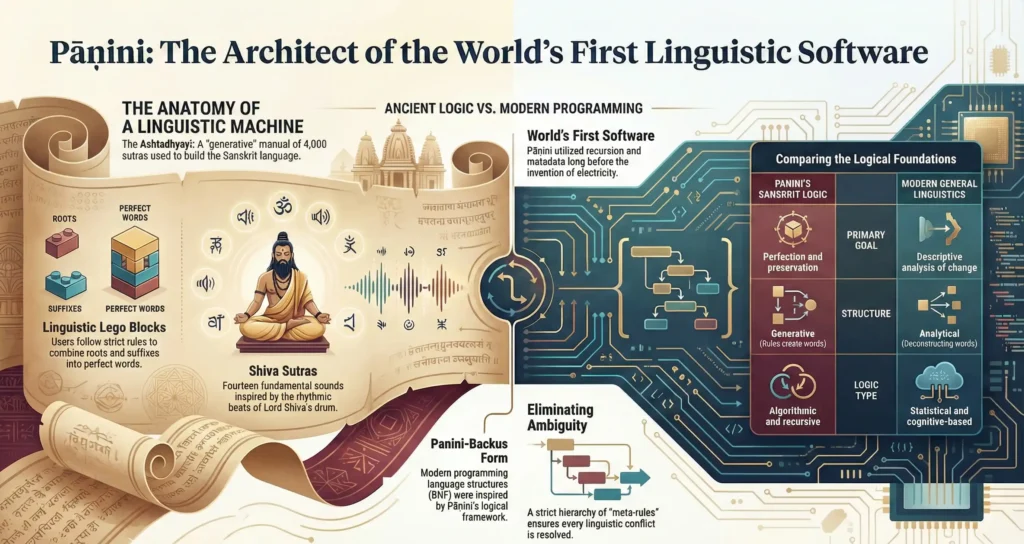
The Ashtadhyayi is not a book in the traditional sense. It is a linguistic machine. Comprised of approximately 4,000 sutras (short aphorisms), it was designed to be memorized and passed down through the oral tradition. The Ashtadhyayi significance lies in its “generative” nature. Pāṇini didn’t just list words; he provided the “source code” for the language.
Imagine a set of Lego blocks. Pāṇini provided the blocks (roots and suffixes) and the instruction manual (the sutras). If you followed the rules correctly, you could build any word in the Sanskrit language. If a word didn’t fit the rules, it simply wasn’t Sanskrit. This level of logical rigor was unheard of in the ancient world. It transformed Sanskrit from a naturally evolving dialect into a “perfected” (Samskrita) language, frozen in its most beautiful and logical form.
The Man Behind the Sutras
As an ancient Indian linguist, Pāṇini’s life is shrouded in legends that highlight his dedication. One popular story suggests he was once a struggling student, deemed “slow” by his peers. Determined to overcome his limitations, he retreated to the mountains to meditate on Lord Shiva. It is said that the rhythmic sound of Shiva’s drum (the Damaru) inspired the 14 fundamental sounds of Sanskrit, known as the Shiva Sutras.
Whether this legend is literal or metaphorical, it points to a deeper truth: Pāṇini understood that language is rooted in sound and vibration. He categorized sounds based on where they were produced in the mouth—the throat, the palate, the teeth, or the lips. This phonetic precision is why Sanskrit sounds so melodic and why its chants have a physical impact on the listener.
6 Unfoldings in the Subrahmanyan Chandrasekhar Biography
The Logic That Built the Future
What makes the Sanskrit language logic so fascinating to modern researchers is its striking similarity to computer science. Pāṇini utilized concepts that we now call “metadata,” “recursion,” and “rewriting rules” long before electricity was ever discovered. In the 20th century, when computer scientists like John Backus and Peter Naur were developing programming languages, they realized they were using the same structural logic that Pāṇini had perfected thousands of years ago.
This is why many refer to the Panini Algorithm as the world’s first software. He solved the problem of “ambiguity” in language. In most languages, a sentence can be interpreted in multiple ways. Pāṇini’s rules were so strict and hierarchical that they eliminated confusion. He used a “meta-language”—a set of rules about rules—to ensure that the system could always resolve conflicts.
A Legacy Across Continents
The influence of Pāṇini did not stay confined to the Indian subcontinent. When 18th-century scholars like Sir William Jones “discovered” the connection between Sanskrit, Greek, and Latin, they turned to Pāṇini to understand the mechanics of language. This led to the birth of Indo-European linguistics. Without the clarity provided by the Ashtadhyayi, our understanding of how human languages evolve and relate to one another would be centuries behind where it is today.
Pāṇini’s work also reflects a unique Indian cultural value: the quest for the “ultimate truth” through the smallest possible unit. Just as the Indian heritage preservation efforts in Japan celebrate the intricacy of our art, Pāṇini celebrated the intricacy of our sounds. He believed that by perfecting language, we could more accurately describe reality and, perhaps, reach a higher state of consciousness.
Quick Comparison: Ancient vs. Modern Linguistics
| Feature | Panini’s Sanskrit Logic | Modern General Linguistics |
| Primary Goal | Perfection and preservation of a sacred language. | Descriptive analysis of evolving languages. |
| Structure | Generative (Rules that create words). | Analytical (Deconstructing existing words). |
| Format | Oral sutras (Highly condensed). | Written textbooks and digital databases. |
| Logic Type | Algorithmic and recursive. | Statistical and cognitive-based. |
| Ambiguity | Strictly eliminated via meta-rules. | Often accepted as a natural part of context. |
Curious Indian: Fast Facts
- The Shiva Sutras: Legend says Pāṇini derived the sounds of the alphabet from the beats of Lord Shiva’s drum.
- Mathematical Precision: The Ashtadhyayi is often compared to a mathematical “turing machine” due to its logical consistency.
- Zero Jargon: Despite its complexity, the system is built on “Anubandhas” (markers) that act like chemical symbols in a formula.
- Preservation: Because of Pāṇini’s rules, the pronunciation of Vedic Sanskrit has remained virtually unchanged for over 2,000 years.
- Modern Tribute: The “Backus-Naur Form” (BNF) used in computer science is often called the “Panini-Backus Form” by historians of science.
Conclusion
Pāṇini was more than just a grammarian; he was a visionary who saw the code beneath the chaos of human speech. By mastering Panini Sanskrit Grammar, we don’t just learn a language—we learn how the human mind organizes thought itself. His legacy is a testament to the intellectual heights of ancient India, proving that the tools we use to navigate the digital world today were first forged in the fires of Vedic logic. As we move further into the age of Artificial Intelligence, the “Curious Indian” finds that the answers to our future often lie hidden in the sutras of our past.
7 Secrets of Padmanabhaswamy Temple Treasure
If you think you have remembered everything about this topic take this QUIZ
Results


#1. What is the name of Pāṇini’s monumental work on Sanskrit grammar?
#2. Pāṇini is often compared to modern computer scientists because his grammar functions like a:
#3. According to legend, what inspired Pāṇini to discover the 14 fundamental sounds of Sanskrit?
#4. The Ashtadhyayi is comprised of approximately how many sutras (aphorisms)?
#5. Why is Pāṇini’s grammar described as “generative”?
#6. Which modern computer science concept is strikingly similar to the logic used by Pāṇini?
#7. Pāṇini classified Sanskrit sounds based on:
#8. The Backus-Naur Form (BNF) used in computer programming languages is often historically referred to as:
How did Panini’s work influence computers?
His use of formal rules to define language structure is the exact same logic used to create programming languages like Fortran, Java, and Python.
Where was Panini born?
He was born in Shalatula, which was part of the ancient Gandhara kingdom, located near the modern-day town of Lahor in Pakistan.
Is the Ashtadhyayi still used today?
Yes, it remains the standard for anyone studying traditional Sanskrit and is a major subject of study in both linguistics and computer science departments worldwide.
Why is Panini called the Father of Linguistics?
He was the first person in recorded history to create a complete, scientific, and descriptive analysis of a language’s grammar and phonetics.
Read More: https://curiousindian.in/charaka-4th-century-bce/