
Saturday, December 27, 2025
Everything About India
  • Arts & Culture
  • Festivals of India
  • Indian History
  • Indian Politics
  • Biography
    • Entertainment Personalities
    • Science Personalties
  • More
    • Unsolved India
No Result
View All Result
  • Arts & Culture
  • Festivals of India
  • Indian History
  • Indian Politics
  • Biography
    • Entertainment Personalities
    • Science Personalties
  • More
    • Unsolved India
No Result
View All Result
Everything About India
No Result
View All Result
Home Indian History

Narendra Modi becomes Prime Minister (2014)

Narendra Modi became the 14th Prime Minister of India in May 2014 after his party, the Bharatiya Janata Party (BJP), won a historic majority in the 16th Lok Sabha elections—the first single-party majority at the Union level in 30 years. He was sworn in on 26 May 2014 at Rashtrapati Bhavan, heading the National Democratic Alliance (NDA) government.
Soumyabrata Dey by Soumyabrata Dey
in Indian History, Indian Politics
Reading Time: 4 mins read
0 0
A A
Narendra Modi becomes Prime Minister (2014)

Source: Wikipedia

Share on FacebookShare on Twitter

Table of Contents

Toggle
  • Introduction
  • Background: The 2014 General Election
  • The Swearing-In (26 May 2014)
  • Early Priorities and Governance Style
    • RelatedPosts
    • Raj Reddy: (1937- Present)
    • Har Gobind Khorana: (1922- 2011)
    • Dr. Salim Ali: (1896- 1987)
  • Political Significance
  • Key Dates and Facts
  • Early Signals and Initiatives (2014 snapshot)
  • Interesting Notes
  • Why 2014 Matters
  • Conclusion

Introduction

Narendra Modi became the 14th Prime Minister of India in May 2014 after his party, the Bharatiya Janata Party (BJP), won a historic majority in the 16th Lok Sabha elections—the first single-party majority at the Union level in 30 years. He was sworn in on 26 May 2014 at Rashtrapati Bhavan, heading the National Democratic Alliance (NDA) government.

Narendra Modi becomes Prime Minister (2014)
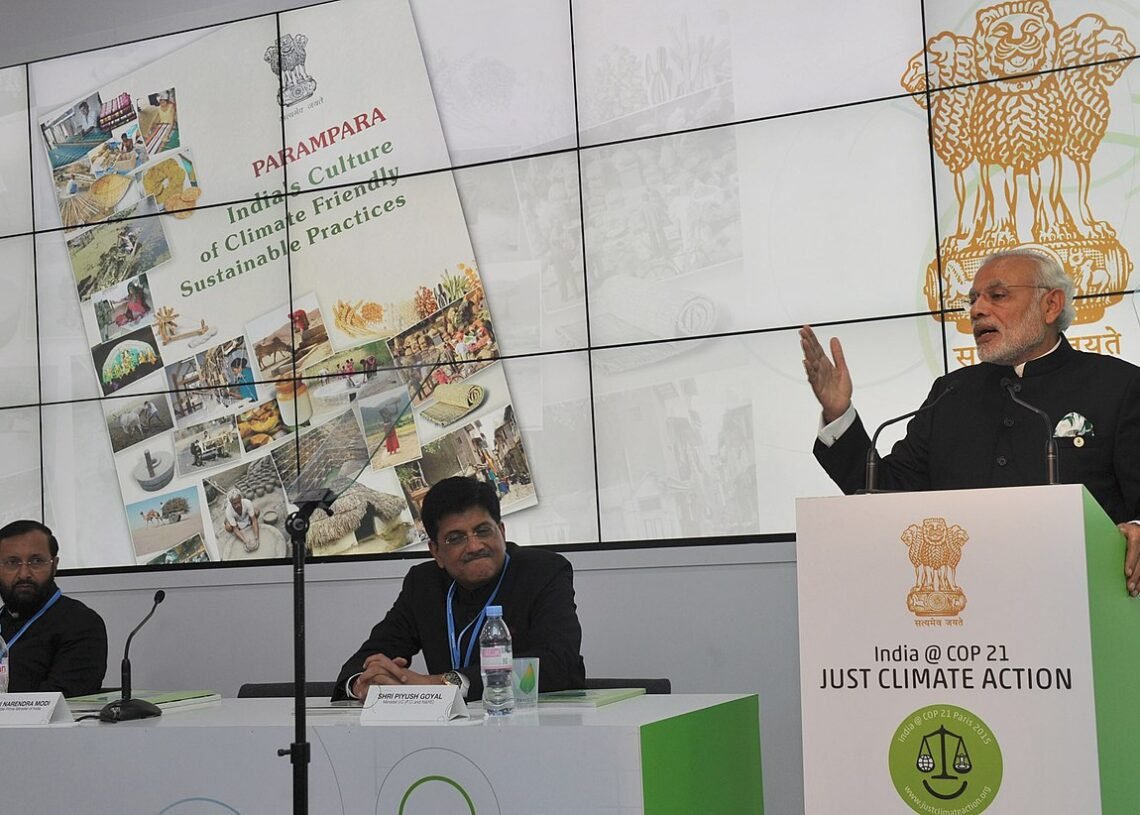
Modi(right) at CoP21 Climate Conference, in Paris, announcing the founding of an International Solar Alliance (ISA). November 2015. | Source: Wikipedia

Background: The 2014 General Election

  • Context: The election followed a decade of United Progressive Alliance (UPA) rule marked by high growth in the mid-2000s and later headwinds—slower growth, inflation, and public anger over corruption scandals.
  • Campaign themes: Modi’s campaign emphasized development, governance, job creation, infrastructure, and a promise of “minimum government, maximum governance,” projecting a CEO-style leadership model built on his tenure as Chief Minister of Gujarat (2001–2014).
  • Mandate: The BJP secured a single-party majority (282 seats out of 543), while the NDA crossed the halfway mark comfortably; the Congress registered its worst-ever tally up to that time.

The Swearing-In (26 May 2014)

  • Venue and ceremony: The oath-taking took place in the forecourt of Rashtrapati Bhavan, New Delhi, administered by the President of India.
  • Regional outreach: Leaders from South Asian countries attended, signaling a neighborhood-first optic at the outset of the new government’s term.

Early Priorities and Governance Style

  • Administrative focus: Streamlining decision-making, curbing red tape, and pushing time-bound project clearances; strong use of the Prime Minister’s Office (PMO) to monitor implementation.
  • Economic thrust: Reinvigorating infrastructure (roads, railways, ports, power), improving ease of doing business, and attracting investment through initiatives such as “Make in India” (launched later in 2014).
  • Social sector and inclusion: Expanding financial inclusion via Jan Dhan (announced later in 2014), sanitation drives, and direct benefit transfer architecture to reduce leakages.

    RelatedPosts

    Raj Reddy: (1937- Present)

    Har Gobind Khorana: (1922- 2011)

    Dr. Salim Ali: (1896- 1987)

Political Significance

  • Return to single-party majority: The 2014 verdict ended three decades of coalition-dominated governments at the Centre, enabling faster legislative and policy moves.
  • Leadership transition: Marked a generational shift in national leadership and a strong, centralized executive style in New Delhi.
  • Party landscape: The BJP emerged as the dominant pole of national politics; opposition parties began recalibrating strategies at both national and state levels.
https://youtu.be/2_N-s5KAv1Q?si=PM7v2YVoclfL3rUn

Key Dates and Facts

  • Election period: April–May 2014, with counting completed on 16 May 2014.
  • Majority milestone: BJP achieved a single-party majority (crossing 272 seats) for the first time since 1984 elections produced a similar dominance for another party.
  • Oath of office: Narendra Modi sworn in as Prime Minister on 26 May 2014.

Early Signals and Initiatives (2014 snapshot)

  • Governance messaging: Emphasis on transparency, accountability, and speed of execution.
  • Investment and manufacturing: “Make in India” pitched India as a manufacturing hub; parallel moves aimed at improving India’s ranking on global business indices.
  • Financial inclusion and services delivery: Rapid rollout planning for bank accounts linked to Aadhaar and mobile (the JAM trinity), setting the stage for later direct benefit transfers and digital governance.

Interesting Notes

  • Ceremony optics: The inclusion of neighboring heads of government at the swearing-in highlighted a diplomatic reset toward South Asia at the very start of the term.
  • Communications: A new idiom of direct mass communication—from public rallies to digital platforms—became central to narrative-setting and governance outreach.

Why 2014 Matters

  • Mandate for change: The election was widely interpreted as a demand for economic revitalization, cleaner governance, and more decisive leadership.
  • Policy capacity: A single-party majority provided legislative bandwidth for reforms and set the template for subsequent policy initiatives in infrastructure, welfare delivery, and digital transformation.
  • Political realignment: 2014 reshaped the competitive map of Indian politics, with downstream effects on state elections, coalition dynamics, and the contours of national debate.
    Narendra Modi becomes Prime Minister (2014)
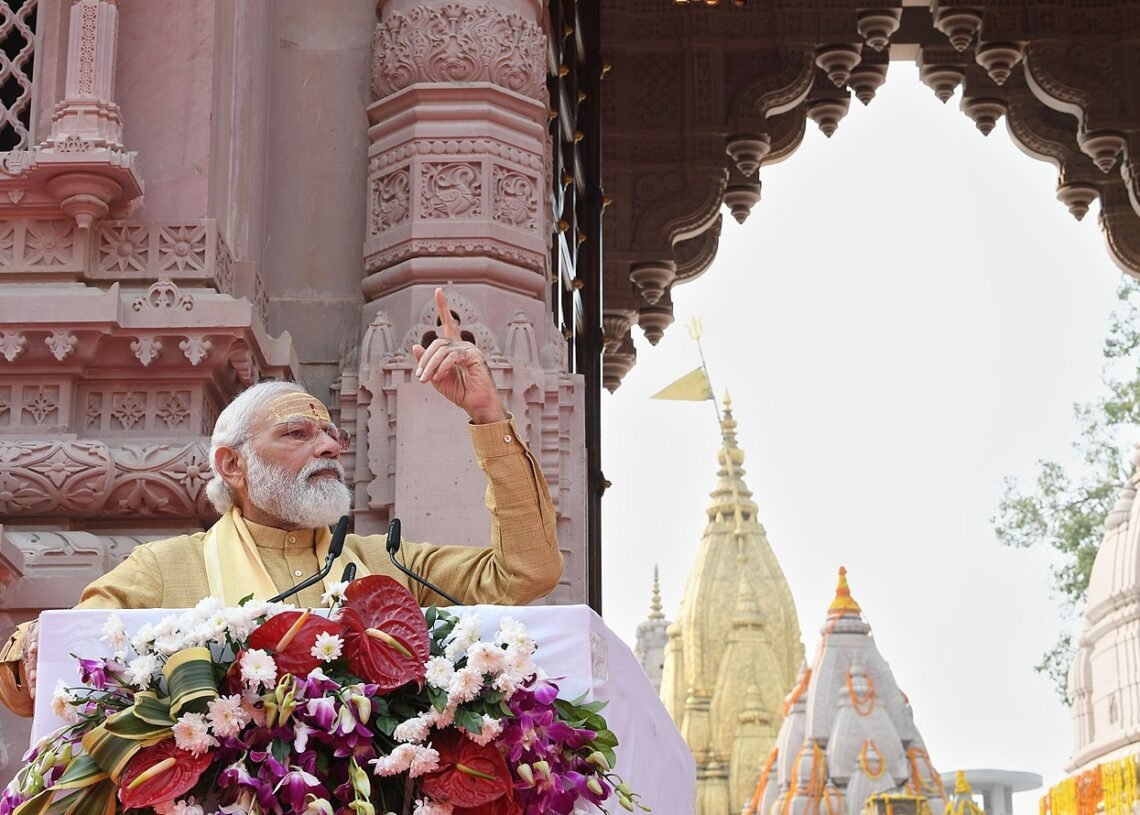
    The Prime Minister, Shri Narendra Modi addressing at the inauguration of Kashi Vishwanath Dham, in Varanasi, Uttar Pradesh on December 13, 2021. | Source: Wikipedia
Conclusion

Narendra Modi’s ascent to the Prime Ministership in May 2014 marked a pivotal transition in India’s political and governance landscape: a decisive electoral mandate, a renewed focus on execution and growth, and a leadership style centered on centralized coordination and high-visibility national initiatives—setting the stage for policy and political trajectories in the years to follow.
Tags: Anti Corruption Development MandateBJP Lok Sabha Majority 282 SeatsDigital India CampaignFirst Single Party Majority Since 1984Gujarat CM to PM TransitionLok Sabha Victory 479505 MarginMake in India InitiativeManmohan Singh SuccessorNarendra Modi Prime Minister 2014NDA 336 Seats TotalNDA DelegationOath Ceremony May 26President Pranab Mukherjee AppointmentRajnath SinghRashtrapati BhavanRSS BJP Hindutva RootsSwachh Bharat LaunchVaranasi
ShareTweetPin
Soumyabrata Dey

Soumyabrata Dey

Related Posts

Raj Reddy: (1937- Present)
Arts & Culture

Raj Reddy: (1937- Present)

December 11, 2025
Har Gobind Khorana: (1922- 2011)
Arts & Culture

Har Gobind Khorana: (1922- 2011)

December 11, 2025
Dr. Salim Ali: (1896- 1987)
Arts & Culture

Dr. Salim Ali: (1896- 1987)

December 11, 2025
No Result
View All Result
December 2025
MTWTFSS
1234567
891011121314
15161718192021
22232425262728
293031 
« Nov    

TAGS

Akbar Ancient India Architectures of India Ayurveda Biography Bollywood biography Bollywood legends British East India Company Buddhism Chandragupta Maurya Civil Disobedience colonial India Dadasaheb Phalke Award Events That Changed History Festivals History History Of Medicine History of Science India Indian cinema Indian cinema icons Indian freedom struggle Indian History Indian National Congress Indian Nationalism Indian Science Indian scientist Inspiration Inspirational stories Kalinga War Mahatma Gandhi Mauryan Empire Mughal decline Mughal Empire Nationalism Partition of India Pataliputra Rigveda Scientific achievements Sikh history Swadeshi Movement Ujjain Unsolved India War elephants ​Indian Mathematician

Archives

  • December 2025
  • November 2025
  • October 2025
  • September 2025
  • August 2025
  • April 2025
  • March 2025
  • July 2017
Facebook Twitter Youtube RSS
Curious Indian TRicolor logo

Explore the soul of Bharat with Curious Indian. A definitive guide to Indian history, arts, culture, biographies, and the events that defined our future.

Follow us on social media:

Recent News

  • Daulat Singh Kothari : (1906–1993)
  • Shivkar Bapuji Talpade: (1864- 1916)
  • Venkatraman Ramakrishnan: (1952- Present)

Category

  • Arts & Culture
  • Battles of India
  • Biography
  • Entertainment Personalities
  • Festivals of India
  • Indian History
  • Indian Politics
  • Places
  • Science Personalties
  • Uncategorized
  • Unsolved India

© 2025 Curious Indian- Everything about India

Welcome Back!

Login to your account below

Forgotten Password?

Retrieve your password

Please enter your username or email address to reset your password.

Log In

Add New Playlist

No Result
View All Result
  • Arts & Culture
  • Festivals of India
  • Indian History
  • Indian Politics
  • Biography
    • Entertainment Personalities
    • Science Personalties
  • More
    • Unsolved India

© 2025 Curious Indian- Everything about India

This website uses cookies. By continuing to use this website you are giving consent to cookies being used. Visit our Privacy and Cookie Policy.
Are you sure want to unlock this post?
Unlock left : 0
Are you sure want to cancel subscription?