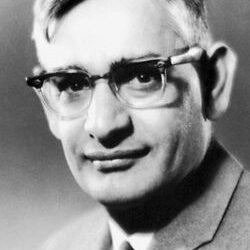
The story of calculus, the powerful mathematical language of change, is often told through the lens of 17th-century Europe with figures like Newton and Leibniz. But imagine an ancient tradition, a brilliant Indian mathematician working in the lush, spice-scented air of 14th-century Kerala, who took the very first, decisive step toward the infinite series—the engine that makes calculus work—centuries earlier. This is the captivating tale of Madhava of Sangamagrama (c. 1340–c. 1425), a foundational figure of Indian science whose profound discoveries are finally receiving the global recognition they deserve.
Madhava, also known as Madhava Acharya, was not just a great thinker; he was the founder of the legendary Kerala School of Astronomy and Mathematics. His revolutionary work provided incredibly precise methods for calculating functions like sine, cosine, and even the value of \pi (Pi). He didn’t just calculate; he fundamentally changed how mathematics viewed the concept of infinity, moving from finite procedures to the limit-passage to infinity. This makes his journey an essential, inspiring chapter in the history of mathematics, proving that genius knows no geographical boundaries. If you’re looking for an inspiration for students of STEM, Madhava’s life, and his quiet revolution in South India, is a story that matters.
🌴 Early Life and the Cradle of Kerala
Madhava was born around 1340 CE in the village of Sangamagrama, which is near modern-day Irinjalakuda in Kerala, India. This region was—and still is—a vibrant hub of learning, trade, and philosophical discourse. While much of his personal life remains shrouded in the mists of time, typical of ancient scholars, the evidence suggests he belonged to the Nambudiri Brahmin community, a lineage traditionally associated with scholarship and priestly duties.
In an era where knowledge was passed down through a close-knit tradition of master and disciple, Madhava’s initial education would have been deeply rooted in the established Hindu astronomical and mathematical texts, the Siddhāntas. Unlike modern universities, his classroom was likely a temple or a specialized school, where students learned through rigorous memorization, verbal commentary, and solving complex problems related to timekeeping, calendar construction, and celestial movements—all essential for religious and civil life.
What sparked Madhava’s deep interest in science wasn’t just rote learning; it was the sheer intellectual challenge presented by the cosmos. He was an Indian astronomer-mathematician tasked with predicting the stars and planets with utmost accuracy. The established methods were good, but Madhava, like all true innovators, saw their limitations. The need for greater precision in his astronomical calculations drove him to ask a simple, yet world-changing question: How can we find the exact value of an angle or a circle’s circumference, not just a close approximation? This thirst for ultimate precision laid the groundwork for his groundbreaking mathematical explorations.
🌌 Journey into Mathematical Analysis
Madhava’s entry into his field was less of a career switch and more of a refinement of the existing scientific tradition. He wasn’t working in isolation; he was engaging with a rich, living mathematical heritage. His early influences included legendary Indian mathematicians like Āryabhaṭa and Bhāskara II, whose works provided the computational backbone of Indian astronomy.
His genius was realizing that the ancient geometric and algebraic methods had reached their limit. The turning point in his career—and in the history of mathematics—was when he dared to embrace the concept of infinity to solve finite problems. Madhava became his own most significant mentor, though the line of scholars who followed him (like Parameśvara, Nilakantha Somayaji, and Jyeṣṭhadeva) firmly cemented his legacy, preserving and expanding his original ideas.
Madhava’s true ‘career’ began when he founded the Kerala School of Astronomy and Mathematics in Sangamagrama. This was not a physical building but an influential intellectual movement. It established a tradition of critically examining existing texts and developing new, more accurate mathematical techniques. It was within this school that his revolutionary scientific achievements would be codified and documented, ensuring their survival for centuries, often in the Malayalam language or Sanskrit verses.
📈 Major Achievements and Contributions
Madhava’s contributions were so far ahead of their time that they foreshadowed core concepts of modern mathematical analysis, including elements of what would later be known as calculus. His key discoveries revolve around the concept of the infinite series—an endless sum of numbers that approaches a finite, precise value.
1. The Madhava Series for Trigonometric Functions
Madhava was the first known scholar to successfully represent trigonometric functions (used to calculate angles and distances) as infinite series. These are now famously known as the Madhava Series (or the Kerala Series).
* Sine and Cosine: He found the infinite power series expansions for the sine (\sin x) and cosine (\cos x) of an angle. These are equivalent to the modern Taylor series expansions for these functions, which were discovered in Europe nearly 300 years later. This breakthrough provided a way to calculate the sine or cosine of any angle to any desired degree of accuracy, a massive leap in astronomical precision.
* Arctangent Series: He derived the infinite series for the arctangent function (\arctan x). When this series is evaluated for a specific value, it provides a means to calculate Pi.
2. The Calculation of Pi (\pi)
Perhaps Madhava’s most famous contribution to the world is his incredible approximation of Pi. Using his arctangent series (now often called the Madhava-Leibniz Series), Madhava calculated the value of \pi to a stunning 11 decimal places—\pi \approx 3.14159265359.
The level of mathematical sophistication required to achieve this accuracy—including developing correction terms to speed up the convergence of the series—demonstrates a profound, intuitive understanding of the concept of a limit, the very kernel of modern classical analysis. This accomplishment wasn’t just a record; it was a demonstration of a new mathematical paradigm: using the infinite to precisely describe the finite.
3. The Foundational Stones of Calculus
Madhava’s work provided methods for:
* Infinite Summation: The very act of working with an infinite number of terms to find a sum is an act of integration (summing infinitely small quantities).
* Error Estimation: His ability to estimate the error after a finite number of terms showed he understood the concept of convergence and the remainder term—essential concepts for modern analysis.
These scientific achievements were crucial for India, giving the Kerala School a mathematical advantage that lasted for centuries. For the world, Madhava’s work stands as independent proof that these profound mathematical ideas were a shared human discovery, developed in different cultures across time.
🚧 Challenges, Lost Works, and Rediscovery
Madhava’s greatest challenge wasn’t a philosophical rival, but the relentless march of time and the limitations of his era. The most significant setback is that almost all of Madhava’s original writings are lost. We know of his brilliant discoveries primarily through the works of his disciples and successors in the Kerala School, such as Nilakantha Somayaji, whose Tantrasangraha (c. 1500) and Jyeṣṭhadeva’s Yuktibhāṣā (c. 1530) explicitly attribute the series and proofs back to their revered founder.
Imagine the frustration: an innovator of this magnitude, whose entire body of original work vanishes, leaving only secondary references! This challenge meant his monumental contributions were isolated. The geographical and cultural distance of Kerala from European academic centers meant that his discoveries had no immediate influence on the rise of calculus in the West—an example of an “uninfluential discovery.”
The turning point for his modern recognition came in the 20th century. Through the diligent work of historians and mathematicians, especially those studying Keralese mathematics, Madhava’s genius was rediscovered. Scholars like C.T. Rajagopal and others were instrumental in translating and analyzing the works of the Kerala School, finally bringing the full scope of Madhava’s contributions to mathematics into the global light, two centuries after European scholars first encountered similar concepts. The irony is that his students preserved his legacy, ensuring his ideas outlived his original manuscripts.
💡 Legacy and Inspiration
Madhava of Sangamagrama’s legacy is a powerful testament to the enduring genius of Indian scientists. He is no longer a footnote but a central figure in the global history of mathematics.
His work, preserved and expanded by the Kerala School, continued to influence astronomical and mathematical thought in South India for over 200 years. His concepts traveled across generations of scholars, nurturing a vibrant intellectual tradition long after his death.
An Inspiration for Students Today
Madhava’s journey offers profound lessons, making him a powerful inspiration for students in India and worldwide:
* The Pursuit of Precision: Madhava teaches us that the best answers come from asking better, more precise questions. His quest for perfect accuracy in astronomy led him to invent an entirely new, more powerful form of mathematics.
* Embracing Infinity: He faced one of the most abstract and complex concepts—infinity—and made it a tool for computation. This encourages young learners to confront the most difficult problems, as they often lead to the greatest breakthroughs.
* The Value of Tradition: Though a revolutionary, Madhava was deeply respectful of the mathematical tradition he inherited. He didn’t start from scratch; he built on the foundations laid by Aryabhaṭa and Bhāskara II. His story shows that true innovation often comes from a deep mastery of the past.
Madhava’s tale is a compelling reminder that our planet’s great intellectual heritage is rich and diverse. For every student grappling with Taylor series in calculus today, the knowledge that an Indian mathematician in the 14th century was the first to unlock that secret should be a source of immense pride and motivation. His is the quiet, powerful voice of a genius who used simple tools to describe the universe’s most complex motions, leaving behind a timeless legacy of mathematical elegance.
Read More: https://curiousindian.in/mahavira/