Introduction
Guru Nanak (1469–1539) founded Sikhism by articulating a radically simple, universal path to the Divine through Naam (remembrance of the One), honest labour (Kirat), and sharing (Vand Chhakna), while rejecting ritualism, caste hierarchy, and sectarian boundaries. His revealed hymns (Bani), later compiled in Guru Granth Sahib, distilled a monotheistic vision of Ik Onkar—One Formless Reality—accessible in all places and tongues, and his long udāsīs (journeys) built congregations (sangat) and service institutions (langar) that gave his message enduring social form.
Birth, early formation, and awakening
Born at Talwandi (Nankana Sahib, now in Pakistan) to Mehta Kalu (Patwari) and Mata Tripta, Nanak displayed contemplative tendencies and compassion from youth, resisting conventional paths of career and ritual status. Apprenticed at Sultanpur Lodhi under brother‑in‑law Jai Ram, he worked in the Daulat Khan Lodi establishment; there, his daily rhythm of work, kirtan, and reflection matured into a sustained God‑consciousness. The formative mystical experience—“na ko Hindu, na Musalman” (there is neither Hindu nor Muslim)—signaled a break with exclusivist identities, and his first companions in song and service, notably the Muslim minstrel Bhai Mardana (rabab player), set an ecumenical template for the mission.
Message and method: Ik Onkar and the three pillars
Ik Onkar and Naam: The One is formless, ineffable, present in all; realization flows from Naam simran (loving remembrance) and sabad (Divine Word) rather than from rites, pilgrimages, or asceticism.
Kirat Karni: Earning by honest labour integrates spirituality with civic duty, sanctifying daily work as worship.
Vand Chhakna and Seva: Sharing earnings and serving all, without distinction, embody equality; the institution of langar (free community kitchen) operationalized this ethic.
His critique targeted empty ritual, caste pride, and clerical mediation—upholding instead the Guru‑Shabad as guide, inward discipline, and ethical conduct in the householders’ life (grihasth).
Udāsīs: journeys that mapped a fellowship
Tradition records multiple long journeys (udāsīs) across the subcontinent and beyond—to the Himalayas and eastern India, to Lanka in the south, to the Arabian centres of Baghdad and Mecca, and to Multan and beyond in the west—where Nanak engaged sants, sūfis, pundits, and commoners alike. These travels were dialogical, using kirtan, discourse, and pointed parables to reframe devotion around the One; anecdotes like the Mecca episode (turning feet toward the Ka‘ba) function as didactic tales about God’s omnipresence rather than as sectarian provocation. The journeys seeded sangats, introduced vernacular kirtan, and established the practice of langar as a social sacrament, making equality tangible.
Bani and language: a people’s scripture
Guru Nanak’s hymns, composed primarily in early Punjabi/Lehndi with Braj, Persian, and Sanskrit inflections, became the core of the later Guru Granth Sahib—a multi‑author canon that includes sants and sūfi voices (e.g., Kabir, Sheikh Farid), modeling interfaith inclusivity at the level of scripture. The Japji Sahib—Nanak’s morning prayer—opens the canon with the Mul Mantar and a cosmology of hukam (Divine Order), kartā purakh (Creative Being), and sahaj (natural equipoise), setting the theology and practice for the panth. The Bani’s prosody and musical assignment to rāgas embed devotion in sung practice, anchoring community through kirtan rather than priestly ritual.
Social reform: equality made practical
Langar, instituted under Nanak and expanded by Mata Khivi (Guru Angad’s consort), made shared eating a sacrament that nullified caste and status boundaries in daily life. Nanak’s sangat model centered lay participation—women and men—as the locus of worship, discourse, and mutual aid, bypassing sectarian gatekeepers and normalizing seva (voluntary service) as spiritual discipline. His critiques of sati, superstition, and exploitative asceticism reframed holiness as righteous conduct—speaking truth, fair dealing, compassion—within family and profession.
Kartarpur and succession
In later years Nanak settled at Kartarpur (on the Ravi), where he farmed, led daily kirtan, and institutionalized sangat‑langar as a self‑sustaining community prototype. Rejecting hereditary transfer, he appointed Bhai Lehna as successor—renamed Guru Angad—on the basis of humility, service, and assimilation of the Shabad, inaugurating the Guruship line as a spiritual office independent of lineage. Kartarpur’s practices—open congregation, shared labour, scripture‑centred worship—became the replicable grammar of the panth across villages and caravan towns.
Dialogues and parables: teaching through encounter
Nanak’s method often used parable‑like encounters: a “true trader” who balances accounts by truth, a “true pilgrim” who walks inward through Naam, a qazi or pandit reminded that God dwells beyond book and form yet within just action. By singing with Bhai Mardana and engaging fakirs, sants, and householders, he collapsed the distance between mosque and temple, field and shrine—directing all to the One known through remembrance and ethical living.
Theology in practice: hukam, grace, and freedom
Central is hukam—the Divine Order by which cosmos and conscience are held; freedom is not license but alignment with hukam through Naam, dissolving haumai (ego) and opening to nadar (grace). The path is neither world‑denying nor fatalist: it asks for remembrance amid labour, justice in exchange, kindness in speech, and courage against oppression—spirituality braided into civic virtue.
Legacy and continuity
Guru Nanak’s synthesis—monotheism without dogma, devotion without priestcraft, equality enacted as langar and sangat—set Sikhism’s foundations that the nine successor Gurus institutionalized: Gurmukhi script (Guru Angad), community consolidation (Guru Amar Das), Harmandir Sahib and scripture‑building (Guru Arjan), miri‑piri (temporal‑spiritual balance) and the Khalsa under Guru Gobind Singh. His life remains a template for interfaith respect and social ethics: encounter without enmity, labour without greed, devotion without superstition—summed in the salutation Sat Kartar (Truthful Creator) and the closing Ardas for sarbat da bhala (welfare of all).
High‑yield anchors
Dates and places: 1469 Talwandi (Nankana Sahib) birth; formative years Sultanpur Lodhi; Kartarpur community; passing in 1539.
Core tenets: Ik Onkar; Naam simran; Kirat Karni; Vand Chhakna; rejection of caste/ritualism; householders’ path.
Institutions: Sangat and langar; scripture‑centred kirtan; succession to Guru Angad by merit, not lineage.
Scriptures: Japji Sahib and Mul Mantar as theological spine; multi‑author canon later compiled as Guru Granth Sahib.
Method: Dialogical journeys (udāsīs); parables; music (rāga‑based kirtan) as communal devotion.

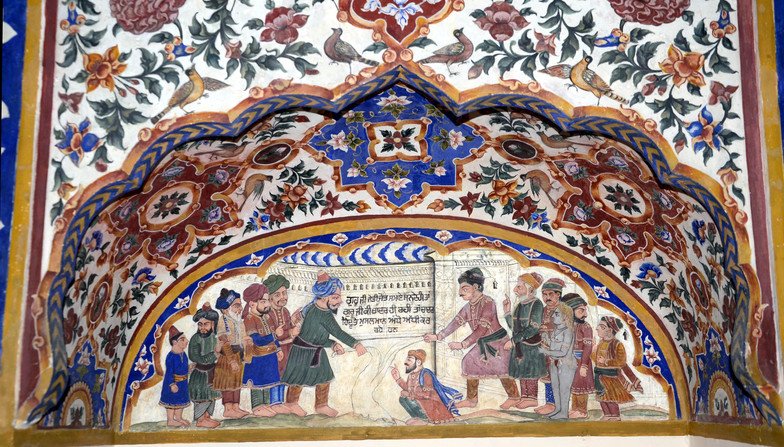
The abandoned Gurudwara Chowa Sahib, located near the Rohtas Fort in Pakistan | Source: Wikipedia

Conclusion
Guru Nanak re‑rooted spirituality in the everyday—One Reality realized by remembrance, earned bread, and shared service—while dissolving walls of caste, creed, and ritual privilege through living institutions of sangat and langar. His hymns gave the panth a scriptural heart; his Kartarpur commune offered a social blueprint; and his succession by merit assured a tradition anchored in Shabad, not bloodline—foundations strong enough to carry Sikhism through expansion, trials, and modernity.