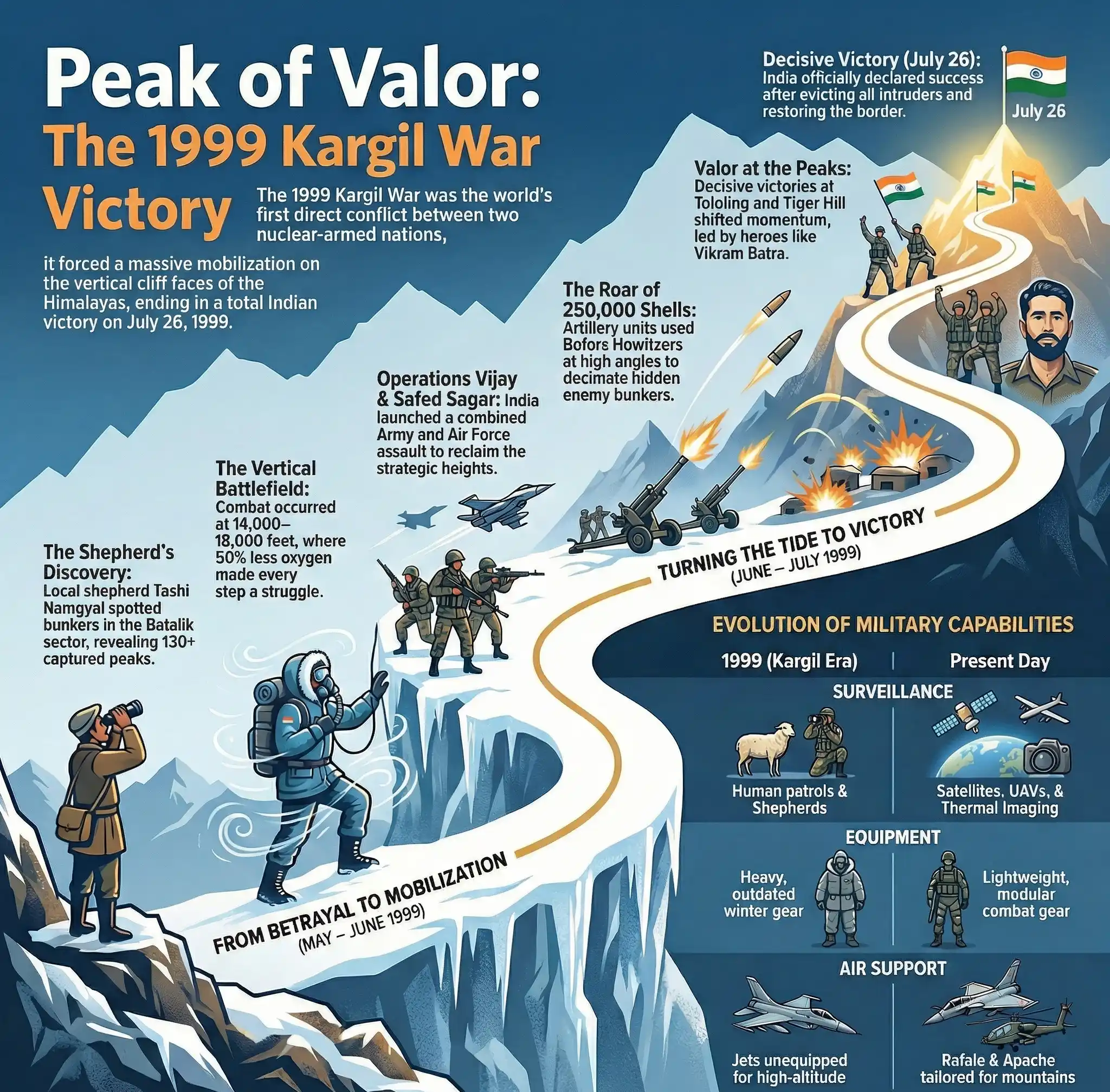
The 1999 Kargil War was not just a border skirmish; it was the world's first direct conflict between two nuclear-armed nations. Triggered by a covert Pakistani infiltration across the Line of Control (LoC) into the Dras, Kargil, and Batalik sectors, it caught India by surprise. The war demanded a massive mobilization of the Indian Army and Air Force under Operation Vijay and Operation Safed Sagar. Fought at dizzying altitudes where the air is thin and the terrain unforgiving, this conflict showcased the sheer grit of the Indian soldier. It ended with a decisive Indian victory on July 26, 1999, now celebrated as Kargil Vijay Diwas.
| Feature | Details |
| Dates | May 3, 1999 – July 26, 1999 |
| Location | Kargil District, Jammu & Kashmir (Line of Control) |
| Primary Operations | Operation Vijay (Army), Operation Safed Sagar (Air Force) |
| Indian Casualties | 527 brave hearts martyred, 1,363 wounded |
| Opponent | Pakistan Army (Northern Light Infantry) & Insurgents |
| Key Battles | Battle of Tololing, Battle of Tiger Hill, Point 4875 |
| Outcome | Decisive Indian Victory (Restoration of status quo ante bellum) |
The Betrayal in the Snow
The winter of 1998 was deceptively quiet. In February 1999, Prime Minister Atal Bihari Vajpayee had taken a historic bus ride to Lahore, signing a peace declaration with Pakistan. The world breathed a sigh of relief, believing the hostility between the two neighbors was thawing.
But high up in the Himalayas, a different plan was unfolding. While diplomats shook hands, the Pakistani military, led by General Pervez Musharraf, launched a covert operation code-named “Operation Koh-e-Paima.” Taking advantage of the harsh winter when Indian troops traditionally vacated extreme high-altitude posts to avoid attrition, Pakistani Northern Light Infantry soldiers disguised as “Mujahideen” crept across the Line of Control. By May 1999, they had captured over 130 strategic peaks overlooking the National Highway 1A—India’s lifeline connecting Srinagar to Leh.
The alarm was raised not by satellite imagery, but by a local shepherd named Tashi Namgyal. While searching for his yak in the Batalik sector, he spotted men breaking stones and building bunkers where no one should have been. His report to the Indian Army triggered the discovery of an intrusion far larger than anyone anticipated.
8 Defining Chapters in the Vikram Sarabhai Biography
The Vertical Battlefield
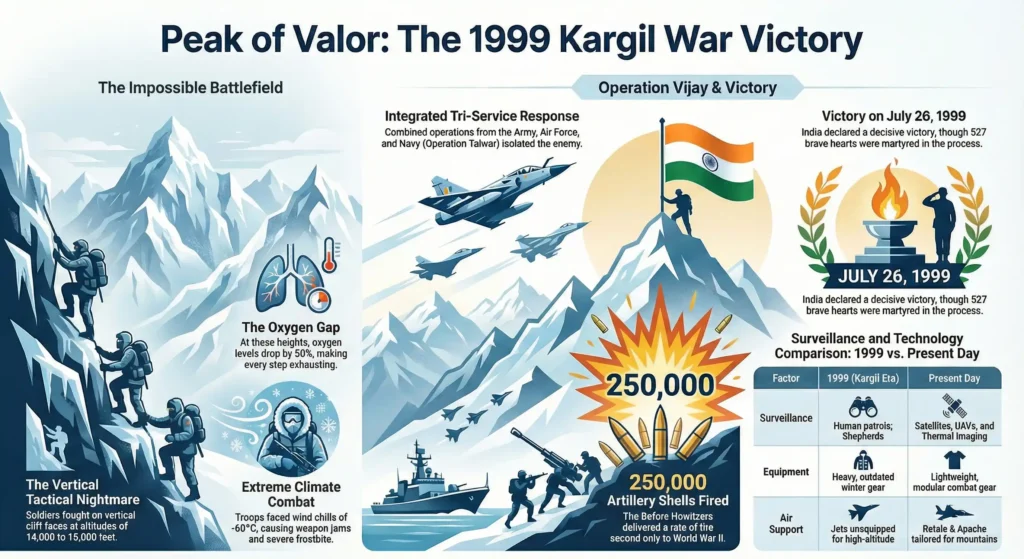
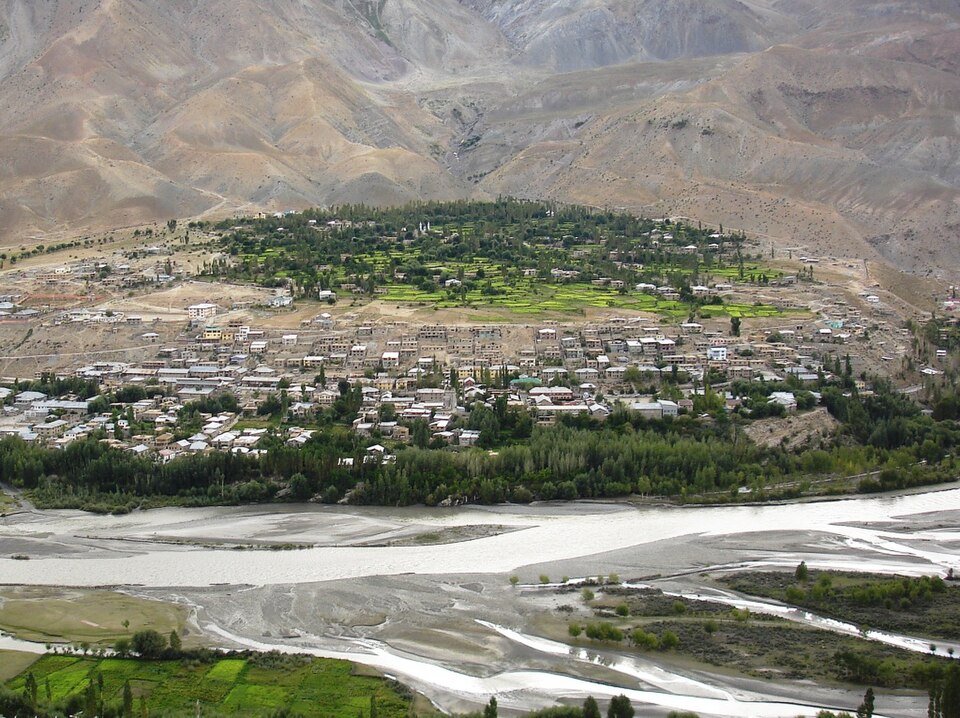
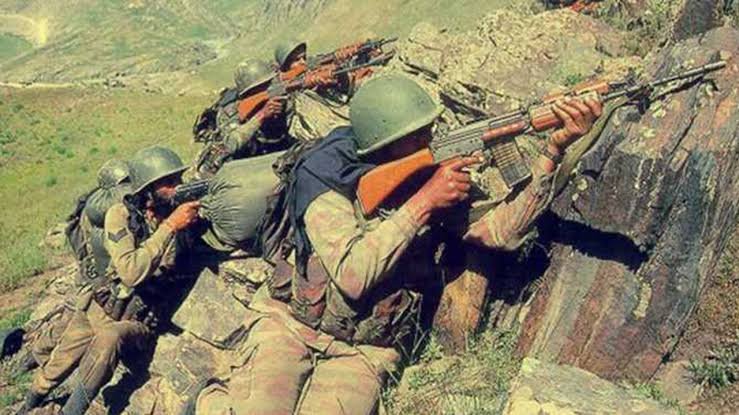
To understand the gravity of the Kargil War, one must understand the terrain. This was not a war fought on flat plains; it was fought on vertical cliff faces at altitudes ranging from 14,000 to 18,000 feet. At these heights, oxygen levels drop by 50%. A soldier carrying a 25kg pack would be breathless after just a few steps. The enemy sat on the mountain tops, effectively looking down the barrel of a gun at Indian troops who had to climb up from the valley floor, completely exposed.
It was a tactical nightmare. The Pakistani intruders had clear lines of sight and could rain down heavy artillery fire on NH-1A, threatening to cut off Ladakh from the rest of India. The Indian Army had to do the impossible: charge up steep, icy slopes under direct enemy fire to dislodge well-entrenched defenders.
The Purulia Arms Drop Mystery 1995: When the Sky Rained Guns
Operation Vijay: Valor Beyond Measure
The Indian response was swift and furious. On May 10, the Indian Government launched Operation Vijay. It began with setbacks; early patrols sent to investigate were ambushed, and Captain Saurabh Kalia was captured and brutally tortured, signaling that this was no ordinary insurgency.
The turning point came with the Battle of Tololing in mid-June. It was the first major success, where troops from the 2nd Rajputana Rifles fought hand-to-hand in the freezing darkness to recapture the peak. This victory boosted morale across the entire front.
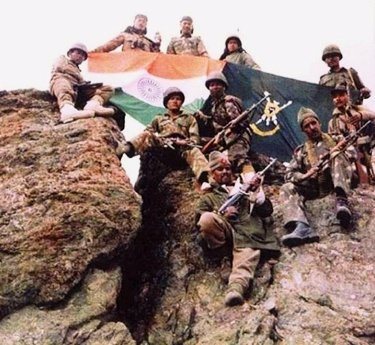
Then came the legendary capture of Tiger Hill. The 18 Grenadiers, led by men made of steel, executed a multi-pronged attack. It was here that Yogendra Singh Yadav, despite being shot multiple times, crawled up the cliff face to silence enemy bunkers, earning the Param Vir Chakra.
No story of Kargil is complete without mentioning Captain Vikram Batra. Code-named “Sher Shah,” he became the face of the war. After capturing Point 5140, he famously radioed his command with the Pepsi slogan, “Yeh Dil Maange More!” (The heart wants more). He fell in the subsequent battle for Point 4875, saving a fellow soldier while taking a bullet to the chest. His sacrifice, along with that of Lieutenant Manoj Pandey—who cleared bunker after bunker on Khalubar despite fatal wounds—defined the spirit of the Indian Army.
The Sky Warriors: Operation Safed Sagar
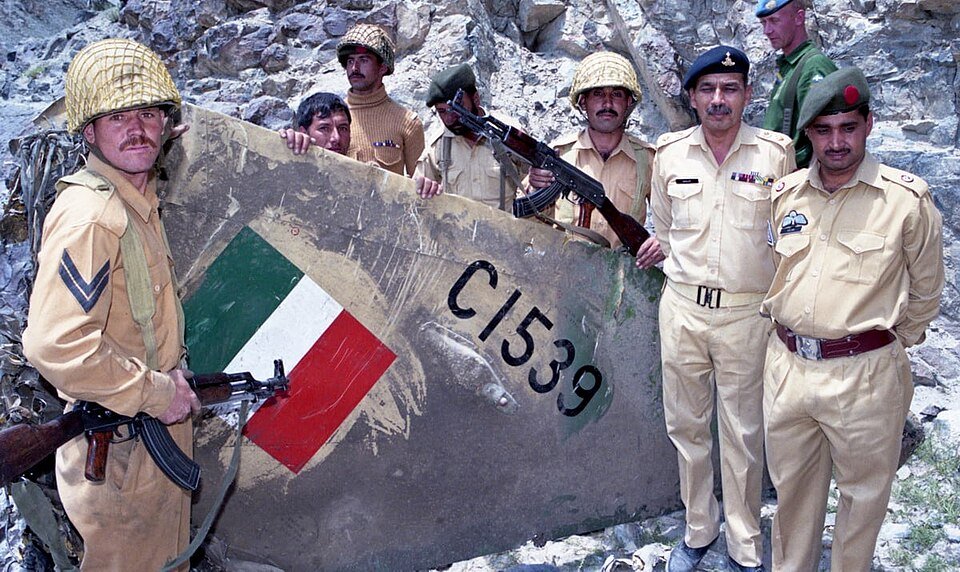
While the infantry climbed, the Indian Air Force (IAF) changed the game from above. Launching Operation Safed Sagar, the IAF faced a unique challenge: flying fighter jets at altitudes they were never designed for. The thin air affected engine performance and bomb trajectory.
To counter the threat of shoulder-fired missiles (which had already downed two Indian jets), the IAF employed the Mirage 2000 armed with laser-guided bombs. They decimated enemy supply lines and bunkers on Muntho Dhalo and Tiger Hill. This was the first time air power was used effectively at such altitudes, earning global military respect.
The “Gunners” Who Shook the Mountains
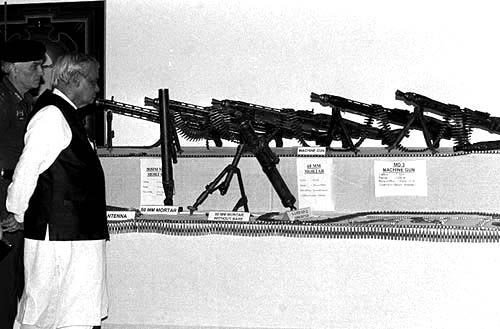
The unsung heroes of Kargil were the artillery units. The controversial Bofors Howitzers, previously mired in political scandal, proved to be the decisive weapon of the war. Their ability to fire at high angles allowed them to hit enemy positions hidden behind mountain ridges. Over 250,000 shells were fired during the conflict, a rate of fire second only to World War II. The terrifying roar of the Bofors destroyed enemy morale and their bunkers, paving the way for the infantry’s final assault.
1971 Nagarwala Case: India’s Great Bank Heist Mystery
Victory and the Price Paid
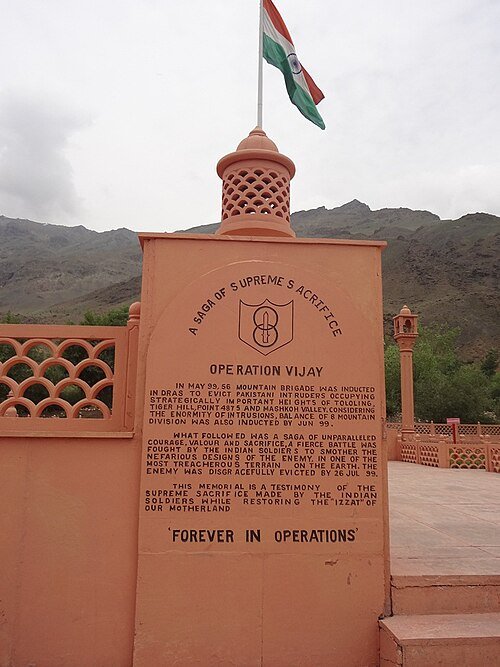
By July, the Pakistani position had become untenable. Diplomatic pressure from the United States and the G8 nations isolated Pakistan globally. On the ground, they were losing peak after peak. On July 26, 1999, the Indian Army declared Operation Vijay a success. The intruders were evicted, and the tricolor flew high once again.
But the victory came at a steep price. 527 soldiers returned home in coffins wrapped in the national flag. They left behind grieving families but a grateful nation that would never forget their sacrifice.
Quick Comparison Table: 1999 vs. Today
| Factor | 1999 (Kargil Era) | Present Day (Post-Reforms) |
| Surveillance | Human patrols; No dedicated satellites | Satellite imagery, UAVs (Drones), and Thermal Imaging |
| Equipment | Heavy, outdated winter gear | Lightweight, modular extreme-weather combat gear |
| Intelligence | Relying on local informants (Shepherds) | Integrated Defence Intelligence Agency & Multi-agency centers |
| Air Support | Jets unequipped for high-altitude precision | Rafale & Apache helicopters tailored for mountain warfare |
Curious Indian: Fast Facts
- The “Barking Deer” Signal: Before the war officially started, local shepherds noticed that the Barking Deer, usually shy, were running down into the valleys, signaling a disturbance on the peaks.
- Operation Talwar: While the Army and Air Force fought on land, the Indian Navy quietly moved its Eastern Fleet to the Arabian Sea (Operation Talwar), blockading Pakistani ports and cutting off their oil supply routes.
- Wind Chill Factor: At the height of battle, soldiers weren’t just fighting the enemy; they were fighting wind chills of -60°C. Weapons jammed, and frostbite was as dangerous as a bullet.
- The 14-Year-Old Soldier: There were reports of Pakistani soldiers abandoning their posts, leaving behind weapons, diaries, and even young recruits who had been misled about the “Jihad.”
Conclusion
The 1999 Kargil War was a testament to the fact that wars are not won by weapons alone, but by the people behind them. It highlighted the vulnerabilities in our intelligence but also the invincible strength of our character. Today, as we look at the majestic peaks of Dras and Kargil, they stand silent, guarding the memories of the brave men who gave their today for our tomorrow.
The Roopkund Skeleton Lake Mystery: Why Were Greeks Dying in the Indian Himalayas?
If you think you have remembered everything about this topic take this QUIZ
Results


#1. Who was the local individual whose initial report triggered the discovery of the massive Pakistani infiltration in the Batalik sector?
#2. What was the specific tactical challenge that made the Kargil terrain a ‘nightmare’ for the Indian troops?
#3. Which officer, posthumously awarded the Param Vir Chakra, famously used the code name ‘Sher Shah’ and the slogan ‘Yeh Dil Maange More!’?
#4. What was the code name of the Indian Air Force operation that utilized Mirage 2000 jets and laser-guided bombs at extreme altitudes?
#5. Which weapon system, previously controversial in Indian politics, proved to be the decisive ‘game-changer’ during the artillery duels in Kargil?
#6. According to the ‘Fast Facts,’ what was the naval operation that cut off Pakistan’s oil supply routes during the conflict?
#7. The war officially ended on July 26, 1999. What is this day now celebrated as in India?
#8. According to the ‘Quick Comparison’ table, how has intelligence gathering changed since 1999?
Why did the Kargil War happen?
It happened because Pakistani troops infiltrated the Indian side of the Line of Control (LoC) during winter to capture strategic peaks and cut off the highway connecting Srinagar to Leh (Ladakh).
Who won the Kargil War?
India won the war decisively. The Indian Army recaptured all the occupied peaks, and Pakistan was forced to withdraw its remaining troops under international pressure.
How long did the Kargil War last?
The conflict lasted for roughly two months and three weeks, from early May 1999 to July 26, 1999.
Who was Captain Vikram Batra?
Captain Vikram Batra was an officer of the Indian Army who was posthumously awarded the Param Vir Chakra. He is famous for his bravery in capturing Point 5140 and Point 4875, and for his catchphrase “Yeh Dil Maange More.”
What role did the Bofors gun play in Kargil?
The Bofors howitzers were crucial in tilting the war in India’s favor. Their ability to fire “high angle” shots allowed them to destroy enemy bunkers hidden behind steep mountain ridges that direct fire couldn’t reach.