Introduction
India’s Constitution stands as the world’s longest written charter, adopted by the Constituent Assembly on 26 November 1949 after exhaustive deliberations spanning 2 years, 11 months, and 18 days across 166 sittings, and enforced on 26 January 1950 to mark the nation as a sovereign democratic republic.

Pre-Independence Roots
Constitutional evolution began with British acts serving colonial interests: Government of India Act 1858 centralized power post-Revolt; Indian Councils Acts (1861, 1892, 1909) introduced limited elections; 1919 Act devolved dyarchy; 1935 Act provided federal framework with provincial autonomy, influencing 75% of India’s structure despite rejection. Indians countered with Motilal Nehru Report (1928), advocating dominion status, joint electorates, and federalism; M.N. Roy proposed Constituent Assembly in 1934, formalized by Congress in 1935.
World War II accelerated demands: August Offer (1940) promised post-war assembly; Cripps Mission (1942) failed over dominion status; Cabinet Mission (1946) allocated 389 seats (296 British provinces, 93 princely)—Congress secured 208, League 73—under population ratio, electing via restricted franchise representing Hindus, Muslims, Sikhs, SC/ST, women (15 like Sarojini Naidu, Durgabai Deshmukh).
Constituent Assembly Dynamics
First meeting on 9 December 1946 at New Delhi’s Constituent Hall drew 211 members amid League boycott; Dr. Sachchidananda Sinha chaired temporarily, succeeded by Dr. Rajendra Prasad (president) and H.C. Mukherjee (vice-president). Jawaharlal Nehru’s Objectives Resolution (13 December 1946), adopted 22 January 1947 unanimously, outlined sovereign republic, equality before law, freedoms of speech/religion, minority safeguards—evolving into Preamble via 42nd Amendment adding socialist, secular, integrity.
Mountbatten Plan (3 June 1947) and Independence Act (18 July) reduced seats to 299, granting sovereignty; assembly doubled as provisional parliament (G.V. Mavalankar speaker) enacting laws till 1952 elections, adopting flag (22 July 1947), anthem (Vande Mataram, Jana Gana Mana on 24 January 1950). Eleven committees, including Union Powers, Fundamental Rights, handled specifics; total debates covered 7635 amendments, adopting 2844.
Drafting Committee Mastery
Formed 29 August 1947, seven-member Drafting Committee under B.R. Ambedkar—joined by Alladi Krishnaswami Ayyar, N. Gopalaswami Ayyangar, K.M. Munshi, Syed Muhammad Saadulla, D.P. Khaitan (replaced by T.T. Krishnamachari)—produced first draft (February 1948, 315 articles) after synthesizing inputs, inviting 8-month public feedback. Second draft (October 1948) incorporated suggestions; final presented 4 November 1948 underwent third reading (14 November-26 November 1949), with Ambedkar defending borrowings as “no originality in Constitution-making.”
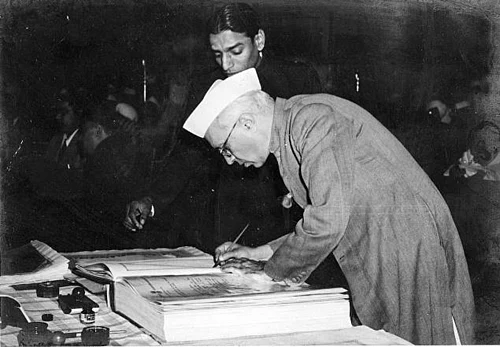
Handwritten by Prem Behari Narain Raizada in Devolution Gothic/Indica scripts (6 months), illuminated by Nandalal Bose (pages) and Ram Manohar Sinha (title), nitrogen-preserved original resides in Parliament Library. 284 members signed on 26 November, celebrated as Constitution Day (Samvidhan Divas since 2015).
Key Provisions and Salient Features
Federal with unitary bias: Article 1 declares “Union of States” (no secession right); single constitution/citizenship, integrated judiciary, All-India Services (IAS/IPS/IFS), center appoints governors, emergency powers (Articles 352, 356, 360) tilt toward unitary during crises. Parliamentary democracy: President nominal head, real executive in PM-led Council of Ministers accountable to Lok Sabha (Article 75(3)); bicameral Parliament.
Fundamental Rights (Part III, Articles 12-35): Six categories—equality, freedom, exploitation ban, religion, culture/education, constitutional remedies—justiciable, inspired by US; suspended in emergencies except Articles 20-21. Directive Principles (Part IV, Articles 36-51): Non-justiciable socio-economic goals (Gandhian, socialist, liberal)—uniform civil code (44), village panchayats (40), education (45, now 21A via 86th Amendment); Fundamental Duties (Part IV-A, Article 51A, 42nd/86th Amendments)—11 duties like sovereignty protection, harmony promotion.
Secular republic: No state religion, equal treatment (44th Amendment removed secular from Preamble? No, added 1976); universal adult suffrage (Article 326); independent bodies—Election Commission, CAG, UPSC; single integrated judiciary with Supreme Court judicial review (basic structure doctrine, Kesavananda Bharati 1973). Rigid-flexible: Basic structure unamendable; amended via special majority/simple process.
Enforcement and Early Impact
26 January 1950 enforced major provisions (citizenship, elections delayed); chosen for 1930 Lahore Purna Swaraj resolution; Rajendra Prasad sworn first President 24 January. Provisional assembly continued as parliament till 1952; first elections (1951-52) validated republic status. Integrated 565 princely states; shaped land reforms, reservations, secular laws amid refugee crises.

Legacy and Enduring Relevance
Endures as living document: 106 amendments (latest 2019); upholds diversity in 1.4 billion population; global model for balancing rights/duties, federalism/pluralism. Preamble guides interpretation; basic structure protects core (democracy, secularism, federalism); inspires movements for equality, environment (Article 48A). At 75+, remains bedrock of world’s largest democracy, adapting via judicial activism and amendments without losing foundational vision.