The Guardian of Genius
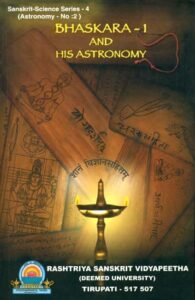
Imagine a world where a revolutionary new idea is born, but without someone to explain its depth and beauty, it risks being lost to history. This is where Bhāskara I steps onto the stage. Flourishing in the 7th century, Bhāskara I was a pivotal Indian mathematician and astronomer, not just for his original contributions, but because he was the most influential popularizer and commentator on the work of the great Aryabhatta.
His story is essential to understanding the transmission and endurance of Indian science. While Aryabhatta sowed the seeds of groundbreaking theories like the Earth’s rotation and advanced trigonometry, it was Bhāskara I who carefully tended the garden, ensuring the knowledge flourished. His clear, friendly explanations of complex concepts solidified his reputation and ensured these scientific achievements became the foundation for future generations. For every student seeking inspiration for students in clarity and dedication, Bhāskara I is a guiding star.
Early Life and Education: Roots in Scholarship
The details of Bhāskara I’s early life are less clearly documented than his later works, but historical context places him firmly in the intellectual heartland of ancient India, likely in the Gujarat or Maharashtra region. He was born around 600 CE, during the tail end of the Gupta period, an era that maintained a strong emphasis on learning, particularly in mathematics and astronomy.

Growing up, he would have been immersed in a culture that used sophisticated numerical systems for everything from calendar creation to religious rites and taxation. His early influences would undoubtedly have included the existing Siddhanta traditions—the established astronomical texts—but, critically, he was a contemporary of a rapidly changing scientific landscape. The works of his near-predecessor, Aryabhatta (composed in 499 CE), would have been circulating, provoking both admiration and debate.
This atmosphere demanded not only the ability to memorize and follow established texts but also the intellectual curiosity and courage to grapple with radical new ideas. Bhāskara I’s education must have been exceptionally rigorous, preparing him to engage critically with the most advanced mathematical concepts of his time.
Journey into Science: The Explainer and Defender
Bhāskara I’s journey into science was defined by his role as an academic bridge builder. He realized that genius, however profound, requires eloquent explanation to survive. He saw the brilliance in Aryabhatta’s concise, almost cryptic verses in the Āryabhaṭīya and understood that without elaboration, these revolutionary ideas might be misunderstood or dismissed.
His scientific career formally began with the composition of several significant works, including the Mahābhāskarīya (Great Book of Bhāskara) and the Laghubhāskarīya (Small Book of Bhāskara). However, his most famous and influential contribution is his commentary, the Āryabhaṭīya Bhāṣya.
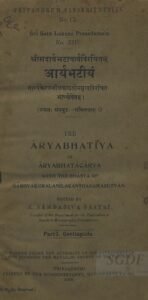
This commentary was not a mere summary; it was a detailed, chapter-by-chapter unpacking of Aryabhatta’s text. He offered proofs, examples, and practical applications, turning a dense, poetic text into an accessible textbook. This was his first and most defining initial career experience—becoming the chief explainer for the most advanced scientific theories of his age.
His work cemented his reputation as an authoritative Indian scientist who prized clarity above all, using simple language and relatable analogies to guide his readers through complex mathematical territory.
Major Achievements and Contributions: The Power of Proof and Approximation
Bhāskara I’s scientific achievements are crucial not for proposing entirely new physical laws, but for making the greatest achievements of his predecessors workable and comprehensible, while also offering significant original insights.
📝 The Bhāṣya: Preserving the Revolution
His detailed commentary, the Āryabhaṭīya Bhāṣya, is arguably his single most important contribution to the world. By taking the time to explain the methods for calculating sines (trigonometry), roots, and the Earth’s circumference, he ensured that Aryabhatta’s knowledge was disseminated widely across India, serving as the primary resource for subsequent generations of mathematicians like Bhāskara II.
🌐 Bhāskara’s Sine Approximation Formula
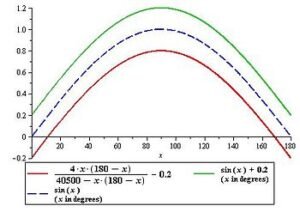
In his own work, particularly the Mahābhāskarīya, he introduced an incredibly elegant and accurate formula for calculating the sine of an acute angle without the use of tables. This was essential for rapid astronomical calculation in the field. The formula is written in verse, but mathematically, it’s expressed as:
This formula yields a highly accurate result, particularly when the angle x is close to zero, and is a stunning example of ingenious mathematical approximation—a true scientific achievement in early analysis. It shows his deep understanding of trigonometric principles.
0️⃣ The Early Use of Hindu-Arabic Numerals
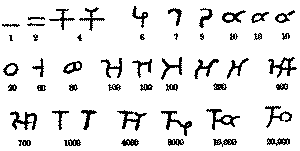
Bhāskara I was one of the earliest known scholars to explicitly use and write numbers in the Hindu-Arabic decimal numeral system with a place-value system. He used concrete examples to illustrate the vastness of large numbers (e.g., 10^{18}) and clearly explained the positional importance of digits. His use of this system helped solidify its adoption in India, paving the way for its later spread to the Arab world and eventually Europe.
Challenges and Turning Points: The Weight of Legacy
Bhāskara I’s main challenge was the intellectual climate itself. He operated between two monumental figures: Aryabhatta, whose ideas were often considered unorthodox, and the later, highly critical Brahmagupta, who vocally disputed many of Aryabhatta’s theories, particularly the rotation of the Earth.
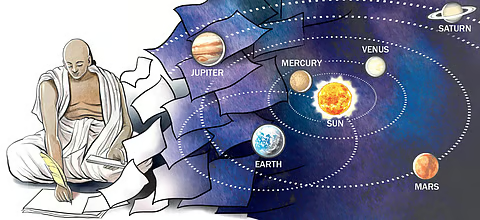
His turning point was the decision to stand as a faithful, yet pragmatic, interpreter of Aryabhatta. By choosing to devote his energy to the detailed explanation of his predecessor’s work, he faced the risk of being overshadowed or drawn into heated academic battles. However, his choice proved to be a masterful strategic move:
* He insulated Aryabhatta’s work: His comprehensive commentaries ensured that even when Brahmagupta criticized Aryabhatta’s astronomical parameters, the fundamental mathematical tools and trigonometric concepts, clearly laid out by Bhāskara I, remained indisputable and universally used.
* He ensured clarity: His friendly, conversational style of writing in the Bhāṣya allowed the revolutionary concepts to penetrate beyond the elite circles, establishing a common mathematical language that helped unify the different schools of thought.
In this sense, his greatest challenge—the complexity of Aryabhatta’s text—became his defining opportunity to establish himself as the voice of reason and clarity in Indian mathematics.
Legacy and Inspiration: The Importance of Interpretation
Bhāskara I is often less celebrated than his namesakes (Aryabhatta or Bhāskara II), yet his legacy is arguably the most crucial for the continuity of science. Without his efforts, many of Aryabhatta’s ideas might have been corrupted or lost.
He leaves an indelible mark on Indian science and provides profound inspiration for students and professionals alike:
* The Power of Teaching: Bhāskara I’s life teaches us that advancing knowledge is just as important as generating it. The gift of a great teacher who can make the complex simple is indispensable to human progress.
* The Virtue of Detail: His meticulous dedication to writing comprehensive proofs and examples underscores the necessity of rigor and detail in any scientific or scholarly field. Precision is paramount.
* Building the Bridge: He reminds us that true progress often relies on those who can successfully translate radical ideas into mainstream practice, building the intellectual bridges that connect one generation of genius to the next.
Bhāskara I was a true Indian scientist, a gifted mathematician, and an exceptional educator whose commitment to clarity ensured that the light of ancient Indian scientific achievements continued to shine brightly for the rest of the world.
Read More: https://curiousindian.in/brahmagupta-c-598-668-ce/