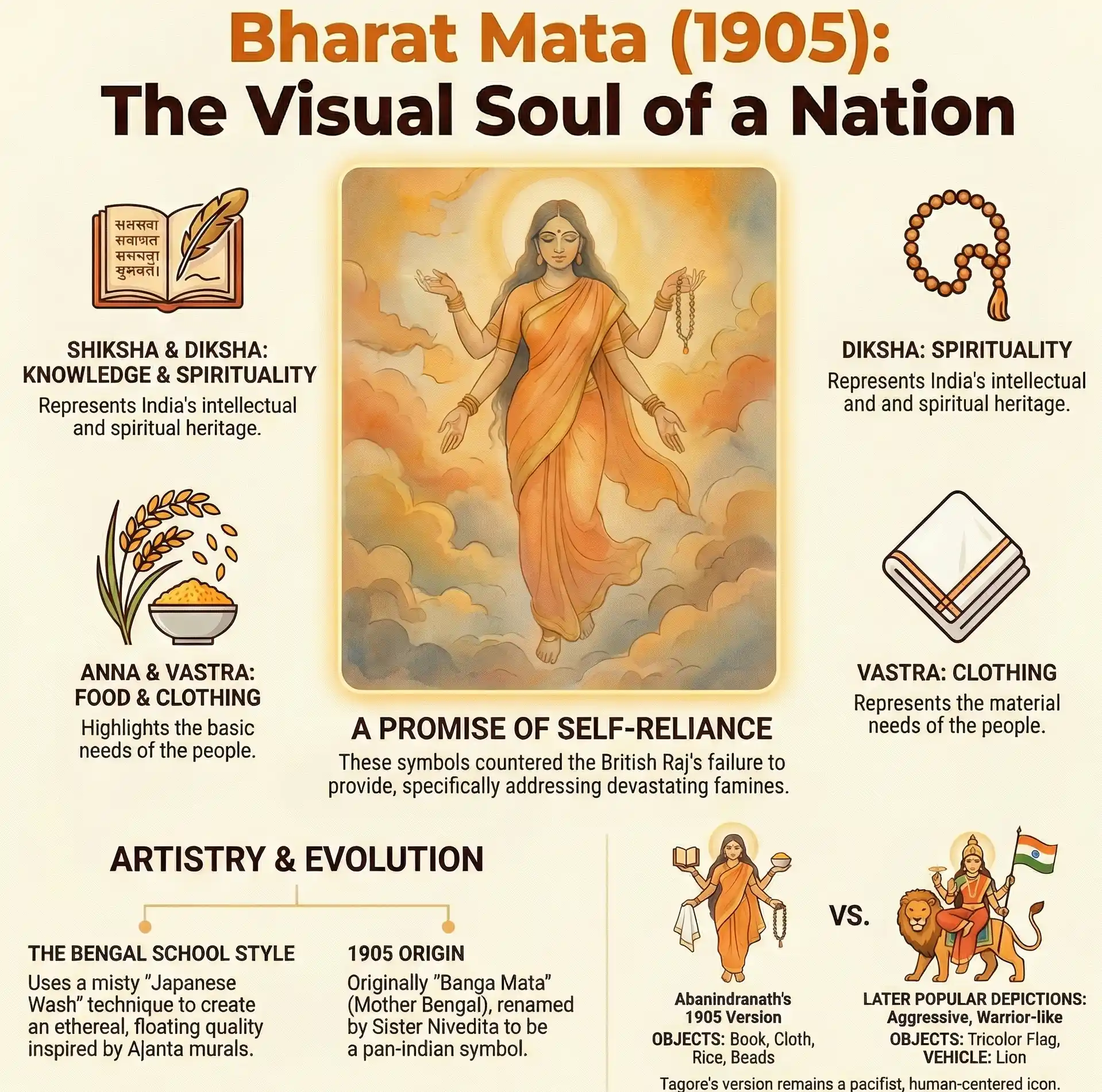
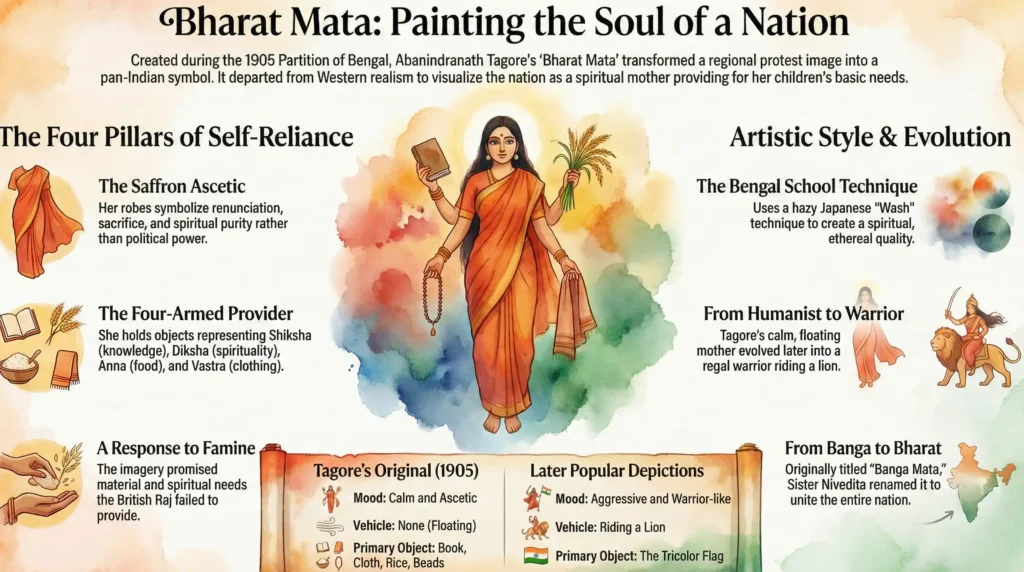
Bharat Mata is a watercolor painting created by Abanindranath Tagore in 1905. Painted during the turmoil of the Partition of Bengal (Banga Bhanga), it depicts a saffron-clad woman, resembling a Hindu ascetic, holding four symbolic objects in her four hands: a book, sheaves of paddy, a white cloth, and a rudraksha mala (garland). Originally titled Banga Mata (Mother Bengal), it was renamed Bharat Mata (Mother India) to serve as a pan-Indian symbol of resistance against British rule. The painting is considered the first visualization of the Indian nation as a mother goddess, blending the aesthetics of the Bengal School of Art with the political fervor of the Swadeshi Movement.| Feature | Details |
| Artist | Abanindranath Tagore |
| Year | 1905 |
| Medium | Watercolor (Wash Technique) |
| Original Title | Banga Mata (Mother Bengal) |
| Context | Partition of Bengal / Swadeshi Movement |
| Symbolism | Four Hands holding Food, Cloth, Knowledge, Faith |
| Key Promoter | Sister Nivedita |
| Location | Victoria Memorial Hall, Kolkata |
| Style | Bengal School (Indian Style) |
The Context: A Nation Divided
In 1905, Lord Curzon announced the Partition of Bengal to divide the Hindu and Muslim populations and weaken the nationalist movement. The streets of Calcutta erupted in protest. It was in this atmosphere of intense nationalism that Abanindranath Tagore, the nephew of Rabindranath Tagore, picked up his brush. He wanted to create an image that would unite the people, not by anger, but by devotion.
The Image: A Secular Goddess
Unlike later depictions of Bharat Mata riding a lion with a flag, Abanindranath’s version was calm and ascetic.
- Saffron Robes: She wears the color of renunciation, symbolizing sacrifice and spiritual purity.
- Four Hands: The four arms represent divine power, but the objects she holds represent the basic needs of the Indian people:
- Shiksha (Knowledge): A manuscript/book in the upper left hand.
- Diksha (Spirituality): A Rudraksha mala in the upper right hand.
- Anna (Food): Sheaves of paddy (rice) in the lower left hand.
- Vastra (Clothing): A piece of white cloth in the lower right hand.This symbolism was powerful because it promised that the Mother would provide for her children’s material and spiritual needs—something the British Raj had failed to do (proven by repeated famines).
From Banga Mata to Bharat Mata
Originally, Abanindranath titled the painting Banga Mata (Mother Bengal) as a protest against the partition. However, Sister Nivedita (Swami Vivekananda’s disciple) saw its potential to unite the entire country. She reprinted it in the journal Prabasi and renamed it Bharat Mata. She famously wrote:
“From now on, let the mother be the center of our worship… I would reprint it by the tens of thousands and scatter it over the land, till there was not a peasant’s cottage that did not have it.”
The Bengal School Style
The painting is a classic example of the Bengal School of Art, which Abanindranath founded to counter the Western academic realism promoted by British art schools.
- Technique: It uses the Japanese Wash Technique (a hazy, mist-like effect), which Abanindranath adapted.
- Aesthetics: The figure is elongated and ethereal, drawing inspiration from Mughal miniatures and Ajanta murals rather than European oil paintings. It is distinct for its “spiritual” quality—the Mother seems to be floating rather than standing on solid ground.
Legacy and Evolution
The image of Bharat Mata evolved significantly after Abanindranath.
- Anandamath: The concept of the motherland as a goddess was first literary popularized by Bankim Chandra Chatterjee in his novel Anandamath (1882) with the song Vande Mataram.
- Aggressive Transformation: In later years, revolutionary groups and political parties transformed Bharat Mata into a warrior goddess riding a lion, holding a tricolor flag. However, Abanindranath’s version remains the most “human” and pacifist depiction—a mother offering sustenance, not war.
- Temples: In 1936, a Bharat Mata Temple was inaugurated in Varanasi by Mahatma Gandhi. Interestingly, it houses a relief map of India in marble instead of a statue, emphasizing the land itself as the deity.
Nil Darpan: The Mirror of Indigo
Quick Comparison Table: Abanindranath’s vs. Popular Bharat Mata
| Feature | Abanindranath’s Painting (1905) | Later Popular Depictions |
| Mood | Calm, Ascetic, Sadhvi-like | Aggressive, Warrior-like, Regal |
| Vehicle | None (Floating) | Lion |
| Hands | Holding Book, Cloth, Rice, Beads | Holding Flag (Tricolor) |
| Focus | Self-reliance (Swadeshi) | Political Sovereignty / Territory |
| Style | Ethereal Watercolor (Wash) | Realistic Calendar Art / Oil |
Curious Indian: Fast Facts
- Sister Nivedita’s Admiration: Sister Nivedita was so moved by the painting that she wanted to carry it from Kashmir to Kanyakumari to preach the religion of the Motherland.
- The Model: It is believed that Abanindranath’s daughter, Sunayani Devi (who later became a famous artist herself), may have been an inspiration for the face, though the figure is largely idealized.
- Missing Map: Unlike modern versions, Abanindranath’s painting does not have the map of India in the background. The focus is entirely on the figure.
- Japanese Influence: The painting’s soft, misty look is a direct result of Abanindranath’s interaction with Japanese artists like Yokoyama Taikan, who visited the Tagore house.
Conclusion
Bharat Mata by Abanindranath Tagore is more than just a painting; it is a historical document. It captures a moment when India was trying to define itself not just as a geographical entity, but as a spiritual mother. By visualizing the nation as a provider of food, cloth, and knowledge, Tagore gave the freedom struggle a human face—one that demanded not just territory, but dignity.
Subramania Bharati: The Mahakavi of Indian Nationalism
If you think you have remembered everything about this topic take this QUIZ
Results


#1. In which year did Abanindranath Tagore paint the famous watercolor “Bharat Mata”?
#2. What was the original title of the painting before it was renamed to “Bharat Mata”?
#3. Who was the disciple of Swami Vivekananda that reprinted the image and popularized the name “Bharat Mata”?
#4. The hazy, mist-like effect in the painting is a classic example of which technique adapted by Abanindranath?
#5. The literary concept of the motherland as a goddess was first popularized in which 1882 novel by Bankim Chandra Chatterjee?
#6. What unique feature is housed inside the Bharat Mata Temple inaugurated by Mahatma Gandhi in Varanasi in 1936?
#7. The soft, misty look of the painting was directly influenced by Abanindranath’s interaction with which Japanese artist?
Who painted the famous image of Bharat Mata in 1905?
Abanindranath Tagore painted it.
What do the four hands of Bharat Mata symbolize?
They symbolize Food (Paddy), Clothing (White Cloth), Knowledge (Book), and Faith (Rosary/Mala).
What was the original title of the painting?
The original title was Banga Mata (Mother Bengal).
Which artistic style does the painting belong to?
It belongs to the Bengal School of Art.
Who played a key role in popularizing the painting as ‘Bharat Mata’?
Sister Nivedita popularized it.