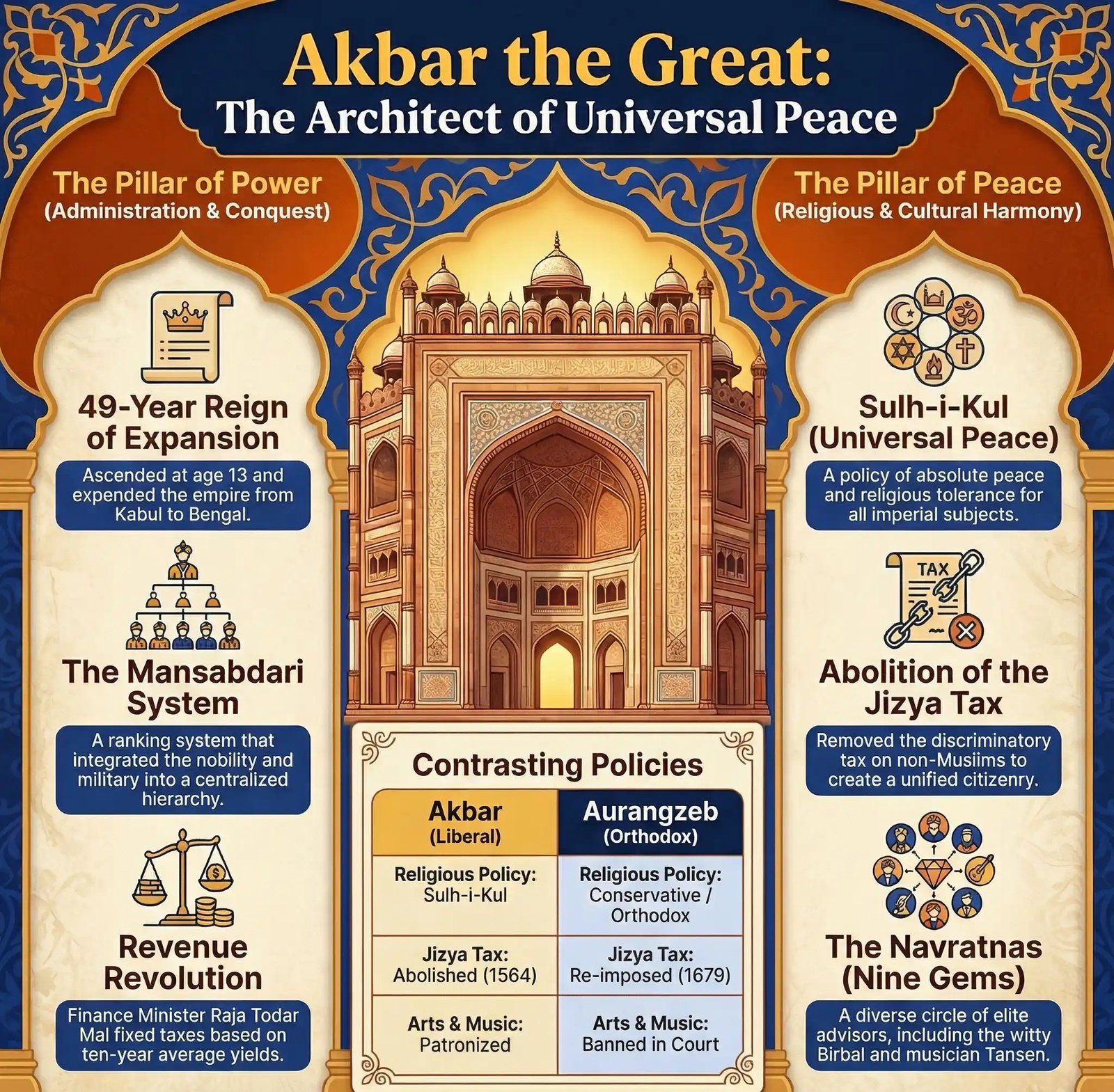
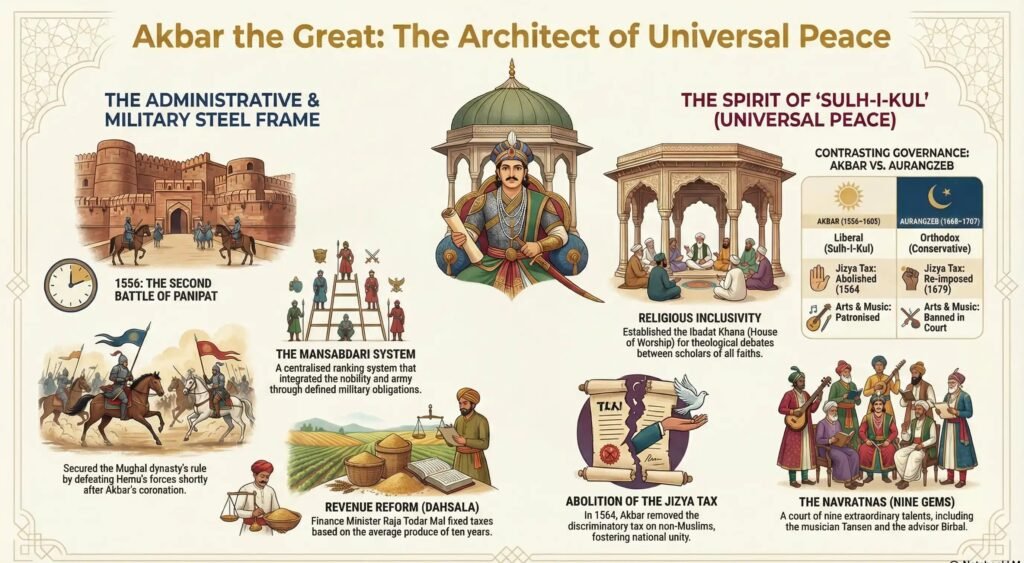
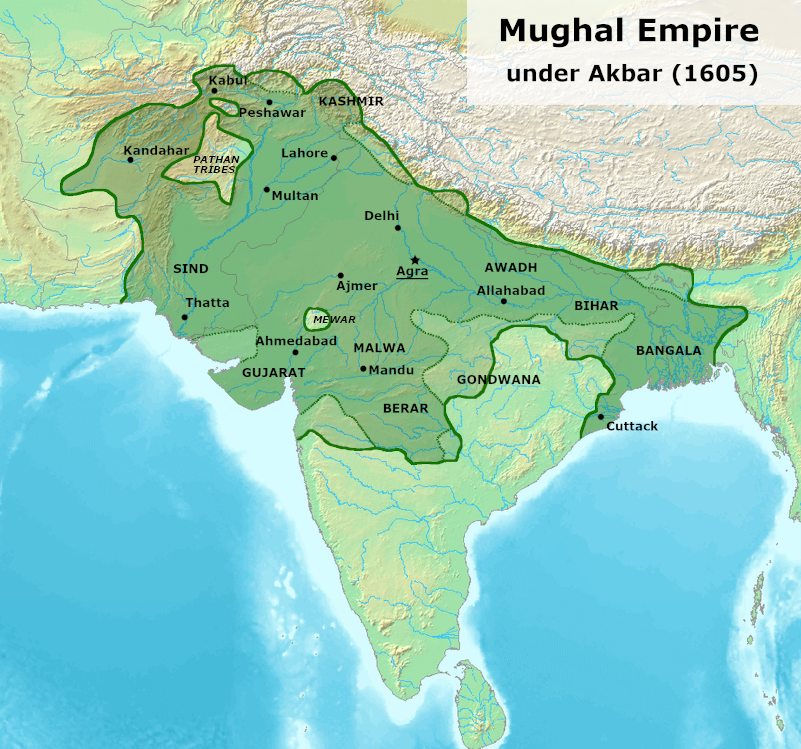
Jalal-ud-din Muhammad Akbar (r. 1556–1605), known as Akbar the Great, was the third and arguably the greatest Mughal Emperor. Ascending the throne at the tender age of 13 after the sudden death of his father Humayun, he secured his empire by defeating Hemu at the Second Battle of Panipat (1556) with the help of his regent Bairam Khan. Akbar is celebrated not just for his military conquests—which expanded the empire from Kabul to Bengal—but for his administrative genius (Mansabdari system) and his revolutionary religious policy of Sulh-i-Kul (Peace with All). He abolished the discriminatory Jizya tax on non-Muslims, married Rajput princesses to forge alliances, and established the Ibadat Khana (House of Worship) to debate truths from all religions.| Feature | Details |
| Reign | 1556 – 1605 |
| Coronation Age | 13 Years (at Kalanaur) |
| Regent | Bairam Khan |
| Key Battle | Second Battle of Panipat (1556) vs. Hemu |
| Capital | Agra / Fatehpur Sikri / Lahore |
| Religious Policy | Sulh-i-Kul (Universal Peace) |
| New Faith | Din-i-Ilahi (Religion of God) |
| Admin System | Mansabdari System |
| Revenue System | Dahsala / Zabti (by Raja Todar Mal) |
| Biography | Akbarnama / Ain-i-Akbari (by Abul Fazl) |
The Boy King and the Second Battle of Panipat
Akbar was born in exile at Umerkot while his father Humayun was fleeing from Sher Shah Suri. When Humayun died in 1556, the Mughal empire was fragile. The Hindu general Hemu (Vikramaditya) captured Delhi and Agra.
- The Battle: On November 5, 1556, the Mughal army led by Bairam Khan clashed with Hemu’s forces at Panipat. A chance arrow hit Hemu in the eye, turning a likely defeat into a decisive Mughal victory. This battle secured the Mughal dynasty’s rule in India.
Rajput Kingdoms: The Warrior Clans of India
Imperial Expansion and Rajput Policy
Akbar realized that to rule India, he needed the support of the indigenous Rajputs.
- Matrimonial Alliances: He married Harka Bai (Jodha Bai), the daughter of Raja Bharmal of Amber (Jaipur). Unlike previous rulers, he allowed his Hindu wives to practice their religion freely inside the palace.
- Rajputs in Court: He appointed Rajputs to the highest positions. Raja Man Singh and Raja Bhagwan Das were among his most trusted generals.
- Military Conquests: He conquered Gujarat (1572), Bengal (1576), and Kashmir (1586). To commemorate his victory over Gujarat, he built the massive Buland Darwaza (Gate of Victory) at Fatehpur Sikri.
Administration: The Steel Frame
Akbar created a highly centralized and efficient administration.
- Mansabdari System: Every official (noble/military officer) was given a rank (Mansab) which determined their salary and the number of soldiers (Sawar) and horses they had to maintain. This system integrated the nobility and the army.
- Land Revenue (Zabti System): His finance minister, Raja Todar Mal, introduced the Dahsala system. Land was measured using bamboo sticks with iron rings, and tax was fixed based on the average produce of the last ten years.
Reign of Emperor Ashoka: The Transformation of a Tyrant
Religious Policy: The Seeker of Truth
Akbar was deeply spiritual and curious. He moved away from orthodox Islam towards a more inclusive approach.
- Ibadat Khana (1575): He built a “House of Worship” at Fatehpur Sikri where he invited scholars of Islam, Hinduism, Christianity (Jesuits from Goa), Zoroastrianism, and Jainism to debate religious truths.
- Abolition of Taxes: He abolished the Pilgrimage Tax (1563) and the hated Jizya tax (1564) on non-Muslims, winning the hearts of the Hindu majority.
- Din-i-Ilahi (1582): He propounded a new syncretic philosophy (often called a religion) called Din-i-Ilahi (Divine Faith), which emphasized morality, piety, and kindness. It had very few followers, including Birbal.

The Navratnas (Nine Gems)
Akbar’s court was famous for its nine extraordinary talents:
- Birbal: The witty advisor and close friend.
- Tansen: The legendary musician (Mian Tansen).
- Abul Fazl: The historian who wrote the Akbarnama.
- Faizi: The poet laureate and brother of Abul Fazl.
- Raja Man Singh: The great general.
- Raja Todar Mal: The finance genius.
- Mullah Do Piazza: The advisor known for his wit.
- Fakir Aziao-Din: The religious mystic.
- Abdul Rahim Khan-i-Khanan: The poet and son of Bairam Khan.
Second Battle of Tarain 1192: The Turning Point of Indian History
Quick Comparison Table: Akbar vs. Aurangzeb
| Feature | Akbar (1556–1605) | Aurangzeb (1658–1707) |
| Religious Policy | Liberal / Sulh-i-Kul | Orthodox / Conservative |
| Jizya Tax | Abolished (1564) | Re-imposed (1679) |
| Relationship with Rajputs | Alliances / Friendship | Conflict / War |
| Arts & Music | Patronized (Tansen) | Banned in Court |
| Empire State | Consolidated & Stable | Over-expanded & Rebellious |
Curious Indian: Fast Facts
- Illiterate Emperor: Despite owning a massive library of 24,000 manuscripts and patronizing scholars, Akbar himself was illiterate (likely due to dyslexia), yet he had a phenomenal memory.
- Vegetarianism: influenced by Jain monks (like Hiravijaya Suri), Akbar gave up eating meat on many days of the week and banned animal slaughter during Jain festivals (Paryushan).
- The Jesuits: Three Jesuit missions from Goa visited Akbar’s court, hoping to convert him to Christianity. Akbar listened intently but remained unconverted, much to their frustration.
- Fatehpur Sikri: He built a stunning new capital at Fatehpur Sikri to honor the Sufi saint Salim Chishti, who had predicted the birth of his son, Jahangir. However, the city had to be abandoned after 15 years due to water shortage.
Conclusion
Akbar the Great was a ruler ahead of his time. In an era of religious wars globally, he championed the idea that a ruler is the father of all his subjects, regardless of their faith. He crafted an Indian empire, not just a Mughal one, fusing Persian culture with Indian traditions to create a legacy of art, architecture, and administration that defined the subcontinent for centuries.
Reign of Harshavardhana: The Empire of Benevolence
If you think you have remembered everything about this topic take this QUIZ
Results


#1. At which location was the 13-year-old Akbar crowned as the Mughal Emperor?
#2. What specific event led to the Mughal victory at the Second Battle of Panipat in 1556?
#3. To commemorate his conquest of Gujarat, which architectural landmark did Akbar commission?
#4. In the Mansabdari system, what did the rank of ‘Sawar’ represent?
#5. Which of the following describes the ‘Zabti’ land revenue system introduced by Raja Todar Mal?
#6. What was the primary purpose of the ‘Ibadat Khana’ established in 1575?
#7. Which member of the ‘Navratnas’ was a close friend and witty advisor who also followed Akbar’s Din-i-Ilahi?
#8. Despite being illiterate, Akbar owned a library of approximately how many manuscripts?
Who was the regent of Akbar during his early years?
Bairam Khan was his regent and mentor.
Which battle secured Akbar’s throne?
The Second Battle of Panipat (1556) against Hemu.
What was the name of the new “religion” founded by Akbar?
Din-i-Ilahi (Divine Faith) or Tauhid-i-Ilahi.
Who was the finance minister responsible for Akbar’s revenue reforms?
Raja Todar Mal.
Why was the Jizya tax abolished by Akbar significant?
It removed the second-class status of non-Muslims, integrating Hindus fully into the empire’s citizenry.