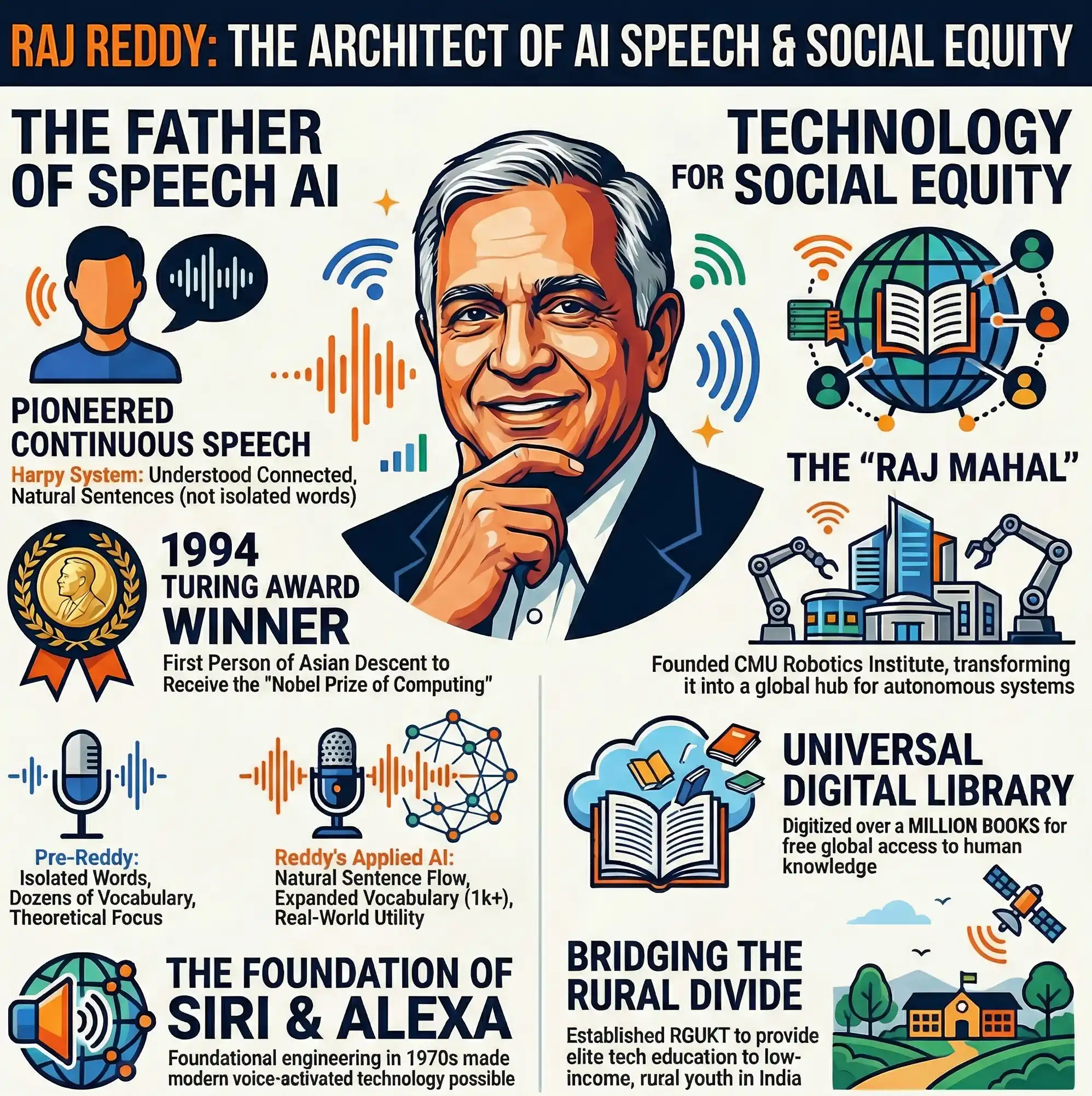
Dabbala Rajagopal "Raj" Reddy (born 1937) is an internationally celebrated Indian-American computer scientist and a founding father of applied Artificial Intelligence (AI). Born in a modest village in Andhra Pradesh, he pursued engineering in India before moving abroad, eventually completing his Ph.D. at Stanford University under AI legend John McCarthy. Reddy's most profound scientific breakthrough was in continuous speech recognition (creating systems like Hearsay I and Harpy), moving AI out of theoretical chalkboards and into real-world utility. For this pioneering work, he received the 1994 A.M. Turing Award (the "Nobel Prize of Computing"). He founded the world-renowned Robotics Institute at Carnegie Mellon University (CMU) and dedicated his later career to leveraging technology to solve societal issues, such as illiteracy and digital divides in the developing world.| Feature | Details |
| Name | Dabbala Rajagopal Reddy (Raj Reddy) |
| Birth Date | June 13, 1937 |
| Birthplace | Katoor, Chittoor district, Andhra Pradesh, India |
| Profession | Computer Scientist, AI Researcher |
| Highest Award | A.M. Turing Award (1994) |
| Civilian Honor | Padma Bhushan (2001, India), Legion of Honor (1984, France) |
| Key Innovation | Continuous Speech Recognition Systems (Harpy, Hearsay) |
| Major Institution | Carnegie Mellon University (Founder of Robotics Institute) |
Writing in the Sand: Early Life
Born on June 13, 1937, in Katoor, a small agricultural village in the Chittoor district of Andhra Pradesh, Raj Reddy’s early life was framed by modest circumstances and limited infrastructure. His father was an agricultural landowner, and his mother was a homemaker.
In a powerful testament to the scarcity of resources during his childhood, Reddy often recounts how his early education lacked basic school supplies. He and his classmates learned the alphabet not with paper and pencils, but by tracing letters with their fingers in a leveled plot of sand. This profound, resource-constrained upbringing instilled in him a lifelong empathy for the underprivileged and a commitment to ensuring that technology serves those at the “bottom of the pyramid.” His sharp intellect eventually earned him a spot at the Guindy College of Engineering in Madras, where he graduated with a Bachelor’s in Civil Engineering in 1958.
Daulat Singh Kothari : (1906–1993)
The Unexpected Computer
Reddy’s path shifted from building physical roads to building digital bridges when he traveled to Australia as an exchange student to earn his Master’s degree in Technology. While working for IBM in Australia in the early 1960s, his curiosity about the emerging computational world intensified.
The major turning point occurred when he read a paper by John McCarthy, the legendary computer scientist who originally coined the term “Artificial Intelligence.” Inspired, Reddy moved to the United States and enrolled at Stanford University. Working directly under McCarthy’s mentorship at the pioneering Stanford AI Lab, Reddy began researching speech recognition. In 1966, he earned his Ph.D. in Computer Science—reportedly Stanford’s very first doctorate in that specific field.
Giving Computers a Voice: The AI Breakthrough
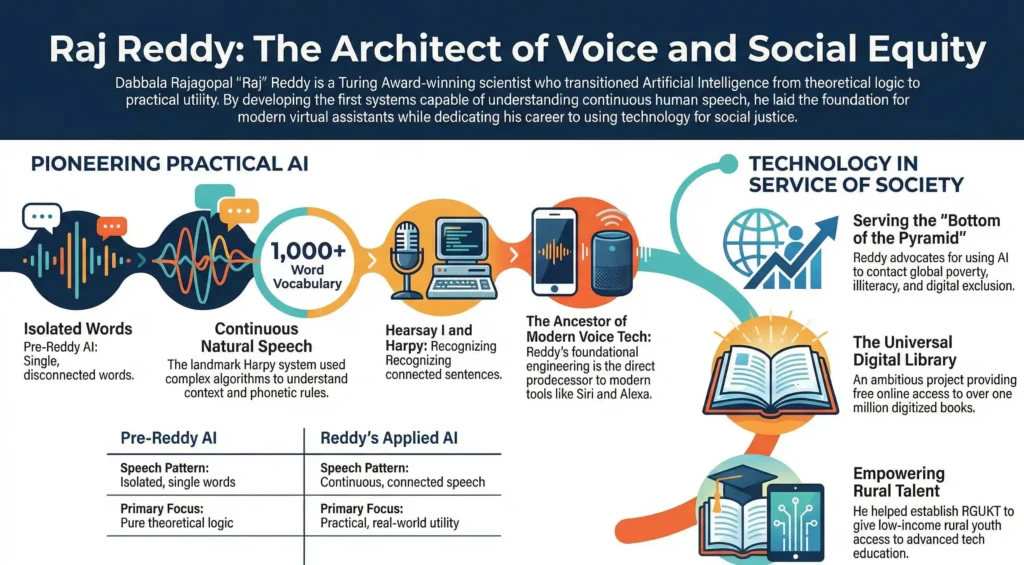
Before the 1970s, making a computer understand human speech was a clunky, frustrating process. Early systems could only recognize isolated, single words, requiring the speaker to pause awkwardly between each word.
Moving to Carnegie Mellon University (CMU) in 1969, Dr. Reddy led teams to develop the first major continuous speech recognition systems, most notably Hearsay I and Harpy.
- The Harpy System: Built in the mid-1970s, Harpy was a landmark achievement. It was capable of understanding a vocabulary of over 1,000 words spoken in connected, natural sentences. It utilized a complex network of algorithms to predict words based on context and phonetic rules.
- The Global Impact: This applied research formed the fundamental bedrock of all modern voice-activated technology. Without Reddy’s foundational engineering, everyday tools like Google Assistant, Apple’s Siri, and Amazon Alexa simply would not exist today.
Venkatraman Ramakrishnan: (1952- Present)
Building the “Raj Mahal”
Reddy was not just a researcher; he was a master institution builder. In 1979, he founded the Carnegie Mellon Robotics Institute, which he directed for over a decade. Under his leadership, the institute became one of the premier hubs for AI, machine vision, and autonomous systems in the world. His students affectionately nicknamed the institute the “Raj Mahal.” He fostered an environment of intense interdisciplinary collaboration, pushing AI from science fiction into practical factory automation, robotics, and human-computer interaction.
Technology in Service of Society
Dr. Reddy’s most heartfelt legacy lies in his advocacy for using AI to combat global poverty and illiteracy. Having lived through the skepticism of the “AI Winter” (a period of reduced funding and interest in AI), he focused his later years on bridging the digital divide:
- The Universal Digital Library: He founded this project with the ambitious goal of providing free, online access to over a million books digitized in multiple languages, making human knowledge accessible to anyone with an internet connection.
- RGUKT: He was instrumental in establishing the Rajiv Gandhi University of Knowledge Technologies (RGUKT) in his home state of Andhra Pradesh. The university’s core mission is to enroll talented, low-income youth from rural areas, giving them direct access to advanced technology education.
Manjul Bhargava: (1974- Present)
Quick Comparison Table: The Evolution of AI Speech
| Feature | Pre-Reddy AI (1950s-1960s) | Reddy’s Applied AI (1970s onwards) |
| Speech Pattern | Isolated, single words | Continuous, connected speech |
| Vocabulary Size | Dozens of words | 1,000+ words (The Harpy System) |
| Focus Area | Pure theoretical logic | Practical, real-world utility |
| Processing Goal | Translating text | Machine perception (Hearing & Seeing) |
| Modern Descendants | Early calculators | Siri, Alexa, Automated translation |
Curious Indian: Fast Facts
- The Turing Award: In 1994, Raj Reddy shared the A.M. Turing Award with Edward Feigenbaum. The Turing Award is globally recognized as the “Nobel Prize of Computing.” He was the first person of Asian descent to win it.
- Global Honors: Beyond the Turing Award, he has been heavily decorated by multiple governments, receiving the Legion of Honor from France in 1984 and the Padma Bhushan from India in 2001.
- The Father of Practical AI: While early pioneers debated the philosophy of AI, Reddy was a pragmatist. His work shifted the narrative from “Can machines think?” to “How can we make machines hear and see?”
Conclusion
Dr. Raj Reddy embodies the absolute best of global science. He is a testament to the fact that brilliant talent can sprout from the sandy soils of rural India and eventually reshape the technological boundaries of humanity. By giving computers the ability to hear and understand us, he laid the tracks for the digital future. Yet, he never forgot where he came from, constantly using his towering influence to ensure that the AI revolution serves the poorest and most marginalized populations on Earth.’
If you think you have remembered everything about this topic take this QUIZ
Results


#1. What prestigious honor, often referred to as the “Nobel Prize of Computing,” did Raj Reddy receive in 1994?
#2. Due to a scarcity of school supplies during his childhood in a modest village, how did Raj Reddy and his classmates learn the alphabet?
#3. Which legendary computer scientist, known for originally coining the term “Artificial Intelligence,” mentored Raj Reddy at Stanford University?
#4. What was the name of the landmark continuous speech recognition system built by Reddy’s team in the mid-1970s that could understand a vocabulary of over 1,000 words?
#5. In 1979, Raj Reddy founded a world-renowned institute at Carnegie Mellon University (CMU) focused on which field?
#6. According to the comparison table, what was a major limitation of AI speech recognition prior to Reddy’s work in the 1970s?
#7. To help combat global illiteracy, Dr. Reddy founded an ambitious project aimed at providing free online access to over a million digitized books. What is it called?
#8. The text notes that without Raj Reddy’s foundational engineering in applied AI, which of the following modern technologies would simply not exist today?
What is Raj Reddy famous for?
He is a pioneering computer scientist famous for developing the world’s first continuous speech recognition systems and for founding the Robotics Institute at Carnegie Mellon University.
What is the A.M. Turing Award?
Often called the “Nobel Prize of Computing,” it is an annual prize given by the Association for Computing Machinery (ACM) to an individual for contributions of lasting and major technical importance to the computer field. Raj Reddy won it in 1994.
What were Hearsay I and Harpy?
They were early, groundbreaking AI systems developed by Reddy and his team at CMU that could understand continuous, connected human speech, a massive leap forward from previous isolated-word recognition systems.
How did Raj Reddy contribute to Indian education?
He championed the creation of the Rajiv Gandhi University of Knowledge Technologies (RGUKT) in Andhra Pradesh to provide high-quality, advanced IT education specifically to talented, low-income students from rural backgrounds.
Who was Raj Reddy’s mentor at Stanford?
He was mentored by John McCarthy, a legendary computer scientist who originally coined the term “Artificial Intelligence.”
Author


Exploring the Soul of Bharat through History, Science, Culture, and its Diversity
Our Mission
Curious Indian is a definitive knowledge portal dedicated to chronicling the events, personalities, and cultural shifts that defined the Indian subcontinent. From the ancient Vedic Period to the complexities of 21st-century politics, our goal is to provide deep-dive analysis that inspires.
Editorial Standards & E-E-A-T
Every article published under our brand undergoes a rigorous fact-checking process. We prioritize primary historical records, academic citations, and credible archives to ensure our readers receive accurate, high-authority information.
Historical Integrity Directly sourcing from ASI archives and academic journals.Topical Authority Comprehensive clustering of Indian Science, Biographies, and Wars.Managed by Paripurna Datta and TEAM | Dedicated to the Knowledge of India.