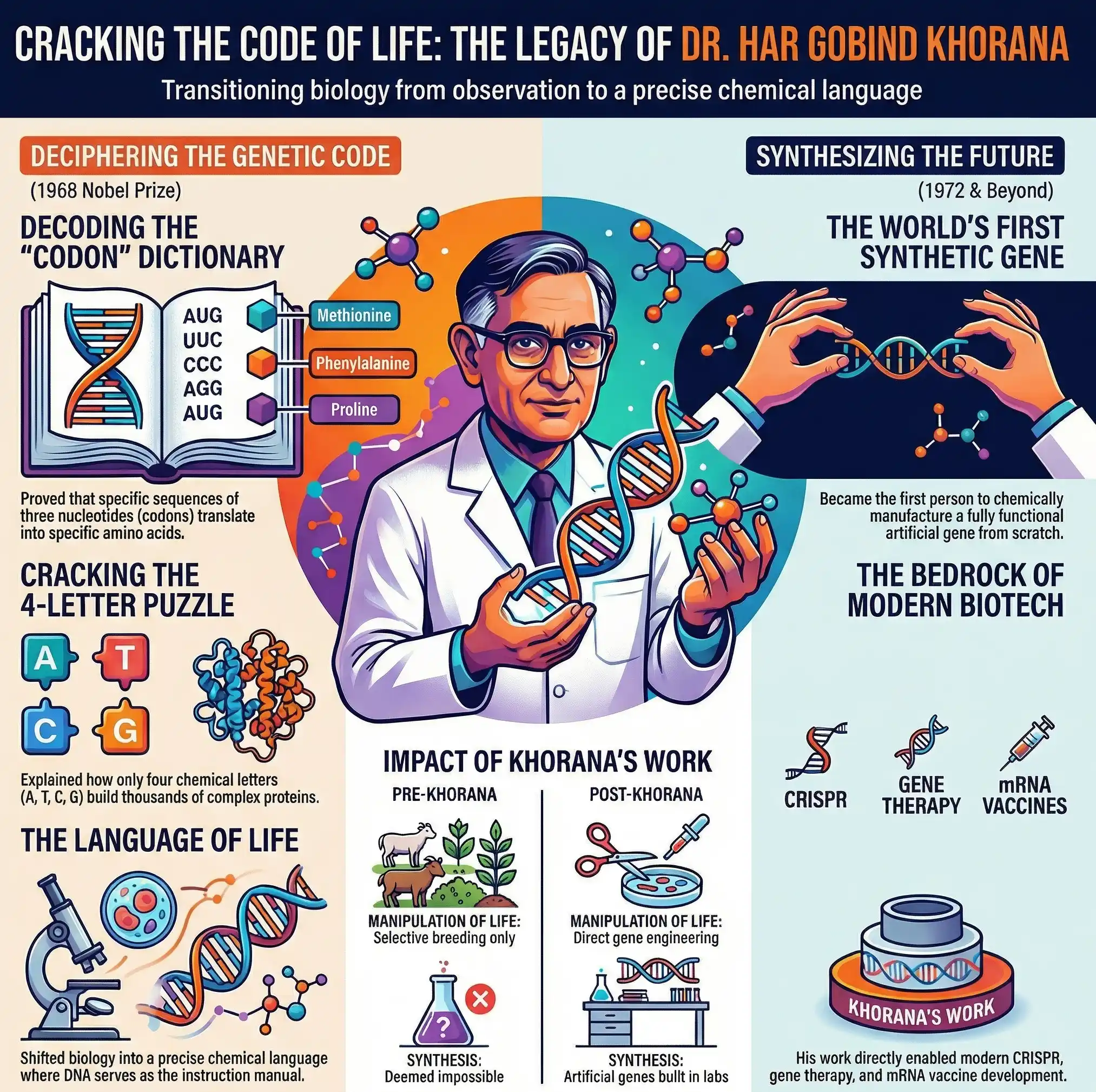
Dr. Har Gobind Khorana (1922–2011) was a legendary Indian-American biochemist who revolutionized molecular biology. Born in a desperately poor village in undivided India, he earned scholarships to study in England and Switzerland. By applying his profound mastery of organic chemistry to biology, he helped solve one of the greatest mysteries of the 20th century: how the sequence of nucleotides in DNA translates into the proteins that build all living things. For identifying these genetic “codons,” he shared the 1968 Nobel Prize in Physiology or Medicine. In 1972, he pushed the boundaries of science even further by becoming the first person to chemically synthesize a fully functional artificial gene. His pioneering work formed the bedrock of modern biotechnology, genetic engineering, and gene therapy.
| Feature | Details |
| Name | Dr. Har Gobind Khorana |
| Lifespan | January 9, 1922 – November 9, 2011 |
| Birthplace | Raipur, Punjab, British India (now Pakistan) |
| Field of Science | Molecular Biology, Organic Chemistry |
| Nobel Prize | Physiology or Medicine (1968) |
| Key Discovery | Cracking the Genetic Code (Codons to Amino Acids) |
| World First | First to chemically synthesize an artificial gene (1972) |
| Major Institutions | Univ. of Wisconsin-Madison, MIT, Cambridge |
A Spark Ignited Under a Tree
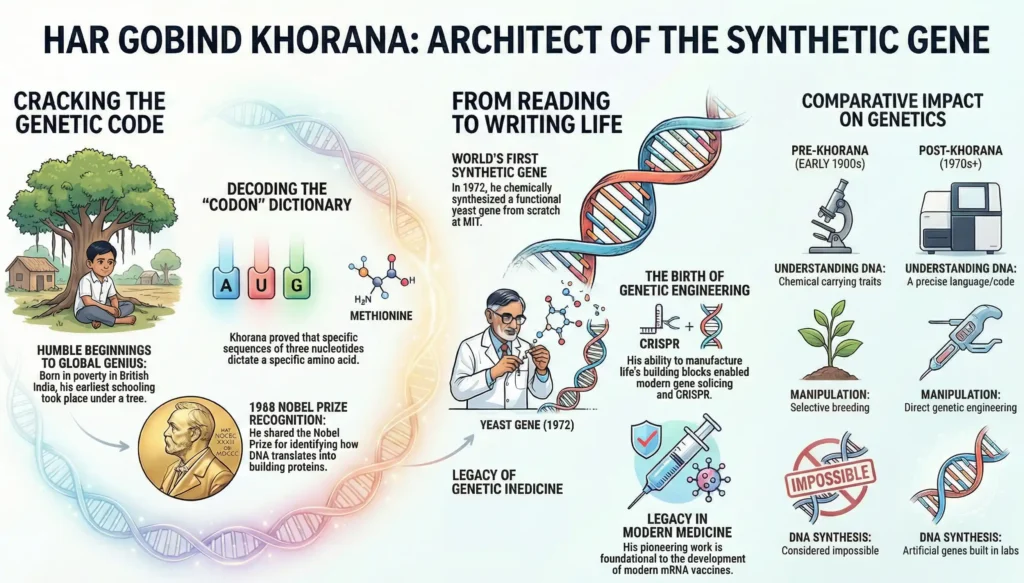
The story of Har Gobind Khorana is a testament to the fact that brilliance knows no geographical boundaries. Born on January 9, 1922, in the small village of Raipur in the Punjab region of British India, his family lived in severe poverty. His father was an agricultural taxation clerk—and famously, the only literate person in their village of 100 people.
Despite their lack of wealth, his father was deeply committed to education. Khorana’s earliest schooling took place literally under a tree. This humble start instilled in him a quiet discipline and an unyielding resolve to rise above his circumstances. He excelled at the D.A.V. High School in Multan and subsequently earned life-changing government scholarships, completing his B.Sc. and M.Sc. in Chemistry at Punjab University, Lahore, by 1945.
Venkatraman Ramakrishnan: (1952- Present)
The Global Pursuit of Knowledge
Khorana’s true journey into world-class science began when a government fellowship allowed him to travel to the University of Liverpool in England to pursue a Ph.D. in organic chemistry.
After completing his doctorate and a postdoctoral stint in Switzerland, he returned to India in 1949. However, the newly independent nation lacked the advanced scientific infrastructure and institutional support he needed. Forced to choose between comfort and scientific progress, he made the difficult decision to leave his homeland. He accepted a fellowship at Cambridge University under Sir Alexander Todd (a future Nobel laureate). Here, surrounded by world-class minds, Khorana began to focus his genius on the core chemical components of life: proteins and nucleic acids.
Shivkar Bapuji Talpade: (1864- 1916)
Cracking the Genetic Code
Khorana’s name is permanently etched into the history of science for solving the ultimate biological puzzle in the 1960s.
- The Problem: Scientists knew that DNA carried genetic instructions using four chemical “letters” (A, T, C, and G). But they didn’t know how these four letters spelled out the complex directions to build thousands of different proteins (made of amino acids).
- The Solution: While working at the University of Wisconsin-Madison, Khorana used his mastery of organic chemistry to physically synthesize long, specific strands of RNA in the laboratory. By creating chains with repeating sequences (like U-G-U-G-U-G…) and feeding them into bacterial systems, he observed which amino acids were produced.
- The Breakthrough: He definitively proved that specific sequences of three nucleotides—known as a codon—dictate a specific amino acid. For example, he proved that the codon UGU (Uracil-Guanine-Uracil) translates to the amino acid Cysteine. He, along with Marshall Nirenberg and Robert Holley, completely deciphered the “dictionary” of DNA, earning them the 1968 Nobel Prize.
Building Life from Scratch: The Synthetic Gene
Khorana was not content with merely reading the genetic code; he wanted to write it. In 1972, while at the Massachusetts Institute of Technology (MIT), he achieved an astonishing feat: he was the first person to chemically synthesize an entire, functional gene (a yeast transfer RNA gene) from scratch in a laboratory.
This was a colossal undertaking of meticulous, painstaking chemistry. It proved that human beings could artificially manufacture the basic building blocks of life, effectively giving birth to the entire modern field of genetic engineering.
Manjul Bhargava: (1974- Present)
Quick Comparison Table: The Impact of Khorana’s Work
| Era | Genetics Pre-Khorana (Early 1900s) | Genetics Post-Khorana (1970s onwards) |
| Understanding of DNA | A chemical that carries traits | A precise language/code that builds proteins |
| Manipulation | Selective breeding of plants/animals | Direct genetic engineering and gene splicing |
| Medical Application | Studying inheritance patterns | Gene therapy, CRISPR, targeted diagnostics |
| Synthesis | Impossible | Artificial genes can be built in a lab |
Curious Indian: Fast Facts
- The India Connection: Although he spent his most productive decades in the USA and became a naturalized citizen in 1966, Khorana remained deeply connected to his roots, frequently mentoring young Indian scientists who traveled to his labs in America.
- The Quiet Genius: Unlike many high-profile scientists, Khorana was notoriously shy and shunned the media spotlight. He rarely gave interviews, preferring to let his painstaking laboratory results speak for him.
- A Lifetime at MIT: Khorana spent the later part of his career as a Professor of Biology and Chemistry at the prestigious Massachusetts Institute of Technology (MIT), working tirelessly in his lab until he formally retired in 2007.
Conclusion
Dr. Har Gobind Khorana fundamentally shifted biology from a study of observation to a precise chemical language. Every time a scientist sequences a genome, utilizes CRISPR gene editing, or develops an mRNA vaccine, they are standing squarely on the shoulders of this quiet man from Raipur. His life teaches us that a curious mind, fortified by education and absolute determination, can rise from the shade of a village tree to unlock the most guarded secrets of the universe.
Daulat Singh Kothari : (1906–1993)
If you think you have remembered everything about this topic take this QUIZ
Results


#1. Where was Dr. Har Gobind Khorana born?
#2. Khorana applied his profound mastery of which scientific field to biology to help solve the mysteries of DNA?
#3. Who was famously the only literate person in Khorana’s childhood village of 100 people?
#4. What specific term is used to describe the specific sequence of three nucleotides that dictates a specific amino acid?
#5. With whom did Dr. Khorana share the 1968 Nobel Prize in Physiology or Medicine?
#6. 6. What groundbreaking world-first feat did Khorana achieve at MIT in 1972?
#7. According to the comparison table, what medical application characterizes the “Genetics Post-Khorana” era?
#8. Despite spending his later career in the USA, what was a key way Khorana remained connected to his Indian roots?
What did Har Gobind Khorana win the Nobel Prize for?
He won the 1968 Nobel Prize in Physiology or Medicine (shared with two others) for his work in deciphering the genetic code and explaining how it controls the synthesis of proteins.
What is a “codon”?
A codon is a sequence of three adjacent nucleotides in DNA or RNA that specifies a particular amino acid to be added during protein synthesis. Khorana helped figure out exactly which three letters code for which amino acid.
What major scientific “first” did Khorana achieve in 1972?
He became the first scientist in history to chemically synthesize a fully functional artificial gene in a laboratory.
Did Khorana conduct his Nobel-winning research in India?
No. While he was born and educated initially in India, the lack of scientific infrastructure in the post-independence era led him to conduct his groundbreaking research in Canada and the United States.
What was his foundational scientific background?
While he is famous for molecular biology, his foundational training and Ph.D. were in organic chemistry, which gave him the unique skills needed to artificially synthesize DNA and RNA sequences.