Kihim, 1930: Salim Ali came home from Germany to find his job gone. So he sat in the scrub by the sea with a notebook and watched the weaver birds build
In 1930 Salim Ali came home from a year of training in Berlin and found that he had no job.
He had gone to Germany to study under Erwin Stresemann at the Berlin Museum, one of the great bird men of Europe. Before he left he had been working as a guide lecturer at the natural history section of the Prince of Wales Museum in Bombay, run by the Bombay Natural History Society. While he was away, the post had been abolished to save money.
He was thirty-three, married, and had no income. Anyone with his energy and his command of English could have walked into a Bombay firm. He did not even apply. His family thought he had gone mad.
His wife, Tehmina, did not. “Don’t take a job,” she told him, “if you can’t enjoy it.”
His family thought he had gone mad. His wife told him not to take a job he could not enjoy.
Tehmina’s family had a small cottage at Kihim, a coastal village south of Bombay across the harbour. The young couple went to live there. The land behind the beach was scrub forest and low hills, and it was full of birds.
Walking in the scrub one day, Salim Ali saw a baya, the common weaver bird. Then he saw more of them. They were a colony, and they were nesting.
Everyone in India knew the baya’s nest, the long hanging bottle of woven grass that swings from the end of a palm frond or a thorn branch. What nobody had properly worked out was who built it, and why, and what happened inside the colony while it was being built.
So for the next three or four months, for hours every day, he watched.
It was the males who built. In the breeding season they turned a bright golden yellow, and each one started weaving a nest of his own, strip by strip of green grass, in a colony alongside the others.
The females did not choose the brightest male. They came and looked at the nests. A female chose her mate by what he had built, not by how he looked. If she liked the nest, she moved in.
And the male did not stop there. As soon as one nest had a female in it, he went off and started another, and another after that. One male might end up with four or five families.
The female did not choose the brightest male. She chose the best builder.
No one had set down the breeding life of the baya like this before. He did it with no laboratory, no equipment and no salary, with a notebook, a pencil and a great deal of patience.
He wrote up what he had seen, and his paper on the nesting habits of the baya appeared in the Journal of the Bombay Natural History Society. It became a classic. It showed what a single careful observer could find out simply by sitting still long enough in the right place.
The year was not only about the bayas. In the quiet at Kihim he also began work on a book, The Book of Indian Birds, which would become the book every Indian birdwatcher learned from. And he made up his mind about the job question. He would stop hunting for one. He would make his own work out of birds.
Not long afterwards he took a proposal to the BNHS for surveys of the birds of India’s princely states, paid for by their rulers. That was the start of the career that made him the Birdman of India.
Tehmina went with him on nearly all of those expeditions. She had been educated at a finishing school in England and, he liked to say, finishing school had not finished her. She helped with his English and shared his days in the field.
She died suddenly in 1939, after a minor operation. He never remarried.
The jobless year at Kihim was the year they had together with nothing to do but watch. He spent it learning how a small yellow bird wins a partner: not by showing off, but by patiently building a home worth moving into.
If you think you have remembered everything about this topic take this QUIZ
Results
QUIZ START
#1. What specific bird species sparked Salim Ali’s lifelong passion for ornithology after he found it as a pre-teen?
Previous
Next
#2. Which 1941 pictorial field guide by Salim Ali is credited with democratizing birdwatching for the Indian masses?
Previous
Next
#3. Living in the coastal village of Kihim, Salim Ali established his scientific credibility by publishing a paper on the complex mating behavior of which bird?
Previous
Next
#4. Dr. Ali’s scientific advocacy directly led to the cancellation of a hydroelectric dam project that would have destroyed which pristine rainforest in Kerala?
Previous
Next
#5. Who co-authored the monumental 10-volume Handbook of the Birds of India and Pakistan with Salim Ali?
Previous
Next
#6. To receive formal training in systematic bird study and ringing, Ali traveled to Germany in 1928 to work under which professor?
Previous
Next
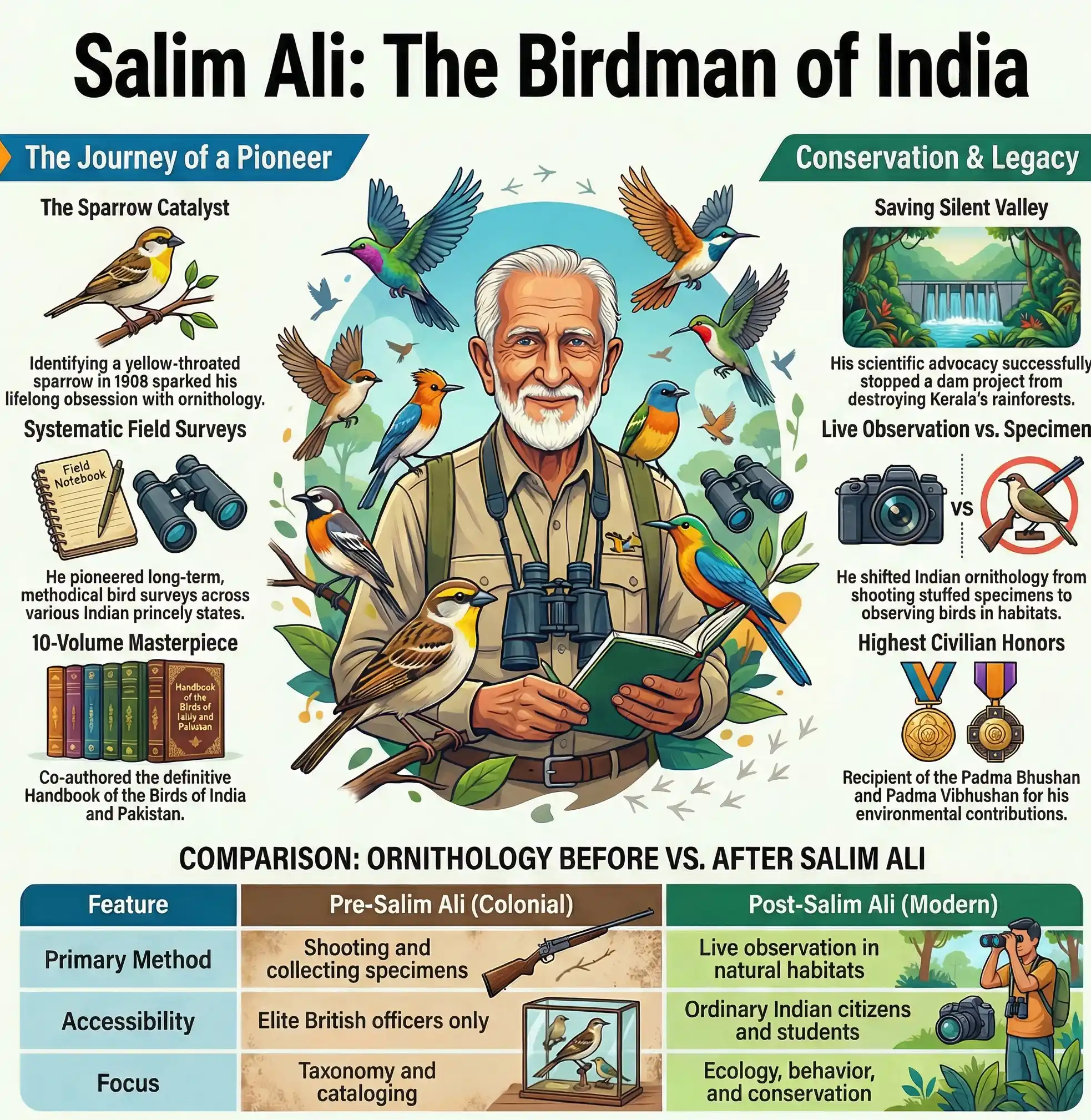
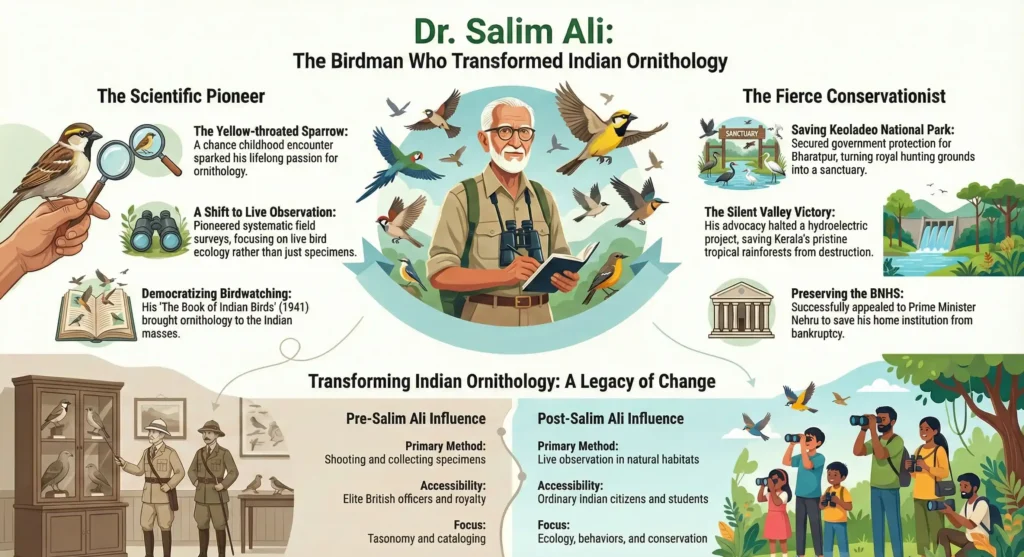
#7. According to the comparison table, what was the primary method of ornithology before Salim Ali (during the Colonial Era)?
Previous
Next
#8. After India’s independence, to whom did Dr. Ali personally appeal to secure funding and save the Bombay Natural History Society (BNHS) from a financial crisis?
Previous
Finish
Why is Salim Ali known as the Birdman of India?
He earned this title because he was the first Indian to conduct systematic bird surveys across the country, fundamentally establishing the field of modern ornithology in India.
As a child, he shot a yellow-throated sparrow and took it to the Bombay Natural History Society (BNHS) for identification. The secretary there showed him the society’s bird collection, sparking his lifelong passion.
What is his most famous book?
His most famous accessible work is “The Book of Indian Birds” (1941), while his ultimate scientific masterpiece is the 10-volume “Handbook of the Birds of India and Pakistan.”
Which major national parks did Salim Ali help save?
He was instrumental in the creation of the Keoladeo National Park in Bharatpur and successfully campaigned to stop a dam project that would have destroyed the Silent Valley National Park in Kerala.
What was his autobiography called?
His autobiography is titled “The Fall of a Sparrow,” referencing the childhood incident that changed his life.
Sources & References
Reader’s Digest, “The Remarkable Life and Work of Salim Ali” — his unemployment after Berlin, his family’s reaction, Tehmina’s advice and the cottage at Kihim.
National Herald, book extract, “Retweeting the story of Sálim Ali, the Birdman of India” (2 July 2023) — the discovery of the baya colony and his findings on building and mate choice.
Bombay Natural History Society, “Sálim Ali” (Stalwarts series) — his training under Erwin Stresemann, the museum post and the baya study, published in JBNHS Vol. 34(4).
Sálim Ali, The Fall of a Sparrow (Oxford University Press, 1985) — his own account of these years; recommended for checking before publishing.
Exploring the Soul of Bharat through History, Science, Culture, and its Diversity
Our Mission
Curious Indian is a definitive knowledge portal dedicated to chronicling the events, personalities, and cultural shifts that defined the Indian subcontinent. From the ancient Vedic Period to the complexities of 21st-century politics, our goal is to provide deep-dive analysis that inspires.
Editorial Standards & E-E-A-T
Every article published under our brand undergoes a rigorous fact-checking process. We prioritize primary historical records, academic citations, and credible archives to ensure our readers receive accurate, high-authority information.
Historical IntegrityDirectly sourcing from ASI archives and academic journals.
Topical AuthorityComprehensive clustering of Indian Science, Biographies, and Wars.
Managed by Paripurna Datta and TEAM | Dedicated to the Knowledge of India.