Saturday, December 27, 2025
Everything About India
  • Arts & Culture
  • Festivals of India
  • Indian History
  • Indian Politics
  • Biography
    • Entertainment Personalities
    • Science Personalties
  • More
    • Unsolved India
No Result
View All Result
  • Arts & Culture
  • Festivals of India
  • Indian History
  • Indian Politics
  • Biography
    • Entertainment Personalities
    • Science Personalties
  • More
    • Unsolved India
No Result
View All Result
Everything About India
No Result
View All Result
Home Arts & Culture

8 Defining Chapters in the Vikram Sarabhai Biography

The Architect of India's Stellar Dream

Lucy Ghosal by Lucy Ghosal
in Arts & Culture, Indian History
Reading Time: 14 mins read
0 0
A A
Vikram Sarabhai Biography
Share on FacebookShare on Twitter

Table of Contents

Toggle
  • The Architect of the Impossible
    • RelatedPosts
    • Raj Reddy: (1937- Present)
    • Har Gobind Khorana: (1922- 2011)
    • Dr. Salim Ali: (1896- 1987)
  • Foundations of a Polymath: Early Life and Education
  • The Cosmic Ray Research and PRL
  • The Homi Bhabha Connection: A Strategic Alliance
  • Genesis of a Giant: The ISRO Foundation History
  • Beyond Science: The Manager and Industrialist
    •  
  • The Final Chapter: The Vikram Sarabhai Death Mystery
  • An Enduring Legacy
  • Curious Indian: Fast Facts
  • Conclusion
  • If you think you have rememberd everything about this topic take this QUIZ
  • Results
    • #1. What was Vikram Sarabhai’s primary motivation for advocating that India, a developing nation, should invest in advanced space technology?
    • #2. Which institution, founded by Vikram Sarabhai in 1947, is often called the ‘cradle of space sciences’ in India?
    • #3. The relationship between Vikram Sarabhai and Homi J. Bhabha is described as a ‘strategic alliance’. How did their scientific domains primarily differ?
    • #4. The establishment of the Thumba Equatorial Rocket Launching Station (TERLS) is a prime example of Sarabhai’s philosophy. What was the key scientific reason for choosing Thumba’s location?
    • #5. What pivotal event led to Vikram Sarabhai taking on the dual responsibility for both India’s space and nuclear programmes?
    • #6. Beyond his work in space research, Sarabhai made significant contributions to another field by helping establish which of these institutions?
    • #7. What aspect of Vikram Sarabhai’s death has led to persistent speculation and conspiracy theories?
    • #8. The text credits Sarabhai with a philosophy termed ‘frugal engineering’. Which of the following anecdotes best illustrates this concept?
    • What was Vikram Sarabhai’s contribution to education?
    • Was there an investigation into the Vikram Sarabhai death mystery?
    • How did the Homi Bhabha connection influence Sarabhai’s career?
    • What awards did Vikram Sarabhai receive?
Vikram Sarabhai redefined the trajectory of a newly independent nation by intertwining scientific rigor with deep patriotism. As the architect of India’s space ambition, he transformed the Physical Research Laboratory (PRL) and later the Indian Space Research Organisation (ISRO) into global powerhouses. His life story serves as a masterclass in institution-building, bridging the gap between pure science and societal application. This Vikram Sarabhai biography delves into his privileged upbringing, his pivotal alliance with Homi Bhabha, his revolutionary management of India's nuclear resources, and the lingering questions surrounding his untimely death in 1971.
AttributeDetails
Full NameVikram Ambalal Sarabhai
Birth DateAugust 12, 1919
Birth PlaceAhmedabad, Bombay Presidency, British India
DiedDecember 30, 1971 (aged 52)
EducationGujarat College, University of Cambridge (Ph.D.)
Known AsFather of the Indian Space Programme
Key InstitutionsISRO, IIM Ahmedabad, PRL, DAE
AwardsPadma Bhushan (1966), Padma Vibhushan (1972)
SpouseMrinalini Sarabhai (Classical Dancer)
Vikram Sarabhai Biography

The Architect of the Impossible

India’s ascent to the elite club of space-faring nations is not a product of chance but the result of a deliberate, audacious blueprint drawn by one man. The Vikram Sarabhai biography is a narrative of intellectual courage. At a time when the world viewed India through the lens of poverty and struggle, Vikram Sarabhai saw a canvas for technological innovation. He posited a theory that was revolutionary for the 1960s: developing nations must leverage advanced technologies not to compete with wealthy powers, but to leapfrog historical developmental hurdles.

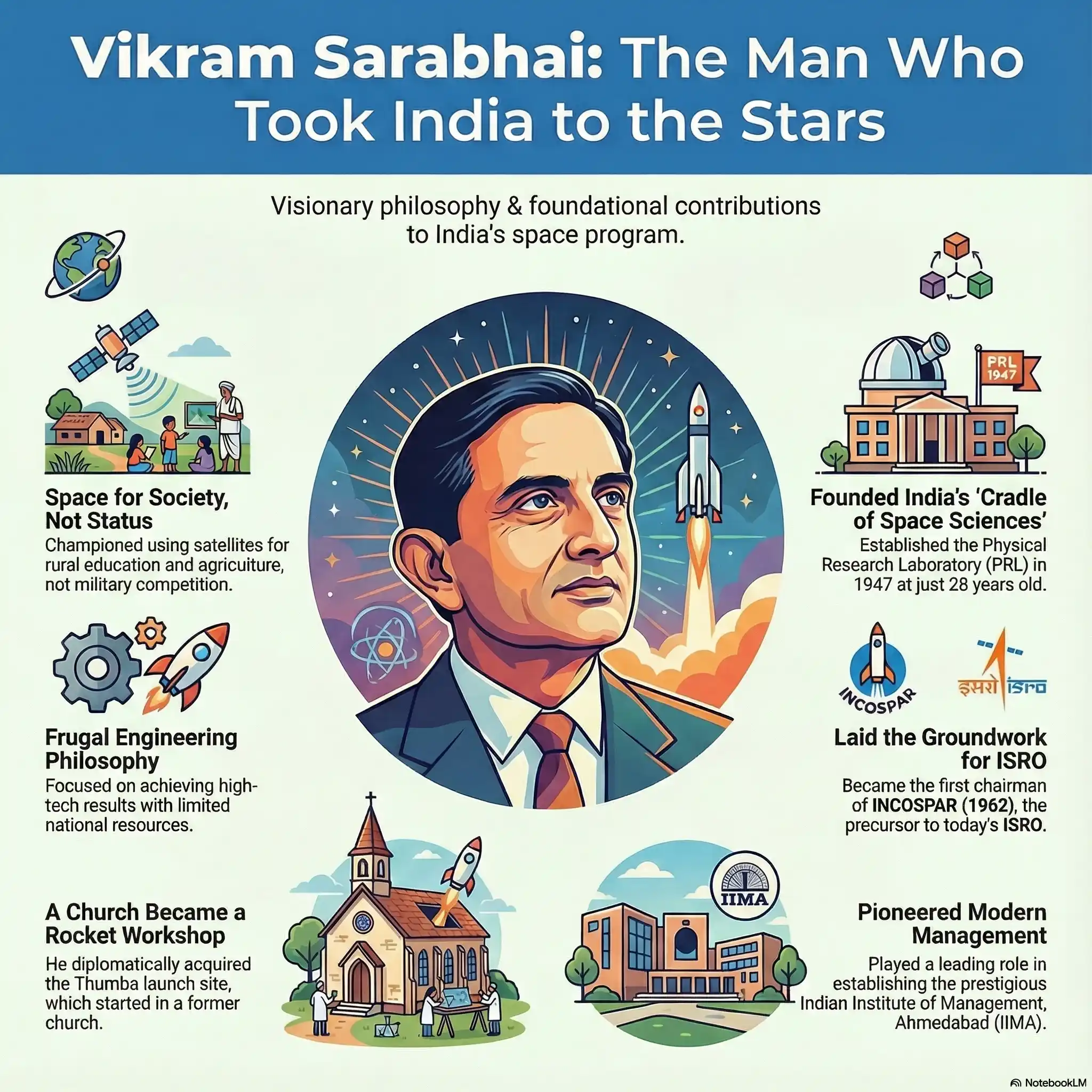
This conviction did not come from a desire for military dominance or national vanity. Instead, Sarabhai championed space exploration for its “social value”—using satellites to educate the rural masses and monitor agricultural yields. This pragmatic yet visionary approach distinguished him from his global contemporaries and cemented his status as the “Father of the Indian Space Program.” His life was a rare convergence of industrial pragmatism, scientific curiosity, and artistic sensitivity.

RelatedPosts

Raj Reddy: (1937- Present)

Har Gobind Khorana: (1922- 2011)

Dr. Salim Ali: (1896- 1987)

Foundations of a Polymath: Early Life and Education

Vikram Ambalal Sarabhai was born on August 12, 1919, in Ahmedabad, into a family that was effectively Indian industrial royalty. The Sarabhai family was instrumental in the Indian independence movement, and their home, ‘The Retreat’, served as a salon for intellectuals. It was here that young Vikram interacted with luminaries such as Rabindranath Tagore, J. Krishnamurti, and Motilal Nehru. These early interactions with the architects of Indian freedom instilled in him a sense of duty that went beyond personal ambition.

His academic journey was equally illustrious. After his initial schooling in Gujarat, he moved to England to study at Cambridge University. However, the onset of World War II forced him to return to India—a twist of fate that would change the course of Indian science. He joined the Indian Institute of Science (IISc) in Bangalore, where he began research into cosmic rays under the mentorship of the legendary Sir C.V. Raman. This period was crucial; it was at IISc that the theoretical physicist in Sarabhai matured, grounding him in the rigors of experimental science that would later define his career.

The Cosmic Ray Research and PRL

Upon returning to Cambridge after the war to complete his Ph.D. in 1947, Sarabhai focused his thesis on “Cosmic Ray Investigations in Tropical Latitudes.” Yet, his heart remained in India. While many scientists of his caliber emigrated to the West, Sarabhai returned to a newly independent India with a specific goal: institution building.

In November 1947, at the remarkably young age of 28, he founded the Physical Research Laboratory (PRL) in Ahmedabad. Often referred to as the “cradle of space sciences” in India, PRL began as a modest residence based laboratory. Sarabhai’s ability to secure funding from charitable trusts and his family’s industrial fortune demonstrated his unique blend of scientific expertise and business acumen. He understood that for science to flourish, it needed stable, well-funded institutions, a principle he adhered to throughout his life.

FeatureVikram SarabhaiHomi J. BhabhaA.P.J. Abdul Kalam
Primary FocusSpace & AtmosphereNuclear PhysicsMissile Technology
Key LegacyISRO, IIMA, PRLBARC, TIFRDRDO, Agni/Prithvi
PersonalityGentle, Diplomatic, BuilderAristocratic, Intense, PerfectionistHumble, Teacher, “People’s President”
PhilosophyScience for DevelopmentScience for SovereigntyStrength respects Strength
DeathSudden Cardiac Arrest (1971)Plane Crash (1966)Cardiac Arrest (2015)

The Homi Bhabha Connection: A Strategic Alliance

To understand the trajectory of Indian science, one must analyze the Homi Bhabha connection. Dr. Homi J. Bhabha, the father of India’s nuclear program, and Vikram Sarabhai shared a symbiotic professional relationship. While Bhabha focused on the atom, Sarabhai looked to the atmosphere. They were the twin pillars of Prime Minister Jawaharlal Nehru’s scientific vision for modern India.

Their bond went beyond friendship; it was a strategic alliance. Bhabha supported Sarabhai’s proposal to the government to set up a space research committee. It was Bhabha’s influence that helped establish the Indian National Committee for Space Research (INCOSPAR) in 1962, with Sarabhai as its chairman. When Bhabha died tragically in a plane crash in 1966, Sarabhai stepped into the breach. He assumed the chairmanship of the Atomic Energy Commission (AEC), managing the dual responsibilities of India’s nuclear and space ambitions. This era showcased his immense capacity for high-stakes leadership.

Genesis of a Giant: The ISRO Foundation History

The ISRO foundation history is rooted in what Sarabhai termed “frugal engineering.” The most evocative example of this philosophy is the establishment of the Thumba Equatorial Rocket Launching Station (TERLS). Thumba, a small fishing hamlet in Kerala, was scientifically significant because the magnetic equator of the Earth passes directly over it. However, the land required for the launch station was occupied by the St. Mary Magdalene Church.

Sarabhai’s approach to acquiring this land is a lesson in diplomacy and empathy. He did not use government force. Instead, he met with the Bishop of Trivandrum and explained that science and spirituality share a common quest for truth. The church was voluntarily ceded to the scientists. The prayer hall became the design workshop, and the bishop’s home became the office. This humble beginning, where rocket cones were transported on bicycles due to a lack of heavy vehicles, set the culture for ISRO: achieving high-tech results with limited resources.

The Roopkund Skeleton Lake Mystery: Why Were Greeks Dying in the Indian Himalayas?

Beyond Science: The Manager and Industrialist

It is a reductionist view to label Sarabhai solely as a scientist. He was a pioneer in management and industry. Recognizing that India’s rapid industrialization required professional management, he played a leading role in establishing the Indian Institute of Management, Ahmedabad (IIMA) in 1961. He wanted to create a cadre of managers who could apply scientific methods to business and governance.

Furthermore, he was deeply involved in his family’s business, Calico Mills, where he introduced modern operations research. He also founded the Ahmedabad Textile Industry’s Research Association (ATIRA). His diverse portfolio—ranging from textiles to nuclear power—demonstrated his belief that the scientific method was universally applicable, whether in a laboratory or a boardroom.


1 of 3
– +
Vikram Sarabhai Biography

The Final Chapter: The Vikram Sarabhai Death Mystery

The sheer intensity of Sarabhai’s workload was legendary, but his sudden demise remains a subject of intense speculation. On December 30, 1971, Sarabhai was in Kovalam, Kerala, to inspect the launch of a Russian rocket. He was reportedly in good health and high spirits, discussing plans for the future. That night, he passed away in his sleep at the Halcyon Castle hotel.

The official cause of death was cardiac arrest. However, the lack of a post-mortem examination, combined with the geopolitical tension of the Cold War era, fueled the Vikram Sarabhai death mystery. Given that India was on the verge of becoming a nuclear and space power, and considering the suspicious death of Homi Bhabha just five years prior, conspiracy theories regarding foreign sabotage have persisted. While no concrete evidence has ever surfaced to support foul play, the timing of his death—depriving India of its visionary leader at a critical juncture—remains a painful, open-ended question for historians and admirers alike.

An Enduring Legacy

Vikram Sarabhai died before he could see his projects fully mature, yet the momentum he generated was unstoppable. India’s first satellite, Aryabhata, launched in 1975, was a direct result of the agreements he signed with the Soviet Union. The Satellite Instructional Television Experiment (SITE), which brought education to 2,400 villages in 1975, was his brainchild.

Today, the Vikram Sarabhai Space Centre (VSSC) in Thiruvananthapuram stands as the lead center for launch vehicle development. Every time an ISRO launch vehicle roars into the sky, it carries the DNA of Sarabhai’s vision. He proved that a developing nation need not wait in the shadows of the developed world; it can light its own path to the stars.

Curious Indian: Fast Facts

FactDescription
Planetary HonorA moon crater (Bessel A) in the Sea of Serenity was renamed the Sarabhai Crater.
Operation ResearchHe was the first Indian to apply Operations Research (mathematical analysis) to industry and business problems.
Artistic DuoHis wife, Mrinalini Sarabhai, was a legendary dancer. Together they founded the Darpana Academy of Performing Arts.
Man of PeaceDespite heading the Atomic Energy Commission, he was a vocal advocate for the peaceful use of nuclear energy and opposed weaponization.
The LanderThe lander for India’s Chandrayaan-2 and Chandrayaan-3 missions was named Vikram in his memory.

Dr. A.P.J. Abdul Kalam: (1931-2015)

Conclusion

The Vikram Sarabhai biography is not merely a chronicle of the past; it is a blueprint for India’s future. He demonstrated that true expertise lies in the application of knowledge for the greater good. By bridging the gap between the scientist’s lab and the farmer’s field, he established a standard of trustworthiness and social responsibility that ISRO continues to uphold. As we witness India’s growing dominance in space, we must remember that the engine of this success was ignited by the gentle, determined soul of Vikram Sarabhai—a man who taught a nation to look up and believe.

If you think you have rememberd everything about this topic take this QUIZ


Results

Share your score!
Tweet your score!
Tweet your score!
Share to other
QUIZ START

#1. What was Vikram Sarabhai’s primary motivation for advocating that India, a developing nation, should invest in advanced space technology?

Previous
Next

#2. Which institution, founded by Vikram Sarabhai in 1947, is often called the ‘cradle of space sciences’ in India?

Previous
Next

#3. The relationship between Vikram Sarabhai and Homi J. Bhabha is described as a ‘strategic alliance’. How did their scientific domains primarily differ?

Previous
Next

#4. The establishment of the Thumba Equatorial Rocket Launching Station (TERLS) is a prime example of Sarabhai’s philosophy. What was the key scientific reason for choosing Thumba’s location?

Previous
Next

#5. What pivotal event led to Vikram Sarabhai taking on the dual responsibility for both India’s space and nuclear programmes?

Previous
Next

#6. Beyond his work in space research, Sarabhai made significant contributions to another field by helping establish which of these institutions?

Previous
Next

#7. What aspect of Vikram Sarabhai’s death has led to persistent speculation and conspiracy theories?

Previous
Next

#8. The text credits Sarabhai with a philosophy termed ‘frugal engineering’. Which of the following anecdotes best illustrates this concept?

Previous
Finish

What was Vikram Sarabhai’s contribution to education?

Beyond space science, Sarabhai was pivotal in founding the Indian Institute of Management Ahmedabad (IIMA) and the Community Science Centre in Ahmedabad, emphasizing the importance of management and science education.

Was there an investigation into the Vikram Sarabhai death mystery?

There was no official public enquiry or post-mortem conducted at the time, which has led to persistent speculation. However, official records maintain that he died of natural causes (cardiac arrest).

How did the Homi Bhabha connection influence Sarabhai’s career?

Homi Bhabha was instrumental in convincing the Indian government to support space research. He appointed Sarabhai as the head of INCOSPAR. After Bhabha’s death, Sarabhai succeeded him as the Chairman of the Atomic Energy Commission.

What awards did Vikram Sarabhai receive?

He was honored with the Shanti Swarup Bhatnagar Medal (1962), the Padma Bhushan (1966), and was posthumously awarded the Padma Vibhushan (1972).

Tags: Father of Indian Space ProgramHomi Bhabha connectionISRO foundation historyVikram Sarabhai BiographyVikram Sarabhai death mystery
ShareTweetPin
Lucy Ghosal

Lucy Ghosal

Related Posts

Raj Reddy: (1937- Present)
Arts & Culture

Raj Reddy: (1937- Present)

December 11, 2025
Har Gobind Khorana: (1922- 2011)
Arts & Culture

Har Gobind Khorana: (1922- 2011)

December 11, 2025
Dr. Salim Ali: (1896- 1987)
Arts & Culture

Dr. Salim Ali: (1896- 1987)

December 11, 2025
No Result
View All Result
December 2025
MTWTFSS
1234567
891011121314
15161718192021
22232425262728
293031 
« Nov    

TAGS

Akbar Ancient India Architectures of India Ayurveda Biography Bollywood biography Bollywood legends British East India Company Buddhism Chandragupta Maurya Civil Disobedience colonial India Dadasaheb Phalke Award Events That Changed History Festivals History History Of Medicine History of Science India Indian cinema Indian cinema icons Indian freedom struggle Indian History Indian National Congress Indian Nationalism Indian Science Indian scientist Inspiration Inspirational stories Kalinga War Mahatma Gandhi Mauryan Empire Mughal decline Mughal Empire Nationalism Partition of India Pataliputra Rigveda Scientific achievements Sikh history Swadeshi Movement Ujjain Unsolved India War elephants ​Indian Mathematician

Archives

  • December 2025
  • November 2025
  • October 2025
  • September 2025
  • August 2025
  • April 2025
  • March 2025
  • July 2017
Facebook Twitter Youtube RSS
Curious Indian TRicolor logo

Explore the soul of Bharat with Curious Indian. A definitive guide to Indian history, arts, culture, biographies, and the events that defined our future.

Follow us on social media:

Recent News

  • Daulat Singh Kothari : (1906–1993)
  • Shivkar Bapuji Talpade: (1864- 1916)
  • Venkatraman Ramakrishnan: (1952- Present)

Category

  • Arts & Culture
  • Battles of India
  • Biography
  • Entertainment Personalities
  • Festivals of India
  • Indian History
  • Indian Politics
  • Places
  • Science Personalties
  • Uncategorized
  • Unsolved India

© 2025 Curious Indian- Everything about India

Welcome Back!

Login to your account below

Forgotten Password?

Retrieve your password

Please enter your username or email address to reset your password.

Log In

Add New Playlist

No Result
View All Result
  • Arts & Culture
  • Festivals of India
  • Indian History
  • Indian Politics
  • Biography
    • Entertainment Personalities
    • Science Personalties
  • More
    • Unsolved India

© 2025 Curious Indian- Everything about India

This website uses cookies. By continuing to use this website you are giving consent to cookies being used. Visit our Privacy and Cookie Policy.
Are you sure want to unlock this post?
Unlock left : 0
Are you sure want to cancel subscription?