The Arthashastra was lost for centuries. A man from Tanjore handed it to a librarian in Mysore in 1905, and India got back a manual of statecraft with no interest whatever in virtue
The Mysore Oriental Library had been open fourteen years. Its librarian, Rudrapatna Shamasastry, spent his days going through palm-leaf manuscripts and working out what they were.
In 1905 a Tamil brahmin from Tanjore handed in a bundle written in Grantha script. Shamasastry read it and realised he was holding the Arthashastra, a book that until that morning existed only as a title quoted by other authors.
He published the Sanskrit text in 1909 and the full English translation in 1915.
For centuries it was a rumour with a name attached. Then it was a book on a desk in Mysore.
Fifteen books, a hundred and fifty chapters, some six thousand short prose statements, and almost nothing in it about how to be good.
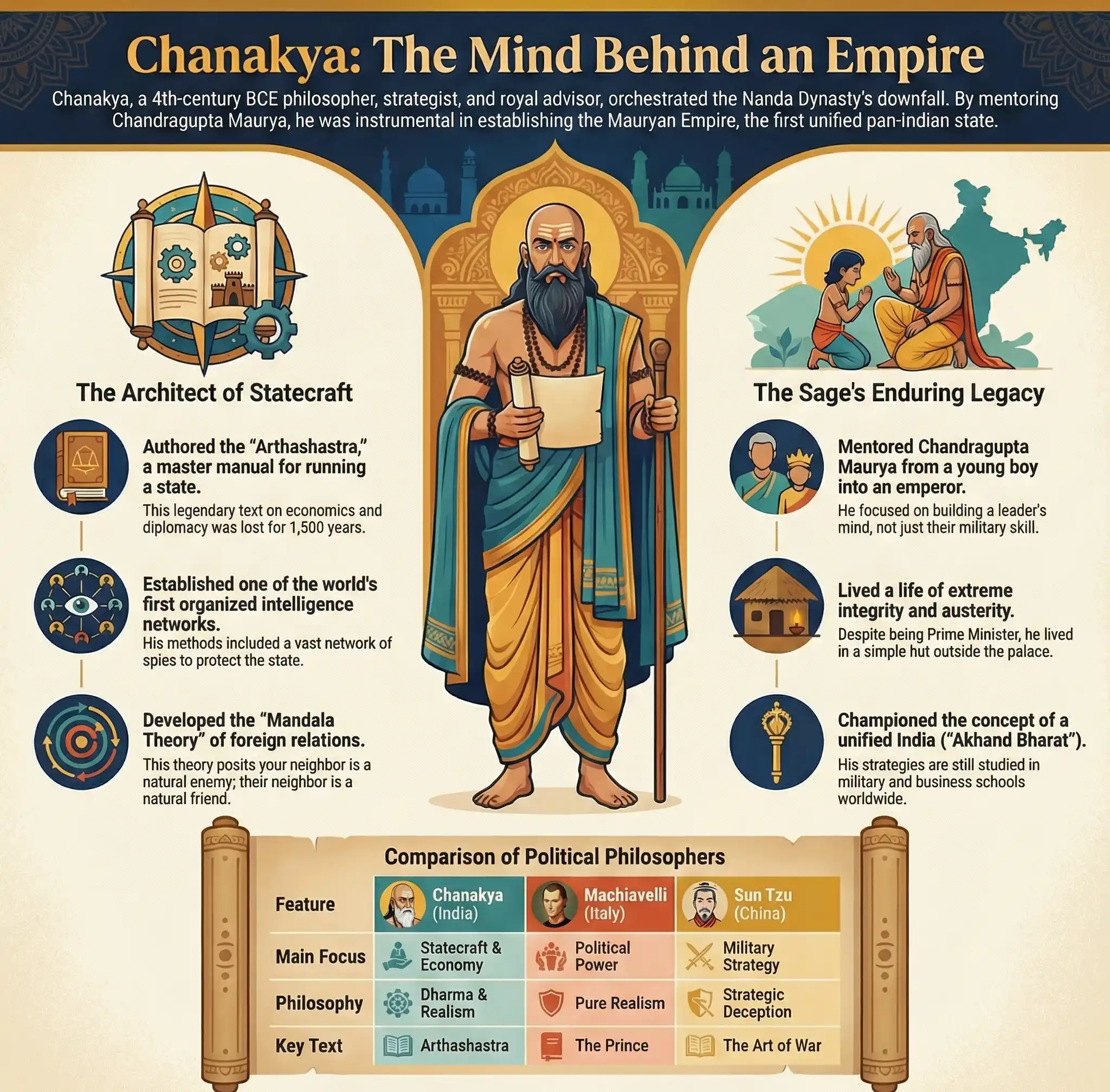
It is an operating manual for a state. Revenue and how to assess it. Mines, forests, irrigation, weights and measures, the inspection of goods for adulteration. The pay scale of every official from the chief minister down to the man who watches the elephants. The layout of a fort, the siting of a capital, the running of a treasury.
By 1905 European scholarship had settled into a comfortable account of India: a civilisation of exceptional spiritual depth and no great interest in the material world, contemplative by temperament, not much given to the practical business of power.
The Arthashastra does not fit that account anywhere. It arrived in the middle of the nationalist decades and was read at once, by Indians and Europeans, as evidence that India had produced a hard-headed political science of its own, centuries before Machiavelli, and had then mislaid it.
The reputation is deserved. The foreign-policy theory works outward in rings: the king who shares your border is your natural enemy, the king beyond him is your natural friend, and the whole of diplomacy follows from the geometry.
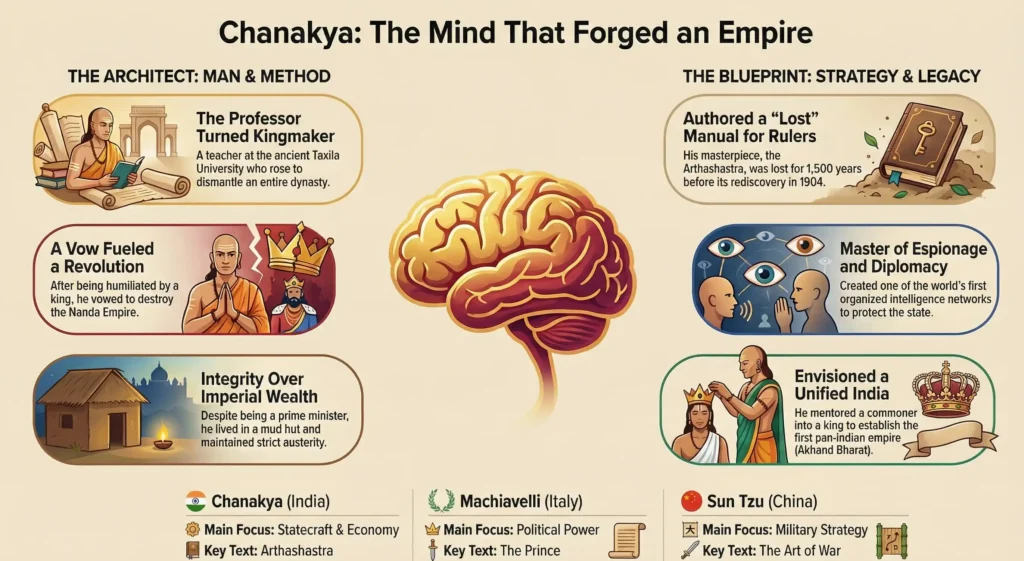
There are four instruments for handling an opponent, and they are listed without embarrassment: conciliation, payment, sowing division, and force. There is an entire apparatus of intelligence, with agents placed as ascetics, householders, merchants, cooks and poisoners, and a class of women agents used for the same purposes. There are instructions for provoking discontent inside a rival’s territory and for ruining him with his own subjects.
The half that gets left out
What the popular version leaves out is that the same book is obsessive about the machinery of welfare, and says plainly why.
The king’s happiness lies in the happiness of his subjects, and what pleases him is of no account beside what pleases them. The king’s day is divided into set periods with fixed duties, and hearing petitions comes early in it. There are obligations on the treasury in famine. There are penalties for officials who squeeze the people they administer, and rules on the property of widows, on adulterated goods and on false weights.
It is not a book about cruelty. It is a book about control, and control includes keeping the population fed and the merchants honest.
Who wrote it
Tradition gives it to Kautilya, also called Chanakya and Vishnugupta, the brahmin who brought down the Nandas and put Chandragupta Maurya on the throne around 321 BC. The famous story of the insult at the Nanda court and the oath sworn over untied hair comes from later drama and from Buddhist and Jain chronicles, not from the Arthashastra, which says nothing about its author’s life.
Modern scholarship has complicated the rest. Thomas Trautmann’s statistical study of the text in 1971 concluded that it is the work of more than one hand. Patrick Olivelle’s critical edition of 2013 treats it as composite, with core material from perhaps the second century BC to the first century AD and compilation later still, assembled under a famous name.
The text itself supports this. It repeatedly cites earlier authorities by name and disagrees with them, which is how a tradition writes, not how a lone genius does.
A minister may or may not have written it. A profession certainly did.
What survived
One copy in Grantha script, recopied at some point from an older recopy, sitting uncatalogued in a provincial library. Other manuscripts turned up elsewhere in India once people knew what to look for, and a Malayalam manuscript in Munich produced a second edition in the 1920s.
The margin was that thin. A book that changed what the twentieth century believed about ancient India spent several hundred years as a bundle of leaves that nobody had opened.
If you think you have remembered everything about this topic take this QUIZ
Results
QUIZ START
#1. What was the personal motivation that drove Chanakya to dismantle the Nanda Empire and establish the Mauryan Dynasty?
Previous
Next
#2. Chanakya’s ‘Mandala Theory’ of foreign policy is best described by which of the following principles?
Previous
Next
#3. Where was the lost manuscript of the ‘Arthashastra’ finally rediscovered in 1904?
Previous
Next
#4. Chanakya famously stated that ‘all undertakings depend upon finance.’ Which aspect of the state did he emphasize as the foundation for a king’s strength?
Previous
Next
#5. What does the anecdote about Chanakya switching lamps when a conversation turned from state business to personal matters illustrate?
Previous
Next
#6. What does the anecdote about Chanakya switching lamps when a conversation turned from state business to personal matters illustrate?
Previous
Next
#7. What was the core goal of Chanakya’s tactics, as expressed by the term ‘Yogakshema’?
Previous
Next
#8. Chanakya is credited with proposing the concept of a unified Indian subcontinent. What is this concept called?
Previous
Finish
What is the central message of Chanakya Neeti?
The central message is the importance of practical wisdom, self-discipline, and strategic thinking in achieving success and maintaining a stable society.
Not at all. While it covers military strategy, the majority of the text is dedicated to civil administration, economic policy, law, and social welfare.
Why did Chanakya support Chandragupta Maurya?
He saw in Chandragupta a leader who could unify the fragmented kingdoms of India and protect the land from foreign invasions, such as those led by Alexander the Great.
What does “Kautilya” mean?
The name Kautilya is often interpreted as “crooked” or “shrewd,” referring to his sophisticated and sometimes ruthless political tactics.
How is Chanakya relevant to modern business?
Many leaders use his principles of management, human resource allocation, and risk assessment to navigate the competitive world of modern corporate strategy.
Sources & References
Patrick Olivelle, King, Governance, and Law in Ancient India: Kautilya’s Arthasastra (Oxford University Press, 2013) — the critical text, its composite character and the dating of its layers.
R. Shamasastry, Kautilya’s Arthashastra (Government Press, Bangalore, 1915) — the first complete English translation and the circumstances of the 1905 find.
Thomas R. Trautmann, Kautilya and the Arthasastra: A Statistical Investigation of the Authorship and Evolution of the Text (1971) — the evidence for multiple authorship.
Oriental Research Institute, Mysore — the provenance of the palm-leaf manuscript handed in from Tanjore.
Exploring the Soul of Bharat through History, Science, Culture, and its Diversity
Our Mission
Curious Indian is a definitive knowledge portal dedicated to chronicling the events, personalities, and cultural shifts that defined the Indian subcontinent. From the ancient Vedic Period to the complexities of 21st-century politics, our goal is to provide deep-dive analysis that inspires.
Editorial Standards & E-E-A-T
Every article published under our brand undergoes a rigorous fact-checking process. We prioritize primary historical records, academic citations, and credible archives to ensure our readers receive accurate, high-authority information.
Historical IntegrityDirectly sourcing from ASI archives and academic journals.
Topical AuthorityComprehensive clustering of Indian Science, Biographies, and Wars.
Managed by Paripurna Datta and TEAM | Dedicated to the Knowledge of India.