Sunday, December 28, 2025
Everything About India
  • Arts & Culture
  • Festivals of India
  • Indian History
  • Indian Politics
  • Biography
    • Entertainment Personalities
    • Science Personalties
  • More
    • Unsolved India
No Result
View All Result
  • Arts & Culture
  • Festivals of India
  • Indian History
  • Indian Politics
  • Biography
    • Entertainment Personalities
    • Science Personalties
  • More
    • Unsolved India
No Result
View All Result
Everything About India
No Result
View All Result
Home Arts & Culture

Pāṇini: mid 1st-millennium BCE

The Grand Architect of Language

Lucy Ghosal by Lucy Ghosal
in Arts & Culture, Biography, Science Personalties
Reading Time: 7 mins read
0 0
A A
Pāṇini: mid 1st-millennium BCE

Pāṇini: mid 1st-millennium BCE

Share on FacebookShare on Twitter

Table of Contents

Toggle
  • The Grammar God of Ancient India
      • RelatedPosts
      • Daulat Singh Kothari : (1906–1993)
      • Shivkar Bapuji Talpade: (1864- 1916)
      • Venkatraman Ramakrishnan: (1952- Present)
  • 🌱Early Life and Education: The Seeds of Linguistic Curiosity
  • 📐 Journey into Science: The Birth of a Formal System
  • 🤖Major Achievements and Contributions: The Aṣṭādhyāyī and the Algorithm
  • 🧭 Challenges and Turning Points: The Struggle for Perfection
  • 💡Legacy and Inspiration: The Eternal Scientist
  • 🤖 Major Achievements and Contributions: The Aṣṭādhyāyī and the Algorithm
  • The Algorithmic Structure: The World’s First Code
  • Preserving the Sacred Language
  • A Bridge to Modern Science: Computational Linguistics

The Grammar God of Ancient India

Imagine a time over 2,500 years ago, long before computers, calculators, or even modern printing presses. In that ancient world, one man quietly performed an intellectual feat so profound it would eventually be hailed as one of humanity’s greatest scientific achievements. His name was Pāṇini (pronounced PAA-ni-ni), and he wasn’t just a scholar; he was the first known descriptive linguist in history, the founding father of formal language theory.

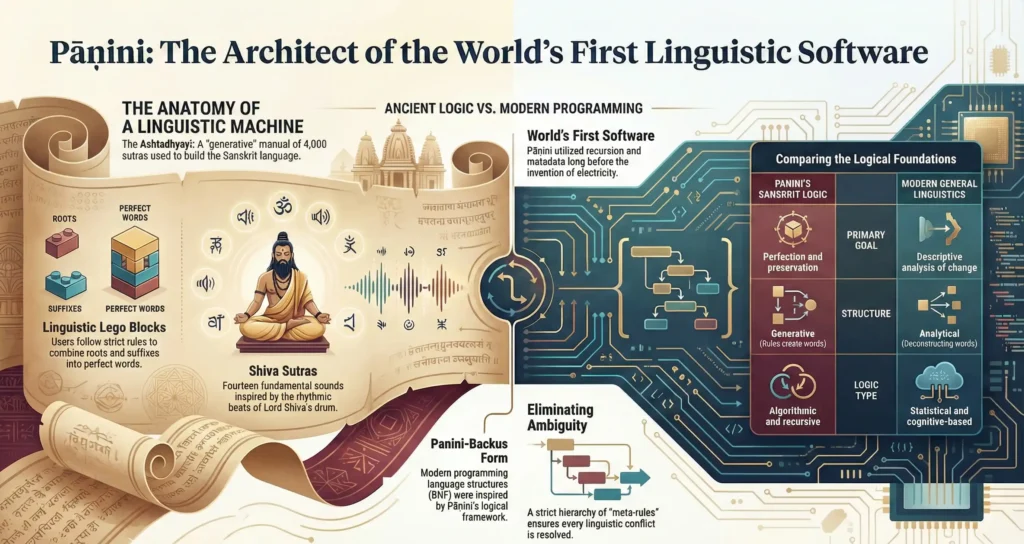
The Ashtadhyayi of Panini

Pāṇini’s story is not just a chapter in ancient Indian history; it’s the genesis of a fundamental scientific discipline. His magnum opus, the Aṣṭādhyāyī (meaning ‘Eight Chapters’), is the most comprehensive and scientific grammar ever written for a non-European language, Sanskrit. It’s a work of such breathtaking precision and logical elegance that modern computer scientists would later marvel at its algorithmic structure. For centuries, Pāṇini’s work has been the bedrock of Sanskrit scholarship, cementing his legacy as a towering Indian scientist whose innovation continues to inspire not only linguists but also the world of computation. His journey is a powerful testament to the brilliance of ancient Indian scientific achievements.

RelatedPosts

Daulat Singh Kothari : (1906–1993)

Shivkar Bapuji Talpade: (1864- 1916)

Venkatraman Ramakrishnan: (1952- Present)

🌱Early Life and Education: The Seeds of Linguistic Curiosity

While the precise dates of his life are debated, scholars generally place Pāṇini around the 6th or 5th century BCE. He is believed to have been born in Śalātura, a town near the modern-day city of Attock in ancient Gāndhāra (now in modern Pakistan). This region was a crucible of learning and cross-cultural exchange, situated near the famous Taxila (Takshaśila) university, a major intellectual hub. This vibrant atmosphere would have been his first informal classroom.

Stamp_of_India_-_2004_-_Colnect_158527_-_Panini

Details of Pāṇini’s childhood are sparse, often wrapped in delightful legends, but we can surmise that his family background was one that valued learning and the sacred texts. To master the Vedas, the ancient, sacred scriptures, required an impeccable understanding of their language. The Vedas were passed down orally for generations, and any deviation in pronunciation or grammar was considered sacrilegious. This intense focus on linguistic preservation likely sparked young Pāṇini’s interest. He didn’t just want to memorize the rules; he wanted to understand why the language worked the way it did.

Imagine Pāṇini as a young man, surrounded by the subtle shifts in dialect and the immense complexity of Vedic chants. He wasn’t satisfied with the existing, often scattered and unsystematic, grammatical treatises. He saw chaos and dreamed of order. This early exposure and a relentless pursuit of perfection in the preservation of Sanskrit—the language of the gods—were the early influences that set him on his incredible path.

📐 Journey into Science: The Birth of a Formal System

Pāṇini and Bharata on Grammar and Art

Pāṇini’s path into the field of linguistics—what we might call formal science today—was driven by necessity: the need to standardize and preserve the correct form of Vedic Sanskrit (the language of the Vedas) from the evolving, more common Classical Sanskrit. His training likely took place at a renowned center of learning like Taxila, where he would have studied under established masters.
The real ‘turning point’ in his career wasn’t a graduation but a self-imposed challenge. He didn’t just critique the existing grammars; he set out to build a flawless system from the ground up. This monumental project culminated in the Aṣṭādhyāyī.

An Engaging Anecdote: Legend suggests Pāṇini sought a comprehensive understanding of language structure, even meditating upon it. One famous tale, though mythological, illustrates his genius: he is said to have derived the fundamental phonetic groupings, known as the Śiva Sūtras or Maheśvara Sūtras, from the drumming sounds of the God Śiva. While a myth, it beautifully conveys the perceived divine inspiration behind the perfect, algorithmic structure he uncovered. His work wasn’t just scholarship; it was viewed as the revelation of a universal linguistic order.

🤖Major Achievements and Contributions: The Aṣṭādhyāyī and the Algorithm

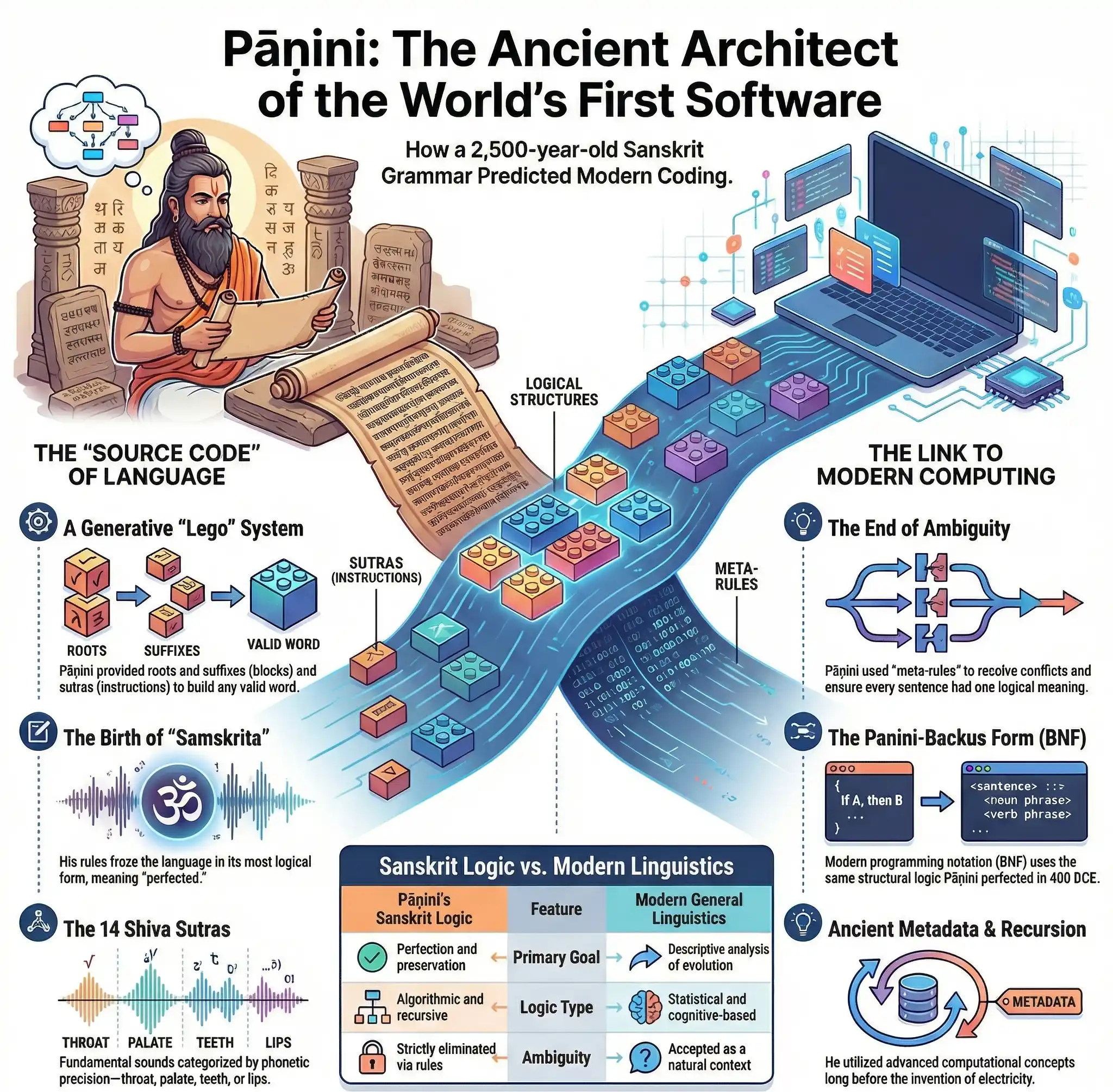
Pāṇini’s single, defining scientific achievement is the Aṣṭādhyāyī. Composed of approximately 4,000 sūtras (aphorisms or rules) organized into eight chapters, it is not merely a book of grammar; it is a meticulously crafted, compact, and complete generative machine for the Sanskrit language.

Pāṇini- The Grammar God of Ancient India

* Algorithmic Structure: Pāṇini used a metalanguage of symbols and conventions to make his rules incredibly precise and interconnected. The sūtras function like a series of algorithms—step-by-step instructions—that can generate all the grammatically correct forms of Sanskrit, and only those forms. This system is so robust that it is non-redundant and non-contradictory.

* The Power of Conciseness: His use of pratyāhāras (abbreviatory formulas) allowed him to condense complex phonological groups into single syllables. This compression technique is a hallmark of his genius, allowing the entire grammar to be memorized, a necessity in the oral tradition of ancient India.

* Impact on India: The Aṣṭādhyāyī formally defined Classical Sanskrit and ensured its survival. It provided a perfect standard that stabilized the language, allowing it to flourish for millennia as the language of philosophy, science, and literature. It’s a core Indian scientific achievement that has maintained cultural and intellectual unity.

* Global Significance: Centuries later, when European scholars encountered Pāṇini’s work, it profoundly influenced the development of modern comparative linguistics. More recently, the Aṣṭādhyāyī’s logical, rule-based, and recursive structure has drawn intense interest from computer scientists. Many consider it to be the world’s first formal system, pre-dating modern recursive functions and the work of computational giants like Noam Chomsky. Pāṇini is, in a way, the grandfather of formal computer languages.

🧭 Challenges and Turning Points: The Struggle for Perfection

Pāṇini's Perfect Rule
Pāṇini’s Perfect Rule

The major challenges Pāṇini faced were not political, but intellectual. To create a grammar that accounted for every possible inflection, derivation, and combination in a language as rich as Sanskrit was a task of immense scale and complexity.

* The Challenge of Exhaustion: He had to observe, categorize, and systematize a vast corpus of spoken and written forms. The sheer mental effort required to collect this data and impose a logical structure upon it would have been a defining moment of sheer intellectual determination.

* The Turning Point of Abstraction: The critical turning point was when Pāṇini moved beyond simply listing grammatical facts (like his predecessors) and instead developed a meta-linguistic framework—a grammar of the grammar. This move from description to abstraction, from listing facts to creating a generative formula, is what elevates his work from good scholarship to true scientific genius. This decision to prioritize systemic rules over simple observation is what made the Aṣṭādhyāyī timeless.

💡Legacy and Inspiration: The Eternal Scientist

Creator-of-Sanskrit-and-Known-as-Father-of-Linguistic-vedic-math-school

Pāṇini’s legacy is both deep and wide. In India, he is revered as a cultural and intellectual giant, the ultimate authority on the language that is the foundation of many Indian cultures. The Aṣṭādhyāyī is still studied today, not just as a historical text, but as a living, working grammar.

* Inspiration for Students: Pāṇini teaches young learners in India and worldwide about the value of precision, systematic thinking, and abstraction. His life is an inspiration for students—a powerful reminder that the most profound discoveries often come from finding simple, elegant structures within apparent complexity. He exemplifies how a keen observer, with relentless focus, can transform a subject from an art (like learning a language) into a rigorous science.

* Lasting Impact on Science: His work is studied in linguistics departments globally and continues to inform the theory of natural language processing (NLP) in Artificial Intelligence. The idea that a language can be reduced to a finite set of elegant, ordered rules—a fundamental principle of computation—was first mastered by Pāṇini.
What can we learn from his journey? That true genius lies not just in solving a problem, but in creating a system to solve all similar problems. Pāṇini’s Aṣṭādhyāyī remains a monument to the scientific spirit of ancient India, a brilliant, compact piece of engineering that continues to speak across millennia, making him one of the greatest Indian scientists to have ever lived.

That’s a fantastic idea! This section is the core of Pāṇini’s story, and expanding it will showcase his scientific genius beautifully.

Here is an expanded draft for the “Major Achievements and Contributions” section, written in the requested storytelling and engaging tone, and optimized with key phrases:

🤖 Major Achievements and Contributions: The Aṣṭādhyāyī and the Algorithm

Major Achievements and Contributions: The Aṣṭādhyāyī and the Algorithm

Pāṇini’s single, towering scientific achievement is a work of intellectual engineering so profound it remains unmatched in its field: the Aṣṭādhyāyī (or ‘The Eight Chapters’). This isn’t merely a book of rules; it is the most complete and precise descriptive grammar ever written for any language in the world—a formal system that many computer scientists today regard as the world’s first-ever program.

The Algorithmic Structure: The World’s First Code

The Aṣṭādhyāyī is composed of approximately 4,000 sūtras (compact, aphoristic rules) arranged into eight distinct chapters. Pāṇini’s genius lies not in the rules themselves, but in how he structured them. His approach was algorithmic. Each sūtra functions like a line of code in a computer program, containing operators, conditional statements, and recursive elements. These rules are interconnected, applied sequentially, and designed to generate every single grammatically correct word and sentence in Sanskrit, and only those forms. This non-redundant and non-contradictory system is the ultimate demonstration of his analytical brilliance.

To achieve this incredible conciseness, Pāṇini developed a brilliant metalanguage—a system used to talk about the language. He invented pratyāhāras (abbreviatory formulas), which are groups of sounds condensed into single syllables using special markers. For instance, he could use one syllable to refer to a vast group of vowels or consonants. This radical compression technique made the massive undertaking of documenting an entire language manageable and memorizable—an absolute necessity in the oral transmission tradition of ancient India. Pāṇini wasn’t just documenting language; he was demonstrating the hidden, perfect logic beneath human speech.

Preserving the Sacred Language

The immediate impact on India was the stabilization and preservation of Sanskrit. Prior to Pāṇini, the language of the sacred scriptures, Vedic Sanskrit, was slowly drifting apart from the commonly spoken language. By setting an unassailable standard, the Aṣṭādhyāyī arrested this linguistic decay. It provided a perfect template, formally defining Classical Sanskrit and ensuring its survival as the vehicle for India’s philosophy, mathematics, science, and literature for millennia. This is why his work is foundational to Indian scientific heritage and intellectual unity.

A Bridge to Modern Science: Computational Linguistics

The truly astonishing part of Pāṇini’s scientific achievement is its relevance today. Centuries after it was written, when the West began studying comparative linguistics, scholars like Ferdinand de Saussure and Franz Bopp were profoundly influenced by the sheer precision of Pāṇini’s methods.

However, Pāṇini’s greatest unintended contribution is to the field of computational linguistics. The same sequential, rule-based, and highly structured format that allowed ancient scholars to memorize grammar now fascinates computer scientists. His work predates the formal grammar models developed by Noam Chomsky in the 20th century, which are foundational to much of modern formal language theory.

When we look at how modern natural language processing (NLP) and artificial intelligence (AI) try to break down and understand human language, they are, in many ways, running on principles first established by the great master of Sanskrit grammar over 2,500 years ago. His rules laid the groundwork for the notion that language could be viewed as a formal, computable system, bridging the gap between ancient thought and the digital age.

Read More: https://curiousindian.in/charaka-4th-century-bce/

Tags: Ancient Indian Scientist​Classical Sanskrit Grammar​Indian Scientific AchievementsPāṇini​Sanskrit Linguist
ShareTweetPin
Lucy Ghosal

Lucy Ghosal

Related Posts

Daulat Singh Kothari : (1906–1993)
Biography

Daulat Singh Kothari : (1906–1993)

December 15, 2025
Shivkar Bapuji Talpade: (1864- 1916)
Biography

Shivkar Bapuji Talpade: (1864- 1916)

December 14, 2025
Venkatraman Ramakrishnan: (1952- Present)
Biography

Venkatraman Ramakrishnan: (1952- Present)

December 14, 2025
No Result
View All Result
December 2025
MTWTFSS
1234567
891011121314
15161718192021
22232425262728
293031 
« Nov    

TAGS

Akbar Ancient India Architectures of India Ayurveda Biography Bollywood biography Bollywood legends British East India Company Buddhism Chandragupta Maurya Civil Disobedience colonial India Dadasaheb Phalke Award Events That Changed History Festivals History History Of Medicine History of Science India Indian cinema Indian cinema icons Indian freedom struggle Indian History Indian National Congress Indian Nationalism Indian Science Indian scientist Inspiration Inspirational stories Kalinga War Mahatma Gandhi Mauryan Empire Mughal decline Mughal Empire Nationalism Partition of India Pataliputra Rigveda Scientific achievements Sikh history Swadeshi Movement Ujjain Unsolved India War elephants ​Indian Mathematician

Archives

  • December 2025
  • November 2025
  • October 2025
  • September 2025
  • August 2025
  • April 2025
  • March 2025
  • July 2017
Facebook Twitter Youtube RSS
Curious Indian TRicolor logo

Explore the soul of Bharat with Curious Indian. A definitive guide to Indian history, arts, culture, biographies, and the events that defined our future.

Follow us on social media:

Recent News

  • Daulat Singh Kothari : (1906–1993)
  • Shivkar Bapuji Talpade: (1864- 1916)
  • Venkatraman Ramakrishnan: (1952- Present)

Category

  • Arts & Culture
  • Battles of India
  • Biography
  • Entertainment Personalities
  • Festivals of India
  • Indian History
  • Indian Politics
  • Places
  • Science Personalties
  • Uncategorized
  • Unsolved India

© 2025 Curious Indian- Everything about India

Welcome Back!

Login to your account below

Forgotten Password?

Retrieve your password

Please enter your username or email address to reset your password.

Log In

Add New Playlist

No Result
View All Result
  • Arts & Culture
  • Festivals of India
  • Indian History
  • Indian Politics
  • Biography
    • Entertainment Personalities
    • Science Personalties
  • More
    • Unsolved India

© 2025 Curious Indian- Everything about India

This website uses cookies. By continuing to use this website you are giving consent to cookies being used. Visit our Privacy and Cookie Policy.
Are you sure want to unlock this post?
Unlock left : 0
Are you sure want to cancel subscription?