The route by which a Sanskrit surgical manual became modern plastic surgery
In 1792, during the war between the East India Company and Tipu Sultan, a Parsi bullock-cart driver named Cowasjee was captured with four others. They worked for the British, and as punishment each of them lost his nose and one hand.
A year later, in Pune, a man of the potter caste rebuilt Cowasjee’s nose. He fitted a thin plate of wax to the stump to get the shape, flattened it and laid it on the forehead, traced round it, cut the marked skin free while leaving a narrow bridge of it attached between the eyebrows, turned the flap down and fixed it in place. He used a borrowed razor and no stitches.
Two surgeons from the British Residency, Thomas Cruso and James Findlay, watched and wrote a report of it on 1 January 1794. It appeared in the Madras Gazette and then, in October that year, with an engraving, in the Gentleman’s Magazine in London.
European surgery had nothing like it. In Pune it was ordinary enough to be done by a potter with a borrowed razor.
Where the operation came from
The technique the two Englishmen were watching is set out in the Sushruta Samhita, the Sanskrit surgical compendium that carries the name of Sushruta.
One detail is worth keeping straight, because most accounts flatten it. The Samhita takes the flap from the cheek. The Pune operation took it from the forehead, which gives a better colour match and a scar that can be covered. Somebody in the long gap between the two improved on the book, and whoever that was is not recorded either.
7 Secrets of Padmanabhaswamy Temple Treasure
How old
Tradition puts Sushruta at Kashi in the sixth century BC, a pupil of Dhanvantari. The text that survives is not that old. It was compiled, expanded and revised across centuries and reached something like its present form in the early centuries of the common era.
What that means in practice is that the surgery is older than any manuscript of it and younger than the legend attached to it, which is the normal condition of ancient Indian technical writing and no reason to think less of it.
What is in the book
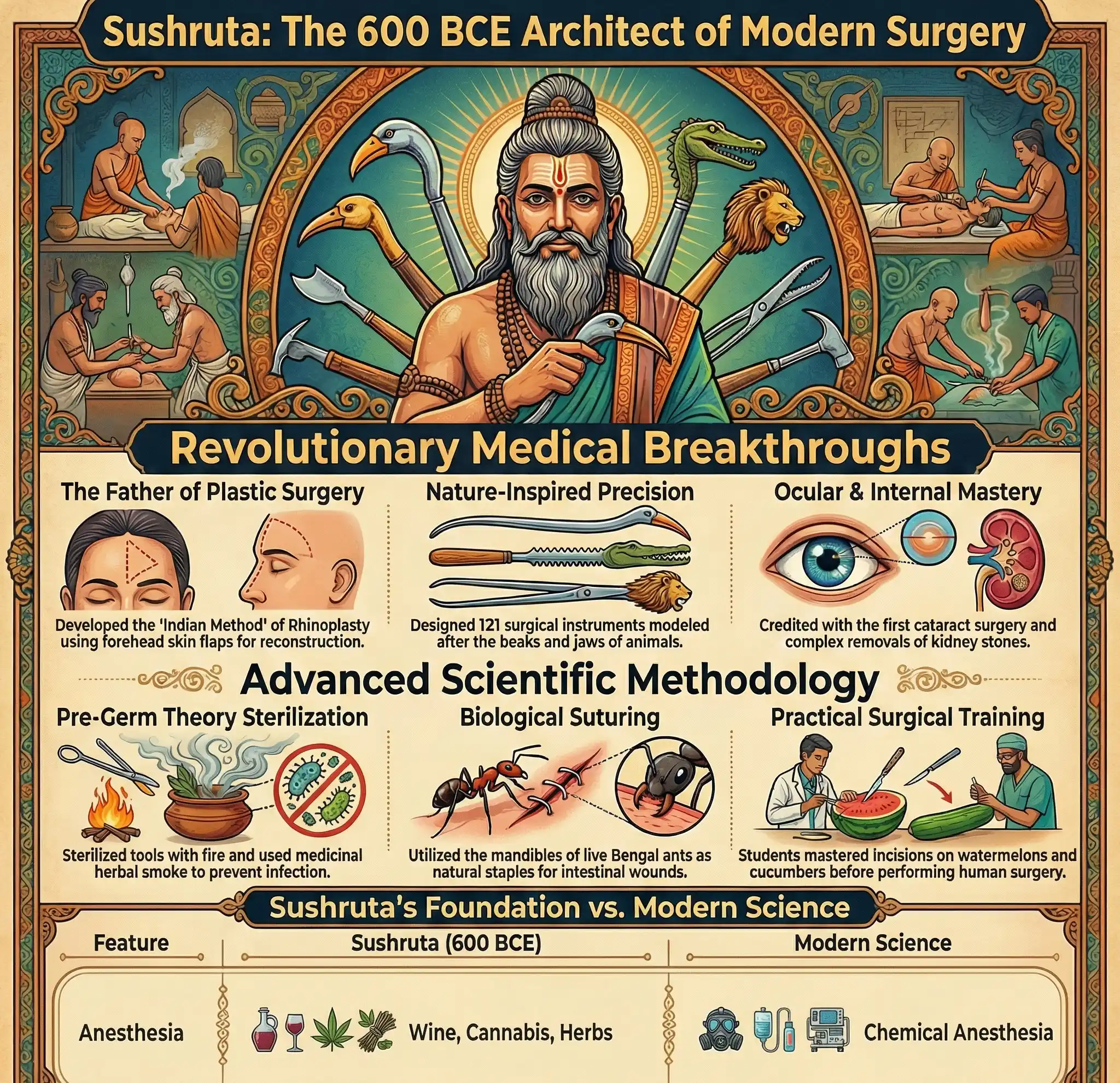
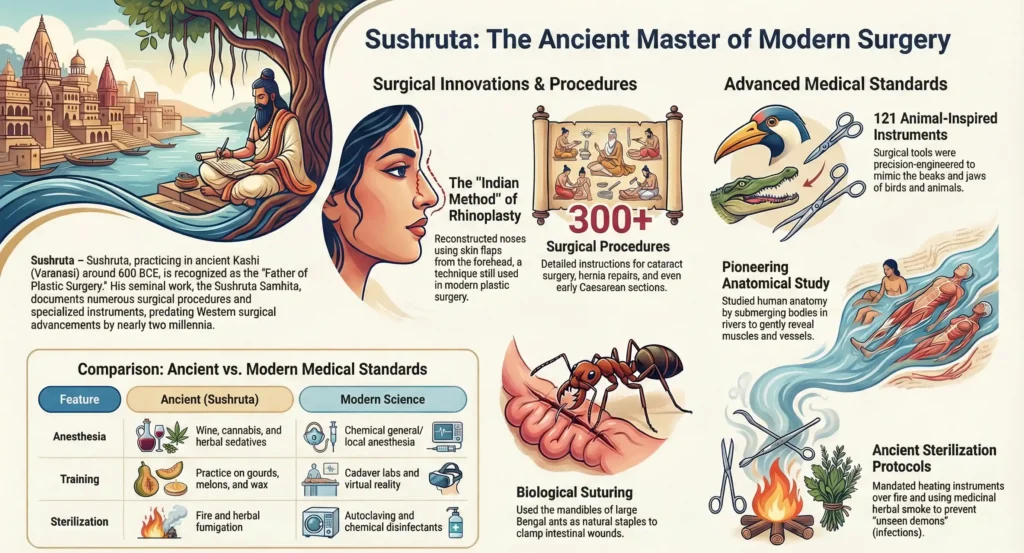
It runs to a hundred and eighty-four chapters. It names over a thousand conditions, describes around three hundred procedures and a hundred and twenty-one instruments, many of them shaped after the jaws and beaks of animals, and divides surgery into eight kinds of operation.
There is couching for cataract, extraction of bladder stones, the management of wounds and fractures, obstetrics, and a method for studying the body that goes directly against the ritual rules about handling the dead: a corpse wrapped and left in running water for seven days, after which the layers can be taken off with a brush and examined.
7 Untold Stories of Battle of Asal Uttar 1965 Victory
Learning on fruit
The training instructions are the part that would be recognised in any teaching hospital today.
Incisions are practised on gourds, melons and cucumbers. Stitching is learned on cloth and hide. Cautery is practised on pieces of meat. Probing is done on worm-eaten wood. Bandaging is practised on mannequins, and bleeding on dead animals. The student does not go near a living patient until his hand already knows the movement.
Two thousand years before anyone called it a simulation lab, the rule was the same: practise on the vegetable first.
Why noses
There is an uncomfortable reason this particular operation was so well developed here. Cutting off the nose was a standard punishment, judicial and domestic, for adultery and for theft, and in Cowasjee’s case for taking the enemy’s pay.
A society that disfigured people as a matter of law produced surgeons who were very good at repairing the disfigurement. The speciality exists because the cruelty did.
1814
A London surgeon named Joseph Constantine Carpue read the Gentleman’s Magazine account, went and talked to Cowasjee’s commanding officer about it, and worked at the problem for twenty years before he trusted himself to try it.
He operated on 23 October 1814 and did a second case after it, and published both in 1816. German surgeons took it up immediately. The forehead flap spread across Europe, and it is still called the Indian method, and it is still the standard way of rebuilding a nose.
Cowasjee was painted, engraved and hung in a London collection. The man who gave him his face back is recorded only by his caste.
6 Unfoldings in the Subrahmanyan Chandrasekhar Biography
8 Defining Chapters in the Vikram Sarabhai Biography
If you think you have remembered everything about this topic take this QUIZ
Results


#1. Sushruta is widely recognized by modern historians and medical professionals as the:
#2. Sushruta designed his 121 surgical instruments to mimic which of the following?
#3. The “Indian Method” of Rhinoplasty, developed by Sushruta, involved reconstructing the nose using:
#4. How did Sushruta study human anatomy to bypass the taboo of touching corpses?
#5. According to Sushruta, what are “Marmas”?
#6. What unique method did Sushruta use to staple intestinal wounds?
#7. To train his students in the art of incision, what objects did Sushruta have them practice on?
#8. Sushruta is credited with performing the first-ever surgery for which eye condition?
Why is Sushruta called the Father of Plastic Surgery?
He developed the first documented technique for reconstructive surgery of the nose (rhinoplasty) around 600 BCE, which is still the basis for some modern methods.
What is the main subject of the Sushruta Samhita?
The main subject is Shalya-Tantra (Surgery), detailing anatomy, over 1,120 diseases, and hundreds of surgical procedures.
How did Sushruta manage pain during surgery?
He used strong wine and various herbal sedatives, like cannabis, to dull the patient’s senses during invasive procedures.
Did Sushruta study human anatomy?
Yes, he used a unique non-invasive method of decomposing bodies in river water to study the muscles and organs without direct dissection.
Read More: https://curiousindian.in/bhaskara-ii-1114-c-1185-ce/
Sources & References
The Gentleman’s Magazine (October 1794) — the report of the operation on Cowasjee, with the engraving that introduced it to European surgery.
Royal College of Physicians Museum (“A Singular Operation”) — Cowasjee’s capture and surgery, the print in its collection, and the difference between the cheek flap of the Samhita and the forehead flap used in Pune.
Encyclopaedia Britannica (“Sushruta Samhita”) — the contents and the dating of the text.
Hektoen International — the transmission of the technique to Europe and Carpue’s operations of 1814.
Author


Exploring the Soul of Bharat through History, Science, Culture, and its Diversity
Our Mission
Curious Indian is a definitive knowledge portal dedicated to chronicling the events, personalities, and cultural shifts that defined the Indian subcontinent. From the ancient Vedic Period to the complexities of 21st-century politics, our goal is to provide deep-dive analysis that inspires.
Editorial Standards & E-E-A-T
Every article published under our brand undergoes a rigorous fact-checking process. We prioritize primary historical records, academic citations, and credible archives to ensure our readers receive accurate, high-authority information.
Historical Integrity Directly sourcing from ASI archives and academic journals.Topical Authority Comprehensive clustering of Indian Science, Biographies, and Wars.Managed by Paripurna Datta and TEAM | Dedicated to the Knowledge of India.