For the first six years of her Hindi stardom the biggest female star in India was dubbed, and then she came back playing a woman mocked for her language
Chandni came out in 1989 and was the first Hindi film in which audiences heard Sridevi.
She had been a major star in Bombay since 1983. In the films before Chandni her voice was replaced in post-production, because she was from Tamil Nadu and her Hindi carried an accent the industry did not want. Rekha dubbed her lines in Aakhree Raasta. Others did it elsewhere.
So for six years the most bankable woman in Hindi cinema appeared on screens across the country speaking in a voice that was not hers, and nobody involved seems to have thought this was strange.
By the time Bombay got hold of her she had already had a career.
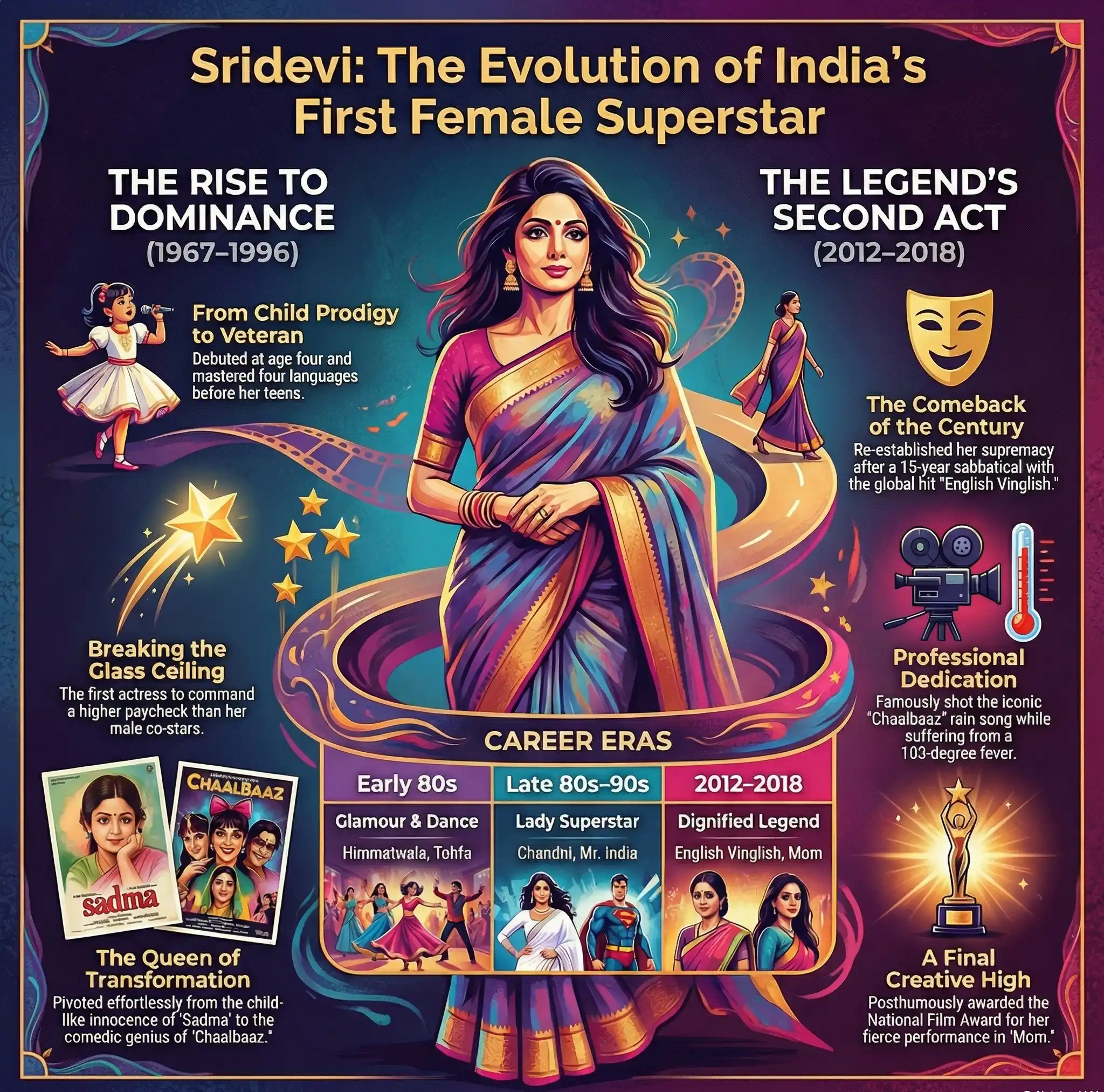
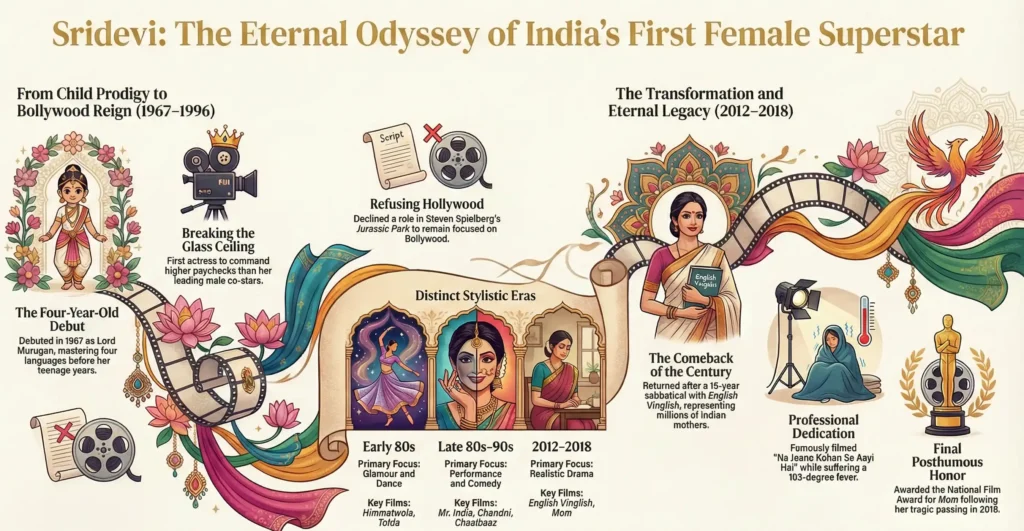
She was born in 1963 in Sivakasi in Tamil Nadu and was acting from about the age of four. She worked in Tamil, Telugu, Malayalam and Kannada before Hindi, and she was a genuine star in several of them at once, which is a thing the industry has only recently started congratulating people for.
The practice was not unique to her, and that is rather the point. A South Indian actress crossing into Hindi films in the 1980s was expected to arrive as a face and have the rest supplied. She was not a discovery. She was an established professional who arrived in a new language market and was told her accent was a problem.
What she could actually do
The range is the part that gets lost behind the photographs.
In Mr India in 1987 she does broad physical comedy well enough to walk off with a film that is named after somebody else and built around him. In ChaalBaaz in 1989 she plays two sisters and won the Filmfare award for it. Chandni is romantic melodrama, Lamhe is something far stranger, and Sadma is close to unwatchable in the way good tragedy is.
There is no male star of that period who was asked to cover that much ground. From about 1985 to 1992 she was the highest paid actress in the country. The industry took to calling her the female Amitabh Bachchan, on the grounds that she could open a film without a male star attached.
She married the producer Boney Kapoor in 1996, made Judaai in 1997, and then simply stopped working.
There was no announcement of a retirement, no farewell tour and no last interview about what it had all meant. She had two daughters and she went quiet. The assumption in the industry was the usual one, which is that a leading actress who marries has finished.
That lasted fifteen years. It is worth sitting with how completely she was written off in that time, by an industry that had been paying her more than anybody else in it a few years earlier.
She came back in 2012, at the age of forty-nine, in a first-time director’s film.
Gauri Shinde, making her first film, wrote Shashi Godbole, a middle class housewife whose husband and daughter treat her as slightly embarrassing in company because her English is poor. Shinde has said the character came from her own mother. It premiered at Toronto to a standing ovation that ran for about ten minutes, and it worked everywhere it went afterwards. It became India’s official entry for the foreign language Oscar that year.
The thing almost nobody said out loud at the time is what the casting actually meant. A woman who had spent the first half of her career having her voice taken off the soundtrack came back to play somebody patronised for how she speaks.
24 February 2018
She died in Dubai at fifty-four, where she had gone for a family wedding. The authorities there recorded the cause as accidental drowning.
She was given a state funeral in Mumbai and carried through the city wrapped in the flag, and the crowds that came out for it were enormous. Mom, released the previous year, won her the National Film Award for Best Actress, given after her death.
What happened on Indian television in the days between those two things does not deserve a polite description. Channels staged reconstructions. A woman who had spent fifty years being looked at was looked at, at the end, about as badly as it can be done.
If you think you have remembered everything about this topic take this QUIZ
Results
QUIZ START
#1. What was Sridevi’s real birth name?
Previous
Next
#2. Which film marked Sridevi’s triumphant comeback in 2012 after a 15-year sabbatical?
Previous
Next
#3. Sridevi reportedly refused a role in which Steven Spielberg movie because the part was too small?
Previous
Next
#4. In her early Hindi films like Himmatwala, who provided the dubbing voice for Sridevi?
Previous
Next
#5. Sridevi made her acting debut at age four in the Tamil film Kandhan Karunai playing which deity?
Previous
Next
#6. The iconic song “Na Jaane Kahan Se Aayi Hai” from Chaalbaaz was shot while Sridevi was suffering from:
Previous
Next
#7. Sridevi was posthumously awarded the National Film Award for Best Actress for which film?
Previous
Next
#8. In the 1983 film Sadma, what kind of character did Sridevi play?
Previous
Finish
What was the real cause of Sridevi’s death?
The official forensic report by the Dubai Police cited “accidental drowning” in a bathtub following a loss of consciousness as the cause of death. Traces of alcohol were also found in her system.
How many movies did Sridevi act in?
Sridevi acted in over 300 films in a career spanning 5 decades, across Tamil, Telugu, Hindi, Malayalam, and Kannada languages.
Who are Sridevi’s daughters?
Sridevi has two daughters: Janhvi Kapoor, who is a successful Bollywood actress, and Khushi Kapoor, who has also recently entered the film industry.
Did Sridevi win a National Award?
Yes, she won the National Film Award for Best Actress posthumously in 2018 for her powerful performance in the movie Mom.
Which was Sridevi’s first Hindi movie?
While her first adult lead role was in Solva Sawan (1979), her debut as a child artist in Hindi cinema was in the film Julie (1975).
Sources & References
Encyclopaedia Britannica (“Sridevi”) — her career across five languages and her principal films.
Directorate of Film Festivals, Government of India — the National Film Award for Best Actress for Mom, awarded after her death.
Toronto International Film Festival, 2012 — the premiere of English Vinglish.
Gulf News, February 2018 — the Dubai authorities’ statement on the cause of death.
Exploring the Soul of Bharat through History, Science, Culture, and its Diversity
Our Mission
Curious Indian is a definitive knowledge portal dedicated to chronicling the events, personalities, and cultural shifts that defined the Indian subcontinent. From the ancient Vedic Period to the complexities of 21st-century politics, our goal is to provide deep-dive analysis that inspires.
Editorial Standards & E-E-A-T
Every article published under our brand undergoes a rigorous fact-checking process. We prioritize primary historical records, academic citations, and credible archives to ensure our readers receive accurate, high-authority information.
Historical IntegrityDirectly sourcing from ASI archives and academic journals.
Topical AuthorityComprehensive clustering of Indian Science, Biographies, and Wars.
Managed by Paripurna Datta and TEAM | Dedicated to the Knowledge of India.