The most famous voice in India spent fifty-five years arguing that singers should be paid when their records sell
Sometime in the early 1960s, in a Bombay recording studio, the most sought-after voice in the country told the producers paying for it that the arrangement was wrong.
A playback singer was paid a fee for a song. Once that fee was handed over, the song belonged to the producer and the label, and it could sell for the next forty years without another rupee reaching the person who sang it. Lata Mangeshkar thought the singer should get a share of that.
India called her the Nightingale, which is a lovely thing to be called and has quietly obscured what she was actually doing. This was a labour dispute, and she ran it for the rest of her life.
Mohammed Rafi took the view that a fee is a fee. The producer pays what the singer asks, the singer sings, and there the matter ends. Her sister Asha Bhosle took broadly the same line. Between them, Rafi and Lata Mangeshkar had recorded more than four hundred duets, and the disagreement stopped the lot.
She has described it plainly enough. “Rafi Sahib didn’t think that we should fight for royalties,” she said, and from 1963 to 1967 the two most popular voices in India did not record together.
Rafi recorded his duets with Suman Kalyanpur. Lata Mangeshkar recorded hers with Mahendra Kapoor. Composers who had built entire careers on pairing those two voices spent four years not being able to.
The argument also ran straight through her own house. Asha Bhosle was on the other side of it, and the two sisters, who between them were most of the female playback singing in India, were split over how singers ought to be paid.
It was S.D. Burman who ended it. At a concert in his honour at Shanmukhananda Hall in 1967 the two of them met on stage, and they went back to recording together with a duet from Jewel Thief. Neither of them had conceded the argument. They had simply decided to sing.
Why she could afford the fight
She could hold that line because she was, by then, close to unavoidable.
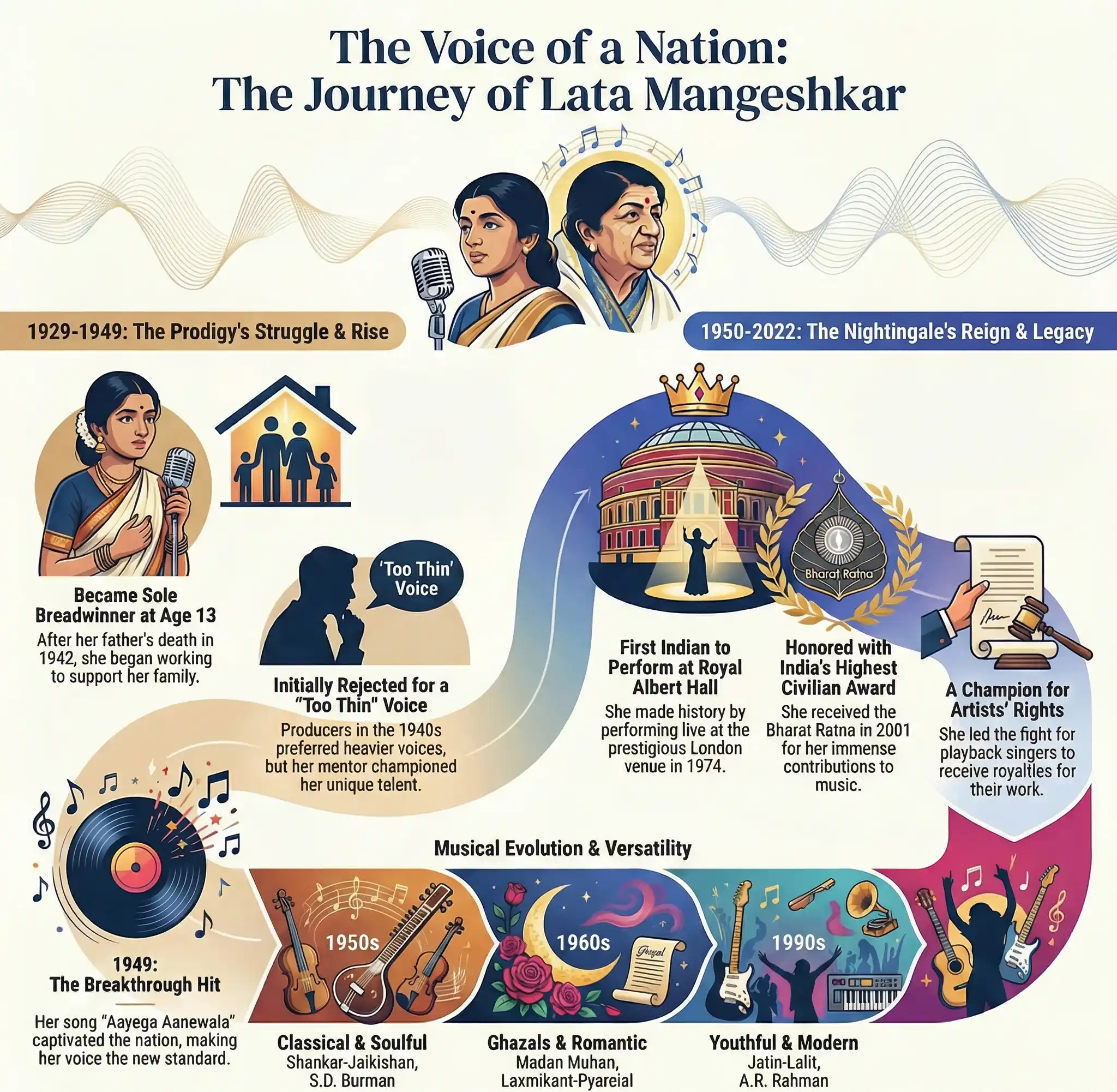
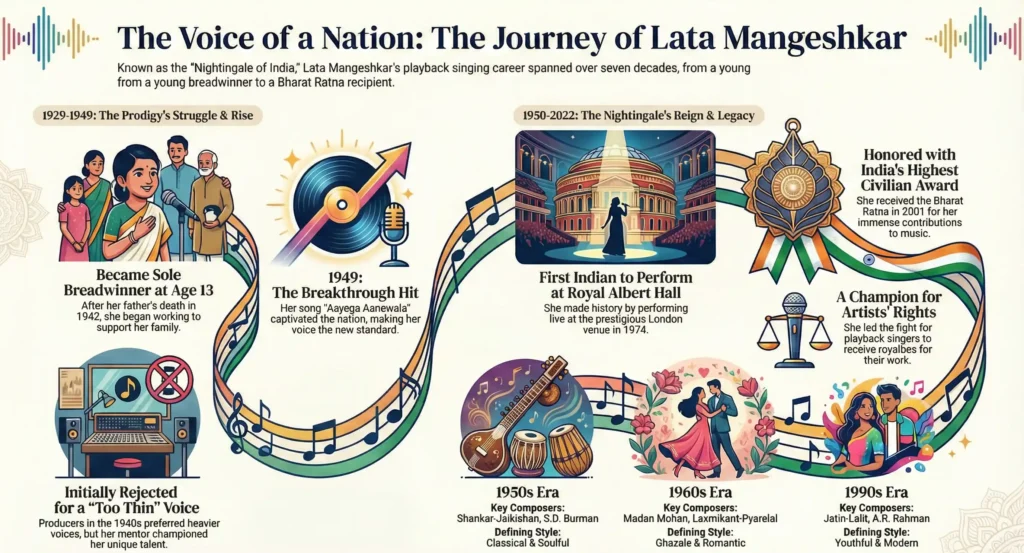
It had not always been so. Producers turned her down early on for having a voice they thought too thin for the microphones of the day, and she spent the 1940s being told she was the wrong sort of singer.
Her voice was on thousands of records in more than twenty languages, and for four decades a Hindi film song without her was a commercial decision that had to be justified. Nobody else in the industry had that kind of leverage, which is precisely why the argument fell to her.
The same dominance is the fair criticism of her. A market that reliably wanted one voice left very little space for the women who were not her, and that is a real cost, whoever you think should carry the blame for it. She did stop accepting the Filmfare award for female playback singing after 1969, so that somebody else could win it.
She was still making the same argument fifty years later, and still losing it.
In 2012, at eighty-three, she pointed out that the label held nearly all her recordings and was repackaging them into compilation after compilation. She asked what she got out of any of it, and answered her own question: no royalty.
That year amendments to the Copyright Act finally gave performers a statutory right to royalties. In 2013 the Indian Singers’ Rights Association was set up to collect them, with her as its chair. Indian singers actually started receiving royalty payments in 2018.
6 February 2022
She died at ninety-two, about fifty-five years after she first raised it.
The affectionate names did her no favours. Nightingale, Queen of Melody, Voice of the Nation. All of them describe a natural phenomenon rather than a person making decisions, and they made a hard commercial argument sound like weather.
She had also been proved right, which is the part the tributes skipped over almost entirely in February 2022. Every Indian singer collecting a royalty cheque now is collecting it because of an argument she started in a recording studio in 1963.
She was not a bird. She was a working musician who noticed she was being underpaid, said so to the people paying her, and kept saying it until the law changed.
If you think you have remembered everything about this topic take this QUIZ
Results
QUIZ START
#1. What was the initial reason given by producers for rejecting Lata Mangeshkar’s voice in the early 1940s?
Previous
Next
#2. Which 1949 song became Lata’s first massive national hit, setting the gold standard for her ‘thin’ voice?
Previous
Next
#3. What historic reaction did Prime Minister Jawaharlal Nehru have when he first heard Lata sing ‘Ae Mere Watan Ke Logon’ in 1963?
Previous
Next
#4. Lata Mangeshkar used a male pseudonym to compose music for several Marathi films. What was that name?
Previous
Next
#5. In 1974, Lata Mangeshkar became the first Indian to perform live at which world-renowned international venue?
Previous
Next
#6. What significant action did Lata take regarding the Filmfare Awards to promote fresh talent in the industry?
Previous
Next
#7. According to the ‘Eras of Melody’ table, which iconic hit is associated with her 1990s collaboration with modern composers?
Previous
Next
#8. A mysterious incident in 1963 left Lata bedridden for three months. What was the suspected cause discovered later?
Previous
Finish
What was Lata Mangeshkar’s first song?
Her first recorded song was “Naachu Yaa Gade, Khelu Saari Mani Haus Bhaari” for the Marathi film Kiti Hasaal (1942), but it was cut from the final film.
She dedicated her life to taking care of her four younger siblings after their father’s untimely death and focused entirely on her career and family responsibilities.
How many songs did Lata Mangeshkar sing?
While exact numbers vary, it is estimated she recorded over 25,000 to 30,000 songs in more than 36 Indian languages.
When did Lata Mangeshkar receive the Bharat Ratna?
She was awarded the Bharat Ratna, India’s highest civilian honor, in 2001.
Who was Lata Mangeshkar’s Godfather in the industry?
She considered music director Ghulam Haider her Godfather, as he was the first to show complete faith in her voice when others rejected it.
Sources & References
Nasreen Munni Kabir, Lata Mangeshkar in Her Own Voice (2009) — her account of the royalty dispute and the four-year break with Mohammed Rafi.
Yasmin Khalid Rafi, Mohammed Rafi: My Abba, A Memoir (2012) — the same dispute from the other side of it.
The Copyright (Amendment) Act, 2012, Government of India — the statutory right to royalties for performers.
Indian Singers’ Rights Association — its formation in 2013 under her chairmanship and the collection of singers’ royalties.
Exploring the Soul of Bharat through History, Science, Culture, and its Diversity
Our Mission
Curious Indian is a definitive knowledge portal dedicated to chronicling the events, personalities, and cultural shifts that defined the Indian subcontinent. From the ancient Vedic Period to the complexities of 21st-century politics, our goal is to provide deep-dive analysis that inspires.
Editorial Standards & E-E-A-T
Every article published under our brand undergoes a rigorous fact-checking process. We prioritize primary historical records, academic citations, and credible archives to ensure our readers receive accurate, high-authority information.
Historical IntegrityDirectly sourcing from ASI archives and academic journals.
Topical AuthorityComprehensive clustering of Indian Science, Biographies, and Wars.
Managed by Paripurna Datta and TEAM | Dedicated to the Knowledge of India.