How a wounded nation and an underestimated leader found their nerve
In 1965, the Prime Minister of India was a tiny, soft-spoken man named Lal Bahadur Shastri.
He stood barely five feet tall. He was gentle, modest, almost shy, so mild in his manner that many of his own rivals had quietly written him off as weak, a caretaker who would not last. His country, too, was bruised and unsure of itself, still carrying the shame of its crushing defeat by China only three years before.
Across the border, a confident military ruler looked at that small man and that shaken country and saw an opportunity. India, he decided, was too broken and too leaderless to fight. Now was the moment to take Kashmir by force.
He had bet on India’s weakness. He had bet on the little man being afraid. This is the story of the war that followed, and of how a frightened, wounded nation, led by a man everyone underestimated, found the nerve to stand.
The gamble on a broken India
To understand 1965, you have to start with 1962.
India’s humiliation by China, and then the death of Jawaharlal Nehru in 1964, had convinced Pakistan’s President, Field Marshal Ayub Khan, that his neighbour was ripe for the taking. India looked weak, demoralised and adrift. If Kashmir was ever going to be seized, the time was now.
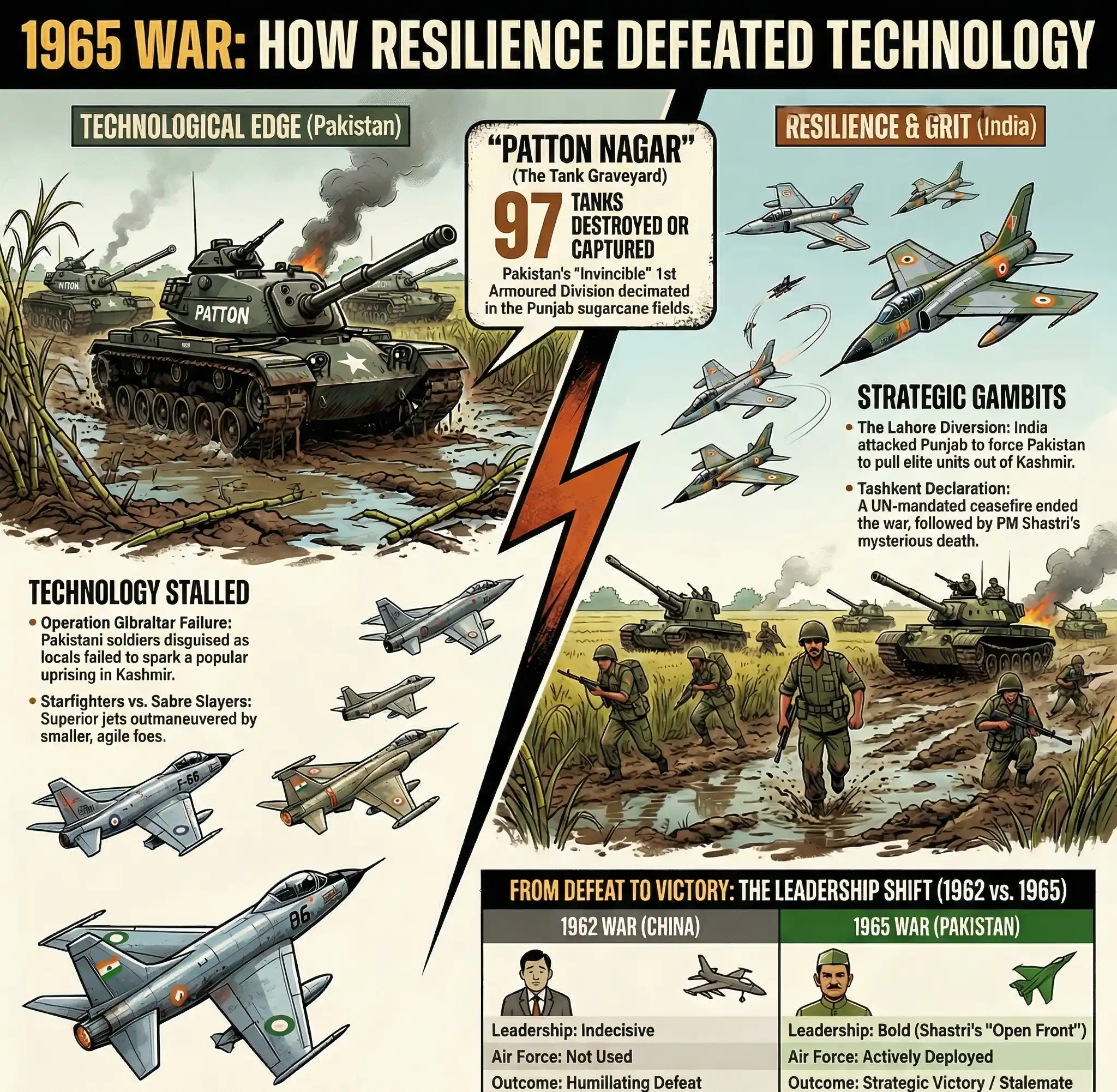
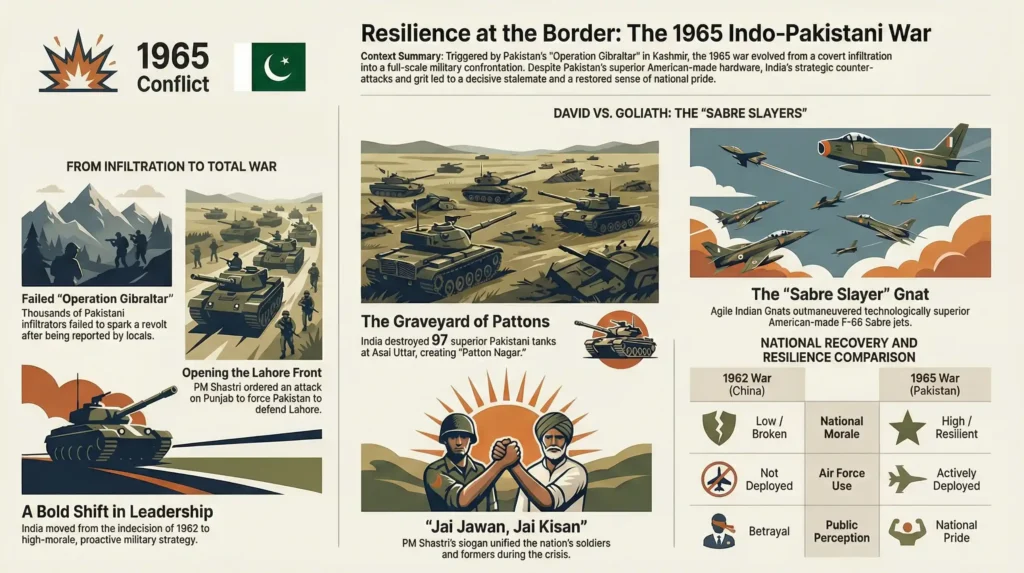
So Pakistan tried a covert gamble called Operation Gibraltar. Thousands of soldiers, disguised as locals, slipped across the ceasefire line into the Kashmir Valley, hoping to stir the people into a revolt that Pakistan could then ride to victory. The plan failed at its very root. The Kashmiris did not rise up to welcome them. In many places they reported the strangers to the Indian authorities instead. The uprising never came. But the failed operation had lit a fuse, and it could not be put out. It was war.
Operation Vijay: How India Won the High-Altitude War of 1999
The little man’s bold call
When Pakistan escalated, sending its armour driving toward the town of Akhnoor to try to cut Kashmir off from the rest of India, the pressure on Delhi was suddenly enormous. And it was here that the gentle little prime minister made the boldest decision of the war.
Instead of letting the fight stay penned in the mountains of Kashmir, where Pakistan wanted it, Shastri ordered the Indian Army to cross the international border and strike straight toward Lahore, one of Pakistan’s greatest cities. Suddenly it was Pakistan that had to rush its forces home to defend its own heartland.
The mild, tiny prime minister his rivals had dismissed as weak answered an attack in Kashmir by marching his army toward Lahore. It was the boldest thing anyone had ever expected of the gentlest man in Indian politics.
The graveyard of Pattons
The hardest fighting came in the sugarcane fields of Punjab, and it became the stuff of legend.
Pakistan’s pride was its armour: gleaming American-made Patton tanks, among the best in the world, which now rolled forward confidently to seize Amritsar. Waiting for them, near a village called Asal Uttar, were Indian troops with far older equipment, Second World War-era Sherman tanks and recoilless guns. But the Indians were clever. They flooded the low fields into soft marsh, so that the heavy Pattons lurched forward and sank, bogged down and helpless. Then, from the cover of the tall sugarcane, the defenders opened fire.
By the time it was over, nearly a hundred of the mighty Pattons had been destroyed or captured, and the battlefield had earned a mocking nickname: Patton Nagar, the city of Pattons.
On one side rolled some of the finest tanks in the world. On the other waited a farmer’s son with a gun bolted to a jeep.
That farmer’s son was Company Quartermaster Havildar Abdul Hamid, who moved through the chaos knocking out enemy tank after enemy tank with his light gun, until he was killed doing it. For his impossible courage he was awarded the Param Vir Chakra, India’s highest honour for valour. He became the war’s enduring image: an ordinary man, from a poor family, undoing million-dollar machines with little more than nerve.
The Indo-Pakistani War of 1971: A Victory of Humanity and Strategy
Gnats and a stalemate
The same story played out in the sky. Pakistan flew superior American jets; India sent up a tiny, nimble little fighter called the Gnat, which used its small size to turn tighter and harder than the bigger planes, and brought down enough of them to earn the nickname “Sabre Slayer.” India was not swept from the air, as many had feared it would be.
But honesty matters more than flag-waving here. By late September, the truth on the ground was simpler and grimmer than any legend. Both armies were exhausted and running low on ammunition. Thousands of young men lay dead on each side. Neither had delivered a knockout blow, and neither was going to.
When the guns finally fell silent, neither side had truly won. Both claimed victory, as nations do. What India had really gained was not territory. It was nerve.
The war ended in a United Nations ceasefire on 23 September. In plain terms, it was a bloody draw. But for a country that three years earlier had been beaten and shamed, a draw against a well-armed enemy felt like something close to redemption.
The tragedy at Tashkent
To turn the ceasefire into a lasting peace, the Soviet Union invited both sides to the city of Tashkent. There, in January 1966, Shastri and Ayub Khan signed the Tashkent Declaration, agreeing to pull back to the lines they had started from.
For India it was a bitter kind of peace. Shastri agreed to hand back the Haji Pir Pass, a piece of high ground the army had taken at real cost and which had long been a route for infiltrators. Many Indians felt the soldiers’ hard-won gains had simply been signed away at the negotiating table.
And then came the blow no one saw coming.
Only hours after he put his name to the peace, far from home in a foreign city, the little prime minister died in the night of a sudden heart attack. The nation he had carried through its first real test of nerve lost him in the very moment of its relief.
His death, so sudden and so far away, has been wrapped in questions ever since. What is beyond question is the grief. India had found a leader it had badly underestimated, just in time to lose him.
Nationalization of Banks 1969: The Midnight Move That Changed India
The size of the heart
So what did India actually win in 1965?
Almost no land. When the maps were redrawn, they looked much as they had before. But India won something a wounded country needed far more than territory.
In 1962, against China, India had learned a hard lesson: that noble ideals without real strength can fail. In 1965 it learned the other half of that lesson, and it is the more hopeful half. Strength, it turns out, is not the same thing as size, or wealth, or owning the best foreign hardware. The enemy had better tanks and better jets. India had a farmer’s son with a gun on a jeep, pilots in undersized planes who refused to give way, and a five-foot prime minister with far more courage than anyone had credited him with.
It would be a cheap kind of patriotism to say that courage simply defeated technology. Wars are not won by heart alone, and 1965, told honestly, ended in a draw. But something real did happen in those five weeks. A frightened, freshly humbled nation discovered that it could steady its hands and hold its ground against a stronger-looking foe. That is a kind of victory that never shows up on a map.
Its truest symbol was the gentle little man who signed the peace and did not live to see the morning. He had given his people two words to carry them through the war, honouring in a single breath the soldier and the farmer: Jai Jawan, Jai Kisan. And in a quiet way, both of those figures, the jawan and the kisan, had just saved the country together, brought into one person in a farmer’s son with a soldier’s heart, on a battlefield full of broken tanks.
A nation, like a person, is not measured by how it behaves when everything is easy. It is measured by what it finds in itself when it is frightened and outgunned. In 1965, India went looking, and found more than it knew it had.
India’s First Nuclear Test: The Story of Smiling Buddha
Green Revolution in India 1966: From Starvation to Self-Sufficiency
If you think you have remembered everything about this topic take this QUIZ
Results


#1. What was the code name of the Pakistani covert operation to incite insurgency in Kashmir that triggered the war?
#2. Who was the Prime Minister of India during the 1965 war?
#3. The Battle of Asal Uttar, where nearly 100 Pakistani Patton tanks were destroyed, is also known as what?
#4. Which soldier was awarded the Param Vir Chakra for destroying four enemy tanks with a jeep-mounted gun at Asal Uttar?
#5. Which small Indian aircraft earned the nickname “Sabre Slayer” for outmaneuvering Pakistani F-86 Sabres?
#6. The war formally ended with the signing of which agreement in January 1966?
#7. Which famous slogan did PM Lal Bahadur Shastri give to the nation during this war?
#8. Under the Tashkent Declaration, India controversially agreed to return which strategic capture to Pakistan?
Who won the Indo-Pakistani War of 1965?
Militarily, it was a stalemate, but strategically, it was an Indian victory. India successfully defended Kashmir, thwarted Operation Gibraltar, and destroyed a significant portion of Pakistan’s superior armor.
What was the famous slogan given by Lal Bahadur Shastri during the war?
He gave the slogan “Jai Jawan, Jai Kisan” to boost the morale of both the soldiers on the border and the farmers fighting a food shortage.
What was the Battle of Asal Uttar?
It was the largest tank battle of the 1965 war, fought in Punjab. The Indian Army destroyed nearly 100 Pakistani Patton tanks, turning the area into a “graveyard of tanks” known as Patton Nagar.
Did India capture Lahore in 1965?
Indian forces reached the outskirts of Lahore (Batapur and Dograi) and threatened the city, but they did not enter or capture the city center, as the objective was to divert Pakistani forces from Kashmir.
What is the Tashkent Declaration?
It was a peace agreement signed on January 10, 1966, between India and Pakistan to end the war and restore the pre-war positions (status quo ante).
Sources & References
- Encyclopaedia Britannica (“Indo-Pakistani War of 1965”) — the origins, Operation Gibraltar, the course of the war, and the ceasefire.
- Prime Minister’s Office, Government of India (Lal Bahadur Shastri) — the prime minister who led India through the war.
- Gallantry Awards portal, Government of India (Abdul Hamid) — the Param Vir Chakra won at Asal Uttar.
- United Nations Peacemaker (the Tashkent Declaration, 1966) — the agreement that ended the war.
Author


Exploring the Soul of Bharat through History, Science, Culture, and its Diversity
Our Mission
Curious Indian is a definitive knowledge portal dedicated to chronicling the events, personalities, and cultural shifts that defined the Indian subcontinent. From the ancient Vedic Period to the complexities of 21st-century politics, our goal is to provide deep-dive analysis that inspires.
Editorial Standards & E-E-A-T
Every article published under our brand undergoes a rigorous fact-checking process. We prioritize primary historical records, academic citations, and credible archives to ensure our readers receive accurate, high-authority information.
Historical Integrity Directly sourcing from ASI archives and academic journals.Topical Authority Comprehensive clustering of Indian Science, Biographies, and Wars.Managed by Paripurna Datta and TEAM | Dedicated to the Knowledge of India.