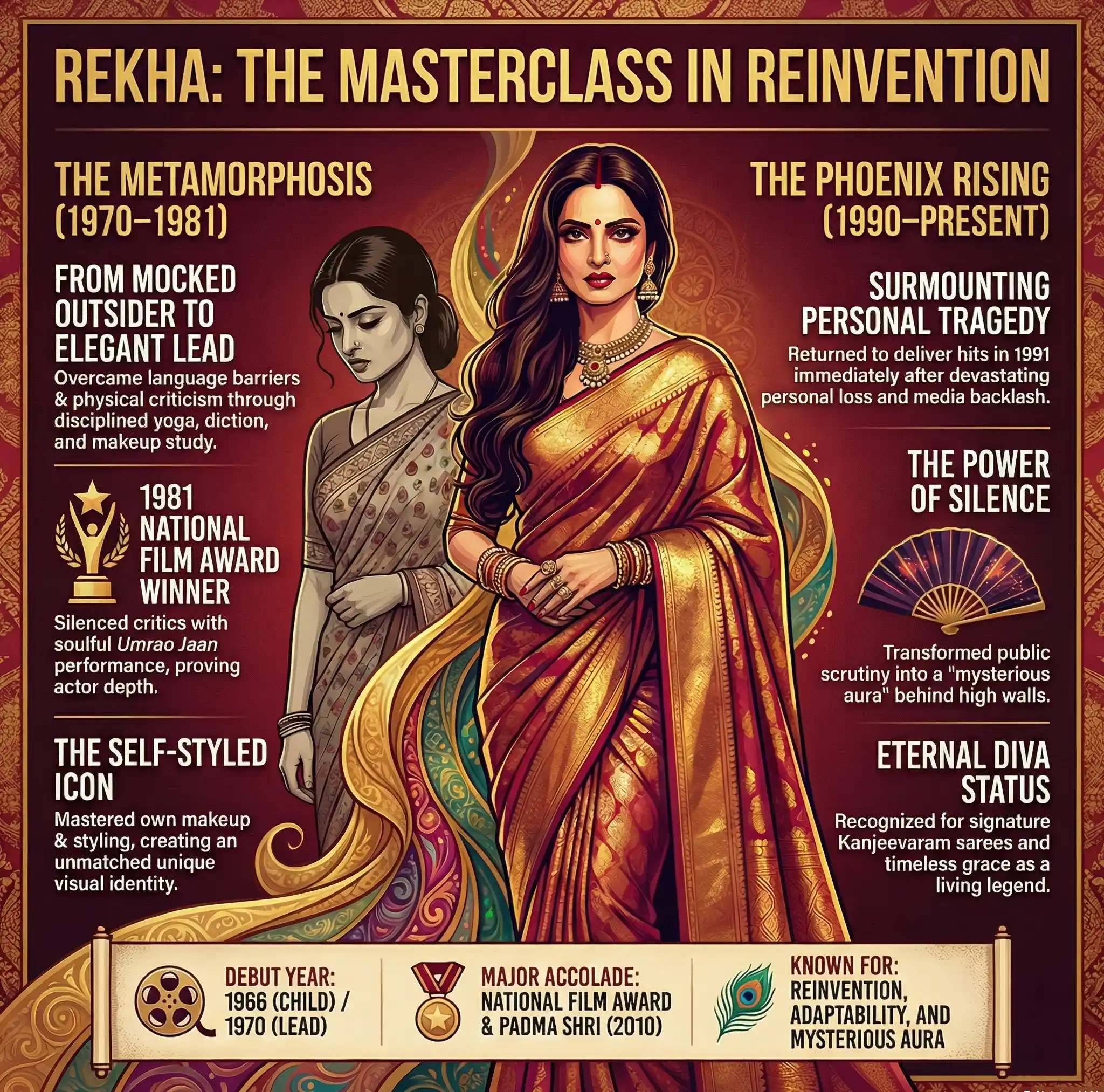
Rekha’s life is a masterclass in survival and reinvention. Born Bhanurekha Ganesan into a fractured family, she was thrust into the film industry at the tender age of 13 to support her mother. Mocked for her dark complexion and weight, she was the industry's "Ugly Duckling" before she willed herself into becoming its swan. The Rekha biography is not just about her cinematic milestones like Umrao Jaan or Khubsoorat; it is about a woman who endured public humiliation, heartbreak, and the suicide of her husband, only to emerge stronger. Today, she is a living legend who wears her silence as elegantly as her signature Kanjeevaram sarees.| Attribute | Details |
| Real Name | Bhanurekha Ganesan |
| Date of Birth | October 10, 1954 |
| Birthplace | Madras (Chennai), India |
| Debut Film | Rangula Ratnam (1966 – Child), Sawan Bhadon (1970 – Lead) |
| Key Awards | 1 National Film Award (Umrao Jaan), 3 Filmfare Awards, Padma Shri (2010) |
| Spouse | Mukesh Agarwal (m. 1990; his death 1990) |
| Father | Gemini Ganesan (Tamil Superstar) |
| Mother | Pushpavalli (Telugu Actress) |
| Famous For | Her mysterious aura, Umrao Jaan, and timeless beauty |
The Phoenix Who Rose from the Ashes
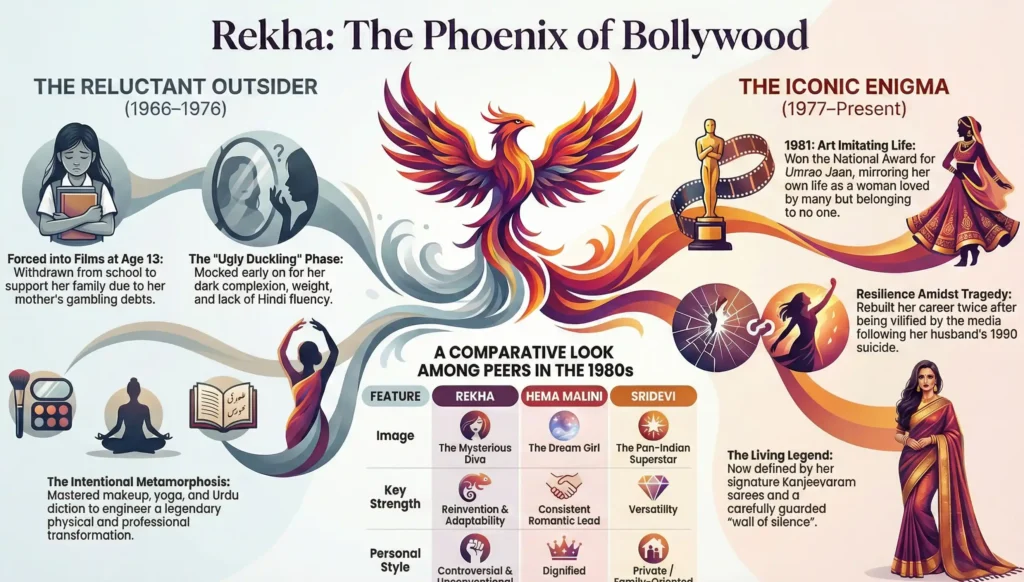
In the glitzy world of Bollywood, stories of struggle are common, but the Rekha biography stands apart for its sheer intensity. Born on October 10, 1954, in Madras, she was the daughter of South Indian superstar Gemini Ganesan and actress Pushpavalli. However, she was born out of wedlock. For years, her father refused to acknowledge her publicly, a rejection that cast a long, painful shadow over her childhood.
While other children played with dolls, young Bhanurekha played hide-and-seek with creditors. Her mother was addicted to gambling, and the family finances were in shambles. At 13, she was pulled out of school and forced to work in films. She hated it. She recalls crying on her way to the studio, terrified of the costumes, the makeup, and the leering men.
6 Unfoldings in the Subrahmanyan Chandrasekhar Biography
The Ugly Duckling Phase (1970–1976)
When Rekha arrived in Bombay to shoot Sawan Bhadon (1970), she was an outsider in every sense. She didn’t speak Hindi, she was considered “too plump” for lead roles, and her dark complexion drew cruel taunts from industry insiders who called her “Kali Kaluta.”
But Rekha was observing. She realized that to survive, she had to rule. In the late 70s, she undertook a transformation that remains legendary. She studied makeup, practiced yoga disciplinedly, and learnt Hindi and Urdu diction. The girl who was once mocked for eating wafers on set became the epitome of grace. This metamorphosis wasn’t just physical; it was an armor she built to protect the vulnerable child inside.
The Golden Era and “The Other Woman”
The late 70s and 80s belonged to Rekha. Films like Ghar (1978) proved she was a serious actor, but Khubsoorat (1980) proved she could carry a film entirely on her comic timing. However, her professional peaks were often overshadowed by her personal life.
Her on-screen pairing with Amitabh Bachchan in films like Muqaddar Ka Sikandar and Silsila (1981) ignited rumors of a passionate affair. While Bachchan never confirmed it, Rekha was often vocal, once famously admitting she was in love with him “like the rest of the world.” This honesty cost her. She was branded a “home-breaker” and “the other woman,” vilified by the press and society. Yet, she stood tall, wearing sindoor (vermilion) to Rishi Kapoor’s wedding in 1980—a bold move that shocked the nation and declared that she answered to no one but herself.
10 Remarkable Facts About Meghnad Saha Life and Achievements
Umrao Jaan: Art Imitating Life
If there is one film that defines her soul, it is Umrao Jaan (1981). Playing the role of a courtesan who is loved by many but belongs to no one, Rekha found a strange resonance with her own life. “Yeh kya jagah hai doston,” she sang, her eyes reflecting a melancholy that acting alone couldn’t produce. She won the National Award for this role, silencing critics who claimed she was just a glamour doll.
The Tragedy of 1990
Just when it seemed she might find stability, tragedy struck again. In 1990, she married Delhi-based businessman Mukesh Agarwal. It was a whirlwind romance, but it ended in a nightmare. Suffering from severe depression, Mukesh committed suicide just seven months after their wedding, using Rekha’s dupatta to hang himself.
The backlash was brutal. The media and even some industry colleagues labeled her a “witch” and a “black widow.” Her film posters were vandalized. Any other actor would have vanished into oblivion. Rekha, however, returned to work. She channeled her grief into Phool Bane Angaray (1991), delivering a hit when everyone wrote her obituary.
7 Incredible Facts in the Satyendra Nath Bose Biography
The Enigma Lives On
Today, Rekha lives in a sea-facing bungalow in Bandra, shielded by high bamboo walls and an even higher wall of silence. She rarely gives interviews. She appears at award shows, looking ageless in her Kanjeevarams, greets the younger generation with a blessing, and vanishes before the spell breaks. She has become her own greatest creation—a mystery that everyone wants to solve but no one can.
Quick Comparison: The Queens of the 80s
| Feature | Rekha | Hema Malini | Sridevi |
| Image | The Mysterious Diva / Seductress | The Dream Girl / Traditional | The Pan-Indian Superstar |
| Acting Style | Intense, method, & subtle | Graceful & classical | Spontaneous & comic genius |
| Key Strength | Reinvention & adaptability | Consistent romantic lead | Versatility (Comedy to Drama) |
| Personal Life | Controversial & unconventional | Dignified second wife | Private but family-oriented |
Curious Indian: Fast Facts
- The Dubbing Artist: In her early Hindi films, Rekha didn’t speak the language well, so her voice was often dubbed by other artists. She only started dubbing for herself fully after Ghar.
- The Madam X Look: Rekha is credited with introducing the “fashion-forward” villainess in Bollywood. Her look in Madam X (1994), with extravagant hats and gold accessories, became a cult fashion statement.
- The Midnight Friend: She is known to be a night owl. Close friends say she often calls them late at night to discuss poetry or life, as she suffers from insomnia.
- No Stylist: Unlike modern stars, Rekha reportedly does her own makeup for events and designs her own look, a skill she mastered during her transformation years.
- The Rajya Sabha Stint: She was nominated to the Rajya Sabha (Upper House of Parliament) in 2012, though she was often criticized for her low attendance.
Conclusion
The Rekha biography is a testament to the fact that you cannot destroy a woman who has already rebuilt herself from scratch. She walked through fire—poverty, rejection, scandal, and death—and came out not as a victim, but as gold. In a world that demands women to be transparent and accessible, Rekha chooses to be an enigma. She reminds us that sometimes, the most powerful thing you can do is simply refuse to be defined by others.
8 Remarkable Secrets in the Jagadish Chandra Bose Biography
If you think you have remembered everything about this topic take this QUIZ
Results


#1. What is Rekha’s real birth name?
#2. Rekha is the daughter of which South Indian superstar who initially refused to acknowledge her?
#3. For which 1981 film did Rekha win the National Film Award for Best Actress?
#4. What tragic event occurred in Rekha’s life in 1990 involving her husband Mukesh Agarwal?
#5. Rekha shocked the nation in 1980 by wearing sindoor (vermilion) to whose wedding?
#6. Unlike most modern stars, what unique habit does Rekha maintain regarding her public appearances?
#7. In 2012, Rekha was nominated to which house of the Indian Parliament?
#8. Which 1980 film proved Rekha’s ability to carry a movie entirely on her comic timing?
Who was Rekha’s husband?
Rekha married Mukesh Agarwal, a Delhi-based businessman, in 1990. Unfortunately, the marriage was short-lived as Mukesh committed suicide seven months later due to clinical depression.
Why does Rekha wear sindoor (vermilion)?
This is one of Bollywood’s biggest mysteries. Rekha has stated in interviews that she wears it as a fashion statement because it suits her, and in her culture, it isn’t strictly reserved for married women. However, fans often speculate it symbolizes her undying love for an unrequited flame.
Did Rekha and Amitabh Bachchan act together after Silsila?
No. Silsila (1981) was the last film where they were paired together. The intense rumors regarding their relationship reportedly made it impossible for them to work together again.
How is Rekha related to Pushpavalli?
Pushpavalli, a famous Telugu actress, was Rekha’s mother. Rekha was born out of Pushpavalli’s relationship with Tamil superstar Gemini Ganesan.
Which is Rekha’s most acclaimed performance?
While she has many hits, Umrao Jaan (1981) is considered her finest performance, earning her the National Film Award for Best Actress.
Read More: https://curiousindian.in/hema-malini-october-1948-present/